0. Introduction In the complex world of C++ template metaprogramming, there is a crucial concept—SFINAE, which is the cornerstone of understanding C++ templates.This mechanism provides powerful compile-time decision-making capabilities for C++ template programming, becoming the foundation for type extraction, conditional compilation, and concept constraints in modern C++.This article will unveil the mysteries of SFINAE, exploring its principles, classic usages, and its evolution in modern C++.1. What is SFINAE? SFINAE (Substitution Failure Is Not An Error) is a rule during C++ template instantiation: when the compiler attempts to substitute a template with a specific type, if the substitution fails, the compiler does not report an error but instead looks for other matching templates. An error is only reported when all possible templates fail to substitute successfully. To better understand the implementation principle of SFINAE, let’s look at the following example:
#include <iostream>
#include <vector>
#include <string>
// 1. Helper tool, the value of void_t is reflected in the instantiation process of void_t,
// which will replace the parameter templates, and if the replacement fails, it checks the current overload, simplifying the process.
// You can also directly use __void_t for easier understanding, or implement it yourself.
template<typename...>
struct make_void { typedef void type; };
template<typename... Ts>
using void_t = typename make_void<Ts...>::type;

// 2. Check if there is a size() member function
template<typename T, typename = void>
struct has_size_member : std::false_type {};
template<typename T>
struct has_size_member<T, void_t<decltype(std::declval<T>().size())>> : std::true_type {};

// 3. Check if there is a begin() member function
template<typename T, typename = void>
struct has_begin_member : std::false_type {};
template<typename T>
struct has_begin_member<T, void_t<decltype(std::declval<T>().begin())>> : std::true_type {};

// 4. Main print function - using SFINAE for overload selection
template<typename T>
typename std::enable_if<
    has_size_member<T>::value && has_begin_member<T>::value,
    void>::type
smart_print(const T& container) {
    std::cout << "Container [size=" << container.size() << "]: ";
    for (auto it = container.begin(); it != container.end(); ++it) {
        std::cout << *it << " ";
    }
    std::cout << std::endl;
}

// 5. Overload for integral types
template<typename T>
typename std::enable_if<
    std::is_integral<T>::value,
    void>::type
smart_print(T value) {
    std::cout << "Integer: " << value << std::endl;
}

// 6. General fallback overload
template<typename T>
typename std::enable_if<
    !has_size_member<T>::value &&
    !std::is_integral<T>::value,
    void>::type
smart_print(const T& value) {
    std::cout << "Value: " << value << std::endl;
}

// 7. Specialization for C-style strings
void smart_print(const char* str) {
    std::cout << "String: \"" << str << "\"" << std::endl;
}

int main() {
    std::vector<int> numbers = {1, 2, 3, 4, 5};
    std::string greeting = "Hello";
    int age = 25;
    double pi = 3.14159;
    const char* name = "Alice";

    // Test various types
    smart_print(numbers);  // Call container version
    smart_print(greeting); // Call container version
    smart_print(age);      // Call integer version
    smart_print(pi);       // Call general version
    smart_print(name);     // Call C string version

    return 0;
}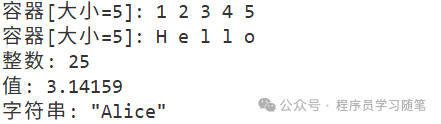 2.Classic Applications of SFINAE We will look at the applications of SFINAE from three aspects:1) To check if a type has specific members, methods, or properties;2) To select different function implementations;3) To check different types of iterators. For the first two, we can see the following examples:
#include <iostream>
#include <type_traits>
#include <vector>
#include <string>
// Implementation of void_t helper
template<typename...>
struct void_type { typedef void type; };
template<typename... Ts>
using void_t = typename void_type<Ts...>::type;
// 1. Check for specific member variable: whether there is a 'size' member variable
template<typename T, typename = void>
struct has_size_member : std::false_type {};
template<typename T>
struct has_size_member<T, void_t<decltype(std::declval<T>().size)>> : std::true_type {};
// 2. Check for specific member method: whether there is a 'size()' method
template<typename T, typename = void>
struct has_size_method : std::false_type {};
template<typename T>
struct has_size_method<T, void_t<decltype(std::declval<T>().size())>> : std::true_type {};
// 3. Check for specific type property: whether there is a 'value_type' nested type
template<typename T, typename = void>
struct has_value_type : std::false_type {};
template<typename T>
struct has_value_type<T, void_t<typename T::value_type>> : std::true_type {};
// 4. Comprehensive check: whether it is a standard library container
template<typename T, typename = void>
struct is_std_container : std::false_type {};
template<typename T>
struct is_std_container<T, void_t<
typename T::value_type, // Property: has value_type
decltype(std::declval<T>().size()), // Method: has size() method
decltype(std::declval<T>().begin()), // Method: has begin()
decltype(std::declval<T>().end()) // Method: has end()
>> : std::true_type {};
// Custom test type
struct CustomContainer {
// Member variable
int size; // Note: this is a member variable, not a method
// Member method
int get_size() const { return 100; }
// Nested type
using value_type = double;
// Other container methods
double* begin() { return nullptr; }
double* end() { return nullptr; }
};
struct SimpleStruct {
// Only member variable
int size = 5;
};
struct MethodOnly {
// Only member method
size_t size() const { return 42; }
};
// Function overload using SFINAE
template<typename T>
typename std::enable_if<has_size_member<T>::value, void>::type
print_size_info(const T& obj) {
std::cout << "Has size member variable: " << obj.size << std::endl;
}
template<typename T>
typename std::enable_if<has_size_method<T>::value && !has_size_member<T>::value, void>::type
print_size_info(const T& obj) {
std::cout << "Has size() method: " << obj.size() << std::endl;
}
template<typename T>
typename std::enable_if<is_std_container<T>::value, void>::type
print_container_info(const T& container) {
std::cout << "This is a standard container, element type: " << typeid(typename T::value_type).name() << ", size: " << container.size() << std::endl;
}
// Main function
int main() {
std::cout << std::boolalpha;
// Test various types
std::vector<int> vec = {1, 2, 3};
CustomContainer custom;
SimpleStruct simple;
MethodOnly method_only;
int primitive = 10;
std::cout << "=== Type Trait Detection ===\n";
// Check member variable
std::cout << "vector has size member variable: " << has_size_member<decltype(vec)>::value << std::endl;
std::cout << "CustomContainer has size member variable: " << has_size_member<CustomContainer>::value << std::endl;
std::cout << "SimpleStruct has size member variable: " << has_size_member<SimpleStruct>::value << std::endl;
// Check member method
std::cout << "vector has size() method: " << has_size_method<decltype(vec)>::value << std::endl;
std::cout << "CustomContainer has size() method: " << has_size_method<CustomContainer>::value << std::endl;
std::cout << "MethodOnly has size() method: " << has_size_method<MethodOnly>::value << std::endl;
// Check type property
std::cout << "vector has value_type: " << has_value_type<decltype(vec)>::value << std::endl;
std::cout << "CustomContainer has value_type: " << has_value_type<CustomContainer>::value << std::endl;
std::cout << "int has value_type: " << has_value_type<int>::value << std::endl;
// Comprehensive check
std::cout << "vector is a standard container: " << is_std_container<decltype(vec)>::value << std::endl;
std::cout << "CustomContainer is a standard container: " << is_std_container<CustomContainer>::value << std::endl;
std::cout << "int is a standard container: " << is_std_container<int>::value << std::endl;
std::cout << "\n=== Function Overload Demonstration ===\n";
// Function overload tests
print_size_info(simple); // Call member variable version
print_size_info(method_only); // Call member method version
print_size_info(vec); // Call member method version
std::cout << "\n=== Container Information ===\n";
print_container_info(vec); // Standard container information
// print_container_info(custom); // Compilation error: not a standard container
// Handle types without size information
std::cout << "\nint type detection results:\n";
std::cout << "Has size member variable: " << has_size_member<int>::value << std::endl;
std::cout << "Has size() method: " << has_size_method<int>::value << std::endl;
std::cout << "Has value_type: " << has_value_type<int>::value << std::endl;
return 0;
}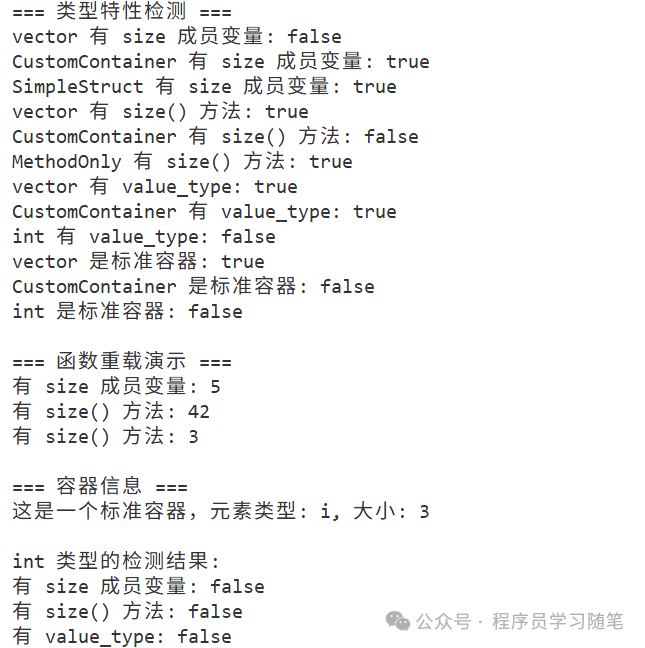 The third example is as follows, implemented in the standard library:
  template<typename _InputIterator>
    inline _GLIBCXX14_CONSTEXPR
    typename iterator_traits<_InputIterator>::difference_type
    __distance(_InputIterator __first, _InputIterator __last,
               input_iterator_tag)
    {
      // concept requirements
      __glibcxx_function_requires(_InputIteratorConcept<_InputIterator>)
      typename iterator_traits<_InputIterator>::difference_type __n = 0;
      while (__first != __last)  {
    ++__first;
    ++__n;
  }
      return __n;
    }
  template<typename _RandomAccessIterator>
    inline _GLIBCXX14_CONSTEXPR
    typename iterator_traits<_RandomAccessIterator>::difference_type
    __distance(_RandomAccessIterator __first, _RandomAccessIterator __last,
               random_access_iterator_tag)
    {
      // concept requirements
      __glibcxx_function_requires(_RandomAccessIteratorConcept<
          _RandomAccessIterator>)
      return __last - __first;
    }
<span> <span>To summarize common usages:</span></span>
<span><span>1) std::enable_if</span></span>: Conditional function overload enabling
<span><span>2) void_t</span></span>: Checking expression validity
<span><span>3) decltype(std::declval<T>().member)</span></span>: Checking member existence
4) Tag Dispatching: Replacing complex SFINAE conditions
3.SFINAE and Modern C++ The C++ language has been evolving, with C++11 introducing std::enable_if, void_t, and other utility functions that simplify the application of SFINAE; C++17’s if constexpr makes the code more readable; C++20’s concepts provide a more intuitive and readable implementation of SFINAE. Let’s take a look at an implementation example in C++17:
#include <iostream>
#include <type_traits>
#include <vector>
#include <string>
template<typename T>
void modern_smart_print(const T& value) {
    if constexpr (std::is_integral<T>::value) {
        std::cout << "This is an integer: " << value << std::endl;
    }
    else {
        std::cout << "General value: " << value << std::endl;
    }
}
int main(){
    modern_smart_print(3);
    modern_smart_print(3.13);
    return 0;
}
4. Conclusion
SFINAE, as the cornerstone of C++ template metaprogramming, provides developers with powerful capabilities for type judgment and decision-making at compile time. From standard library implementations to custom type traits, SFINAE is ubiquitous and profoundly influences the design and implementation of modern C++.
As the C++ language continues to evolve, the forms of SFINAE applications may change, but its core idea: making intelligent type decisions at compile time, will continue to play an important role in C++ programming.