Endianness is a fundamental yet crucial concept in the field of computer science. Strictly speaking, endianness is not directly related to C/C++, as it is determined by the computer’s architecture rather than the programming language.
However, if you choose C/C++ as your primary programming language, it is beneficial to have an understanding of these low-level concepts, as they are frequently encountered in the application domains of C/C++.
Misunderstanding endianness can lead to some very basic errors, especially in network communication programming, where incorrect handling of endianness can result in data not being parsed correctly.
This article will provide a brief introduction to the definition, historical background, and application areas of endianness.
What is Endianness??
Endianness refers to the order in which multi-byte data is stored in memory or transmitted over a network, determining how the most significant byte (MSB) and least significant byte (LSB) are arranged in memory address space.
Depending on the order of byte arrangement, it is mainly divided into two types: Big-Endian and Little-Endian.
✧Big-Endian: This means that the most significant byte is stored at the lowest address, while the least significant byte is stored at the highest address. This arrangement is similar to how humans write numbers (for example, in the number 1234, the thousand’s digit 1 is on the leftmost side). It is commonly found in processor architectures like PowerPC and SPARC, as well as in the standard specifications of network protocols (such as the TCP/IP protocol family).
➢Example of Big-Endian with 0x12345678
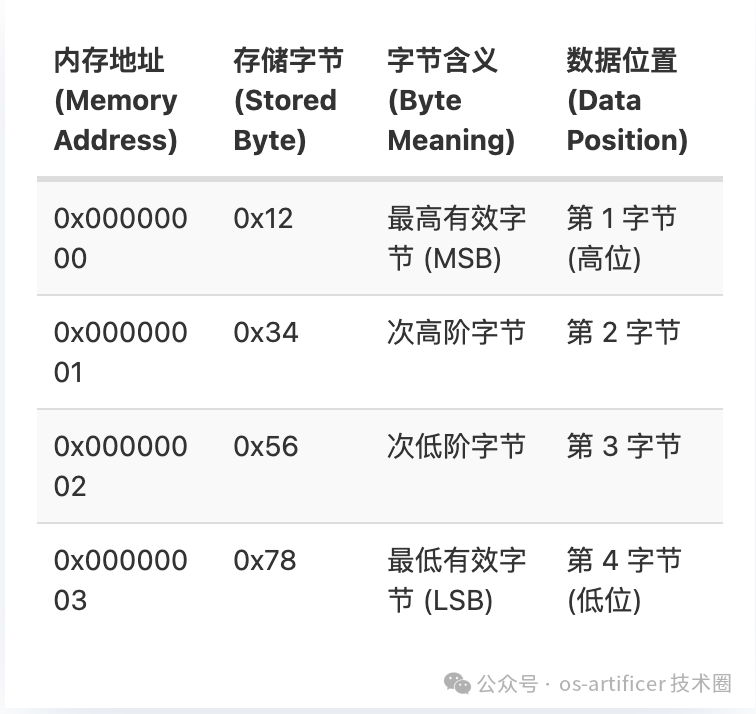
↓ ↓ ↓ ↓
Memory address increment direction →
Core rule: Byte arrangement order = Data writing order (0x12 → 0x34 → 0x56 → 0x78)
Consistent with human reading and writing habits.
✧Little-Endian: In contrast to Big-Endian, the least significant byte is stored at the lowest address, while the most significant byte is stored at the highest address (for example, in the number 1234, the unit’s digit 4 is on the leftmost side). This design is more favorable for computer hardware to perform fast calculations (especially operations involving the least significant bit), and is widely adopted by mainstream processors such as x86 and ARM (default configuration).
➢Example of Little-Endian with 0x12345678
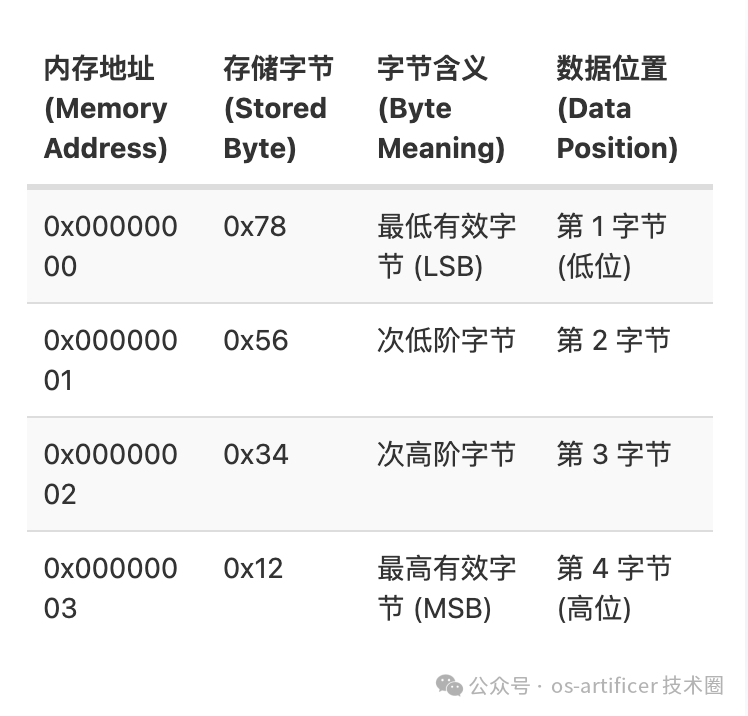
↓ ↓ ↓ ↓
Memory address increment direction →
Core rule: Byte arrangement order (0x78 0x56 0x34 0x12)
Opposite to human reading and writing order.
✧Mixed Endianness: This refers to the simultaneous use of both Big-Endian and Little-Endian to store multi-byte data (for example: 0x34 0x12 0x78 0x56). This is an extremely rare arrangement that has existed historically but is now seldom applied.
Why are there multiple types of Endianness?
The differences in endianness arise from the technical trade-offs and historical path dependencies in the development of computers. The fundamental reasons can be attributed to divergences in hardware design philosophy, differences in performance optimization goals, and the lag in the standardization process.
From a hardware design perspective, early computer engineers faced a balance between circuit complexity and computational efficiency during architecture design:
✧The Big-Endian scheme (such as IBM System/360) has advantages in scientific computing due to its alignment with human numerical writing habits and ease of handling sign bits;
✧The Little-Endian scheme (such as DEC PDP-11) allows the CPU to directly operate on key data bits without additional pointer adjustments during basic operations like addition and shifting, thus enhancing computational efficiency.
Differences in performance optimization goals have led different manufacturers to make starkly different choices. For example, the x86 architecture adopted Little-Endian to maximize the use of limited transistor resources at the time, simplifying address calculation logic; while network protocol designers (such as the ARPANET project team) enforced Big-Endian as a unified standard to ensure global device interoperability and reduce the parsing burden on routing devices.
The lag in the standardization process has exacerbated the long-term existence of these differences. In the early days of the computer industry, there was a lack of unified byte order specifications, and manufacturers developed independently based on their own technical routes. Although subsequent attempts were made to unify through protocol standards (such as IEEE 754 floating-point standard, IETF network protocol standards), the compatibility requirements of existing hardware ecosystems (such as the billions of x86 devices that cannot easily reconstruct byte order) have resulted in both Big-Endian and Little-Endian coexisting in different technical fields to this day.
What factors influence Endianness?
The determination of endianness is closely related to multiple technical dimensions, with core influencing factors including hardware architecture design, operating system implementation specifications, and application layer protocol standards.
From a hardware perspective, the microarchitecture design of the processor (CPU) is the fundamental factor determining endianness. Different manufacturers choose specific endianness schemes based on performance optimization and circuit complexity considerations when developing processors. For example, the early Motorola 68000 series adopted Big-Endian to simplify instruction pipeline design, while Intel’s x86 series chose Little-Endian architecture for cost-effectiveness.
The operating system kernel, as an intermediary layer between hardware and software, needs to adapt to the byte order characteristics of the underlying hardware and provide a unified abstract interface. For instance, the Linux kernel distinguishes between different architectures’ byte orders through macro definitions (such as __BIG_ENDIAN, __LITTLE_ENDIAN) and provides system call support for byte order conversion for applications.
Application layer protocol standards (such as network communication protocols, file storage formats) often enforce byte order specifications to ensure cross-platform compatibility. For example, the TCP/IP protocol family explicitly states that all multi-byte network data (such as port numbers, IP addresses) must use Big-Endian (network byte order), while the PE file format under Microsoft Windows uses Little-Endian to store binary data.
The runtime environment of programming languages (such as the Java Virtual Machine specification uniformly adopting Big-Endian), compiler implementation details (such as data type alignment rules), and hardware bus protocols (such as the byte order handling mechanism of PCIe buses) can also indirectly affect the actual performance of endianness.
What are the application areas of Endianness?
Endianness has practical application value in several key areas of computer systems, influencing hardware design, software development, and network communication across multiple levels.
At the hardware architecture level, processor manufacturers need to clearly adopt either Big-Endian or Little-Endian as the standard for memory access, which directly affects the CPU’s read and write logic for registers, caches, and memory data. For example, ARM processors can switch byte order modes through configuration to accommodate different scenario requirements.
In the software development field, programmers must consider the byte order characteristics of the target platform when writing low-level code (such as embedded system development, driver design). When handling binary file formats (such as BMP image files, WAV audio files), network protocol packets (such as IP header fields, Ethernet frame payloads), or cross-platform data exchange, incorrect byte order handling can lead to data parsing errors.
In network communication, although different devices may adopt heterogeneous byte orders (such as Little-Endian PCs coexisting with network Big-Endian standards), enforcing the use of network byte order (i.e., Big-Endian standard) along with conversion functions like htons() and ntohl() can ensure the correctness of data transmission across systems.
In multimedia processing scenarios, audio and video codecs need to perform bit operations according to the byte order specifications of the sampled data, while database systems must adhere to specific byte orders when storing multi-byte numeric types (such as INT, BIGINT) to ensure data consistency.
Common Processor Endianness
✧x86,MOS Technology 6502,Z80,VAX,PDP-11,RISC-V and other processors are Little-Endian;
✧Motorola 6800,Motorola 68000,PowerPC 970,System/370,SPARC (except V9) are Big-Endian;
✧ARM,PowerPC (except PowerPC 970),DEC Alpha,SPARC V9,MIPS,PA-RISC and IA64 have configurable endianness.
Endianness Conventions in Network Communication Protocols
Network transmission generally adopts Big-Endian, also known as network byte order. The IP protocol defines Big-Endian as the network byte order.
Berkeley sockets define a set of conversion functions for converting 16 and 32-bit integers between network order and host byte order:
✧htonl, htons for converting from host order to network order;
✧ntohl, ntohs for converting from network order to host order.
How to dynamically detect Endianness?
Here is a classic implementation method in C language, typically using a union to achieve this. All members of the union share the same memory space, allowing us to access the same memory segment using different data types.
Principle
1. Create a union that contains a multi-byte data type (such as int) and an array of single-byte data types (such as char array);
2. Assign a value to the multi-byte member of the union (for example, assign 0x12345678);
3. Check the value of the first element of the single-byte array (bytes[0]) to determine which byte is stored at the lowest memory address. If bytes[0] is 0x78 (the least significant byte LSB), it is Little-Endian; if bytes[0] is 0x12 (the most significant byte MSB), it is Big-Endian.
Example Code
#include <stdio.h>

int main()
{
    // Define a union
    union
    {
        int  num;      // 4-byte integer
        char bytes[4]; // 4 single-byte characters
    } test;

    // Assign value to the integer member
    test.num = 0x12345678;

    // Check the content of the first byte in memory
    if(test.bytes[0] == 0x78)
    {
         printf("The local byte order is: Little-Endian (小端序)\n");
    }
    else if(test.bytes[0] == 0x12)
    {
         printf("The local byte order is: Big-Endian (大端序)\n");
    }
    else
    {
         // This case theoretically should not happen
         printf("Unable to determine byte order.\n");
    }

    return 0;
}
Author’s Note Thank you to all the friends who have read my article thoroughly. All articles on this public account are the results of my knowledge system organization during my spare time. The reason I chose to publish on this public account is twofold: first, to give my knowledge a home for easy reference; second, to hope that my articles can help some friends who are new to programming. The C/C++ series of articles is a starting point, not an endpoint. In the future, I will also organize and share on topics such as “Go”, “Design Patterns”, “Distributed System Design Architecture”, and “Open Source Project Code Analysis”. If you are interested, you can follow me, and we can learn and communicate together. Regarding the update frequency, since I write articles in my spare time, I cannot guarantee daily updates, but I will try to update at least once a week with valuable and accurate content. If you like it, please give a follow!Scan to add me as a friend and communicate with the author:  Recommended Books by the Author