
In today’s rapidly developing field of spatial biology, spatial multi-omics technology can simultaneously capture multi-dimensional molecular information such as transcriptomes, epigenomes, and proteins from the same tissue slice, providing unprecedented opportunities for analyzing tissue heterogeneity and molecular regulatory mechanisms. However, efficiently integrating these multimodal data while mining spatial information and cross-modal regulatory relationships has been a core challenge in the field.
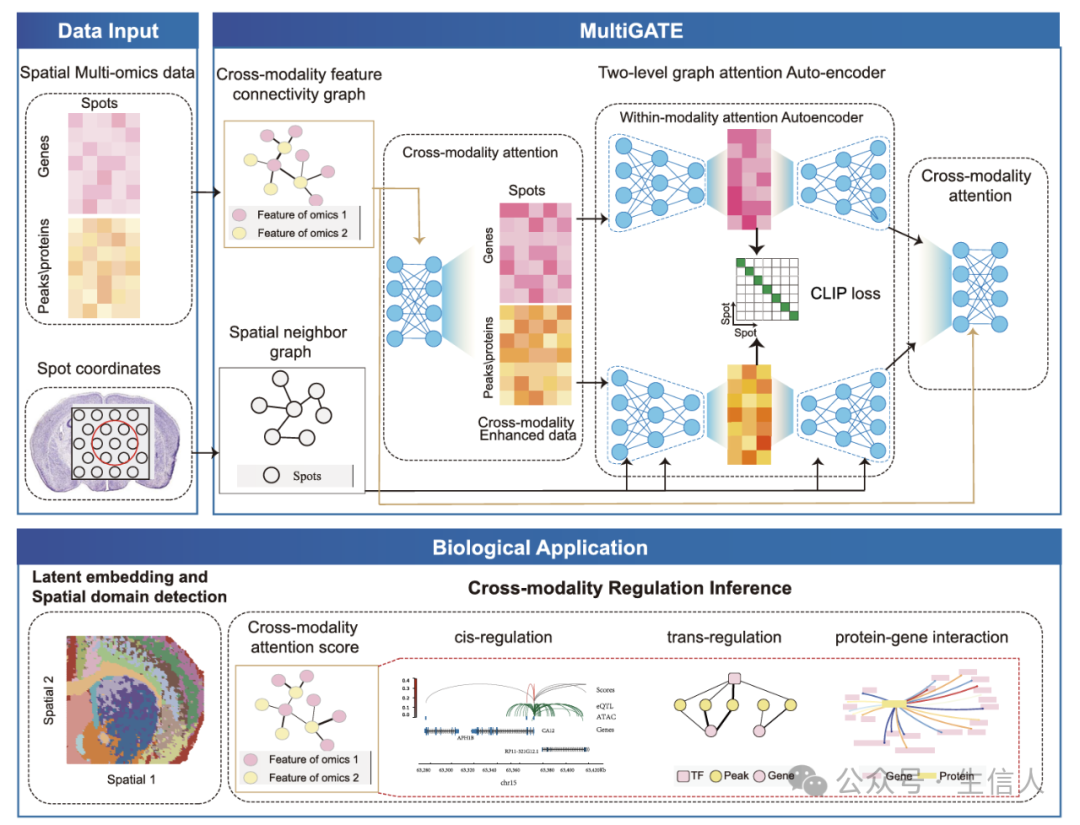
Recently, the team led by Lin Zhixiang from The Chinese University of Hong Kong and the team led by Yang Can from The Hong Kong University of Science and Technology jointly published significant research in Nature Communications, introducing a spatial multi-omics integration analysis tool based on graph representation learning—MultiGATE. This tool achieves a dual breakthrough in spatial pixel embedding and cross-modal regulatory inference through its innovative dual-layer graph attention autoencoder architecture, providing a powerful new tool for spatial multi-omics research!

Top 20 Hot Topics in Tumor Research Over 25 Years
Long press to scan the code for free home delivery
Personal Interpretation|Project Design
Bioinformatics Hotspots|Live Sharing
1. Directly Addressing Pain Points: Three Major Limitations of Existing Tools
Previously, whether for spatial transcriptomics analysis tools (such as SpaGCN, STAGATE) or single-cell multi-omics integration methods (such as Seurat WNN, MOFA+), there have been significant shortcomings in handling spatial multi-omics data:
·Ignoring Spatial Information: Most single-cell multi-omics tools do not consider spatial proximity relationships, which are crucial for analyzing tissue microenvironments;
·Lack of Regulatory Modeling: They only stay at the data integration level and cannot effectively infer cross-modal regulatory relationships between epigenomes, transcriptomes, proteins, and genes;
·Insufficient Depth of Integration: Some tools only merge data through simple methods like principal component analysis, failing to fully exploit the inherent associations of multimodal data.
To address these issues, MultiGATE was born, with the core design philosophy of “simultaneously capturing spatial information and regulatory relationships”, achieving deeper data analysis.
2. Core Innovation: Dual-Layer Graph Attention Autoencoder Architecture
The revolutionary breakthrough of MultiGATE comes from its unique dual-layer graph attention autoencoder design, which cleverly balances spatial information integration and cross-modal regulatory inference:
1. Cross-Modal Attention Mechanism (First Layer)
Specifically designed to model regulatory relationships between different molecular modalities, such as interactions between chromatin open regions (peak) and genes, proteins and genes.
·Innovatively incorporates prior knowledge of genomic distances: The closer the cross-modal features (such as adjacent peak and genes), the higher the default regulatory association probability, consistent with biological common sense;
·Adaptive learning of attention scores: Dynamically adjusts regulatory strength based on observed data, ensuring biological rationality while capturing true regulatory signals;
·Supports multiple types of regulatory inference: Can accurately identify cis-regulatory, trans-regulatory, and protein-gene interaction regulatory patterns.
2. Intra-Modal Attention Mechanism (Second Layer)
Focuses on spatial information integration by constructing spatial neighborhood graphs, making the embedding features of adjacent pixels more similar.
·Adapts to different spatial platform characteristics: Flexibly defines neighborhood relationships based on pixel distribution characteristics of different technologies such as 10× Visium, Spatial ATAC-RNA-seq;
·Preserves local spatial structure: Effectively captures spatial domain features within tissues, providing a reliable foundation for subsequent clustering analysis.
3. Dual Loss Function Support
In addition to traditional reconstruction loss, it innovatively introduces CLIP contrastive loss, forcing alignment of embedding features across different modalities, further enhancing multi-omics integration effects and strengthening the correlation of cross-modal data.
3. Practical Validation: Four Scenarios Demonstrating Superior Performance
The research team conducted comprehensive validation of MultiGATE on various spatial multi-omics datasets from different tissues and platforms, outperforming existing mainstream tools:
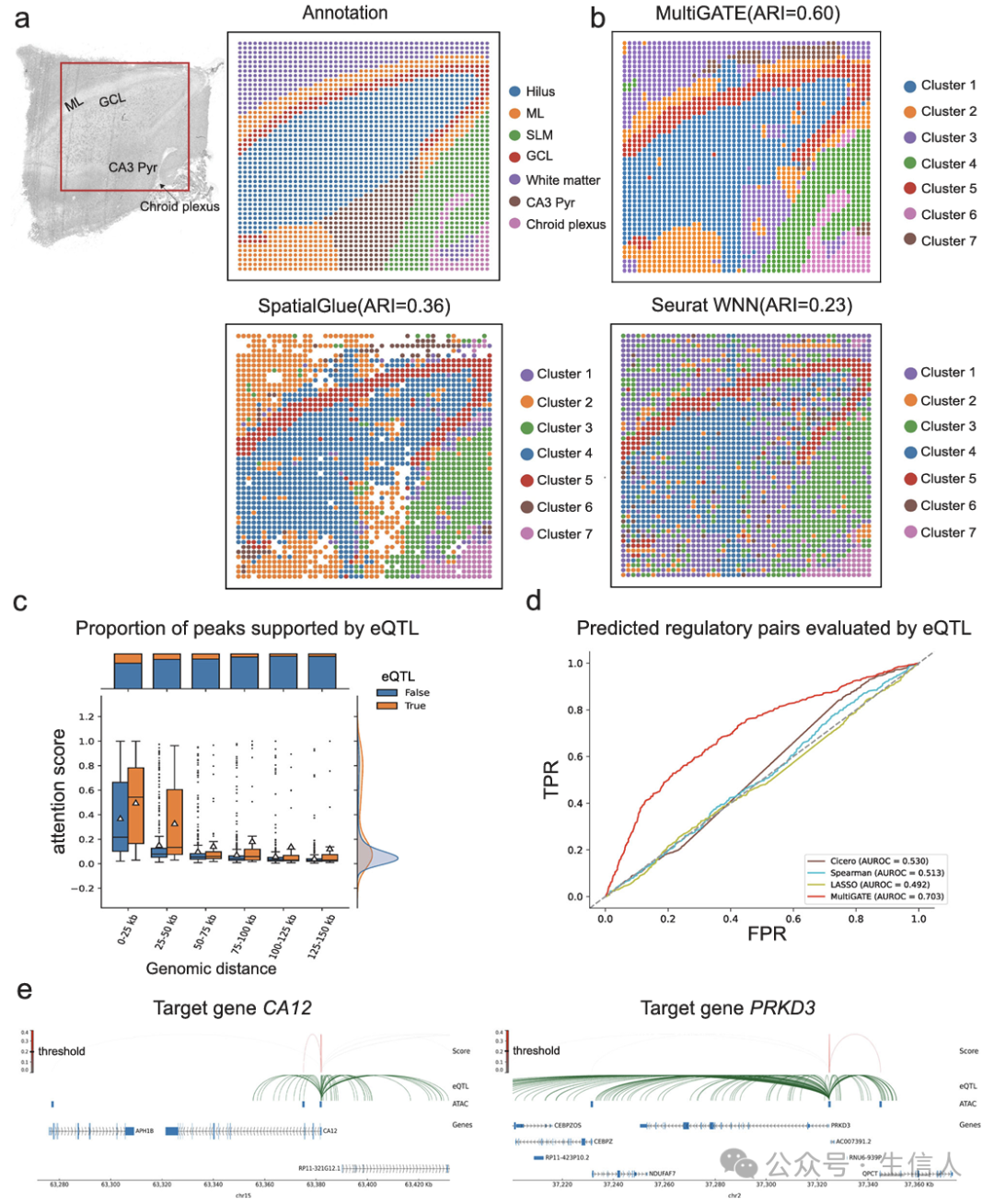
1. Human Hippocampus Spatial ATAC-RNA-seq Data
In analyzing the layered structure of the hippocampus, MultiGATE achieved an Adjusted Rand Index (ARI=0.60) significantly better than SpatialGlue (0.36), Seurat WNN (0.23), and other tools, clearly distinguishing key structures such as molecular layers and choroid plexus. More importantly, its predicted peak-gene associations were highly consistent with eQTL data (AUROC=0.703), far exceeding traditional methods like Cicero and LASSO regression, successfully identifying cis-regulatory regions of functional genes in the hippocampus such as CA12, PRKD3 and others.
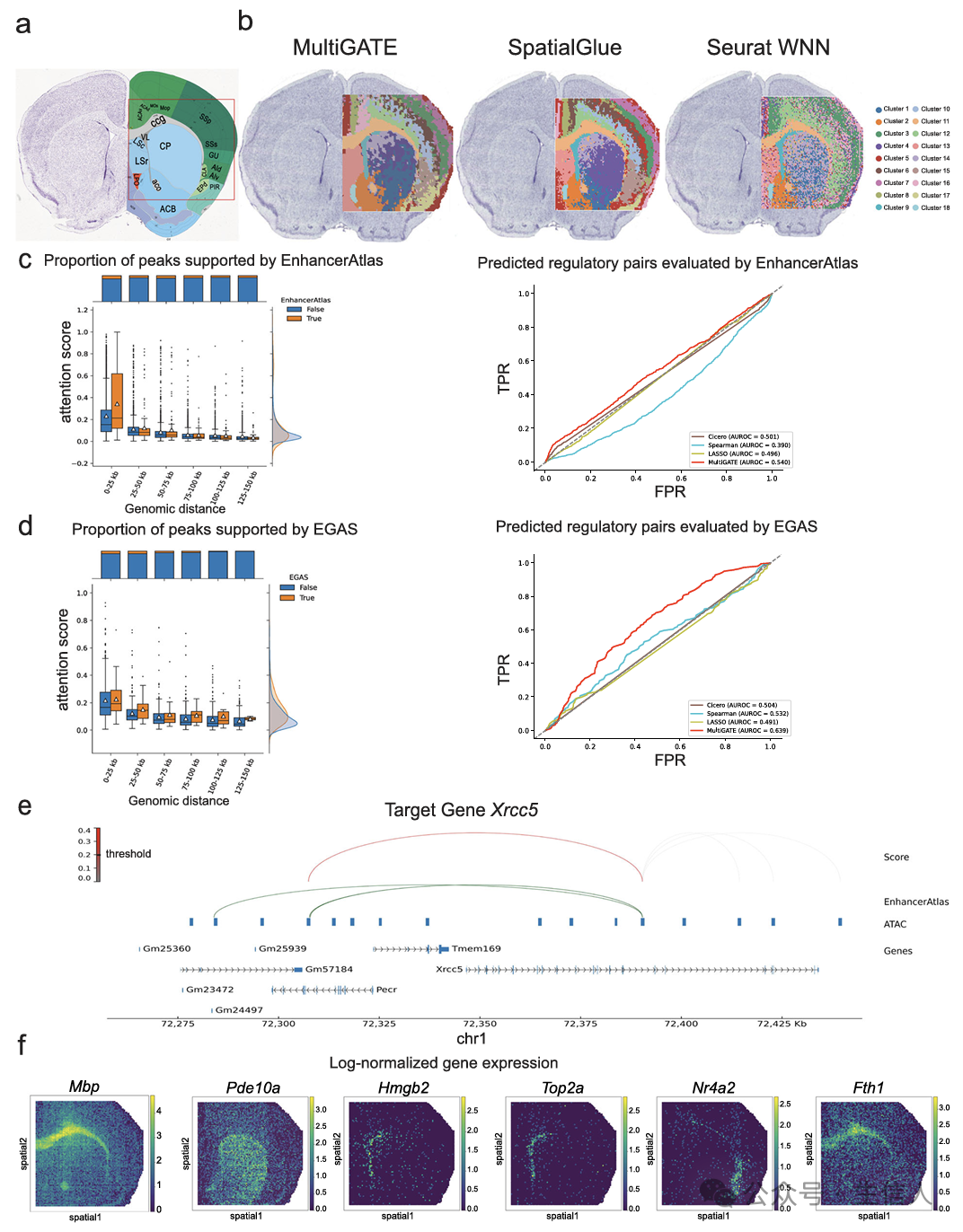
2. Mouse Brain Spatial Multi-Omics Data
In the analysis of mouse P22 brain samples, MultiGATE demonstrated exceptional regional segmentation capabilities, accurately identifying key brain regions such as the corpus callosum, lateral ventricle, and caudate nucleus, while also precisely distinguishing the six-layer structure of the cerebral cortex. Its predicted regulatory relationships were validated against the EnhancerAtlas and EGAS databases, maintaining high accuracy across different genomic distance intervals, successfully capturing the distal enhancer regulatory signals of the DNA repair gene Xrcc5.
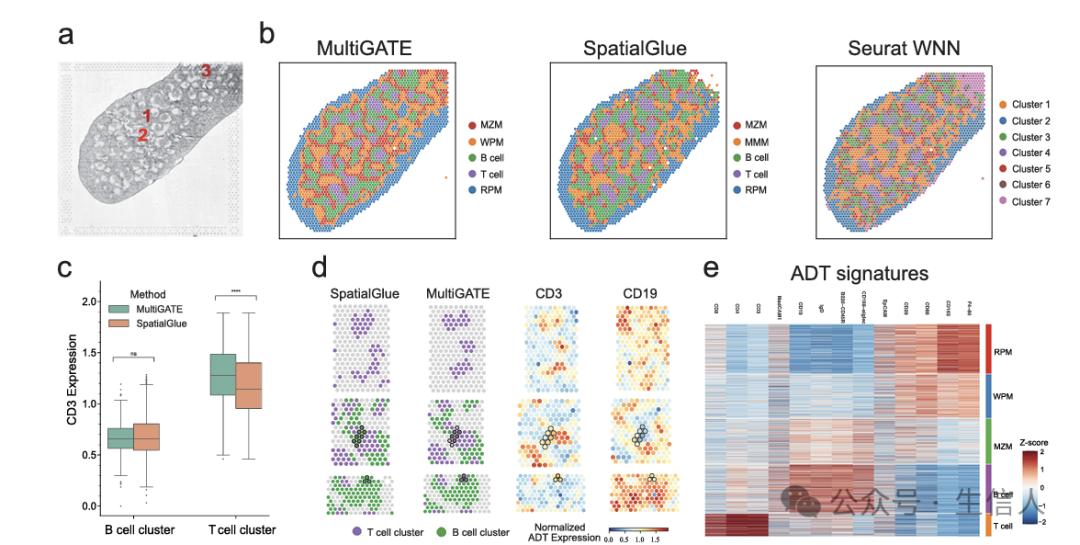
3. Mouse Spleen SPOTS Protein-Transcriptome Data
SPOTS technology can simultaneously detect spatial transcriptomes and protein expressions, MultiGATE achieved precise immune cell clustering on this dataset, clearly identifying T cells, B cells, and three subtypes of macrophages, and restored the anatomical structure of the spleen as “T cells centered, B cells surrounding, macrophages distributed in the outer layer”. Compared to SpatialGlue, MultiGATE showed superior separation effects for T cells and B cells, with more significant differences in CD3 protein expression between the two cell groups (Cliff’s δ=0.953 vs 0.866), reducing cell misclassification.
4. Metastatic Melanoma Slide-tags Data
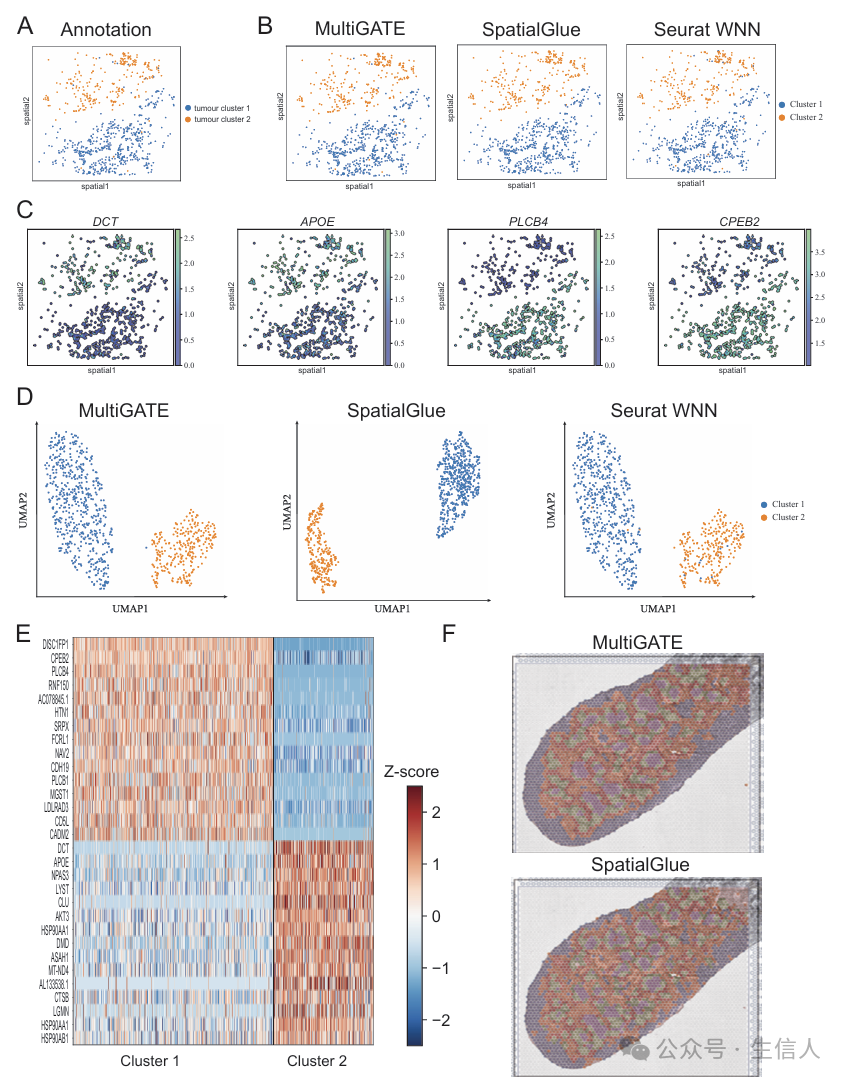
In analyzing tumor heterogeneity, MultiGATE successfully divided tumor cells into two subpopulations, with the mesenchymal-like subpopulation highly expressing TNC, PLCB4, and other invasion and metastasis-related genes, while downregulating MHC gene expression, indicating immune evasion characteristics, providing important clues for elucidating tumor metastasis mechanisms.
4. Core Advantages: Full-Chain Support from Data Integration to Mechanism Analysis
Compared to existing tools, MultiGATE has three core advantages:
1. Dual Functionality: It can achieve high-precision spatial clustering and spatial domain recognition while accurately inferring cross-modal regulatory relationships, meeting research needs from description to mechanism in one stop;
2. Wide Adaptability: Supports various data types such as spatial ATAC-RNA-seq, protein-transcriptomes, single-cell spatial multi-omics, etc., compatible with different technological platforms;
3. Strong Biological Interpretability: The results of regulatory inference are highly consistent with eQTL and enhancer databases, and can identify tissue-specific regulatory networks, providing clear targets for subsequent functional validation.
5. Practical Value: Accelerating Breakthroughs in Multiple Fields of Research
The launch of MultiGATE opens new horizons for spatial multi-omics research, with application scenarios covering:
· Developmental Biology: Analyzing spatially specific regulatory networks during organ development;
· Tumor Research: Revealing tumor microenvironment heterogeneity and interactions between immune cells and tumor cells;
· Neuroscience: Decoding molecular regulatory mechanisms of functional partitioning in brain regions;
· Immunology: Clarifying the spatial organization patterns and regulatory signals of immune cells in immune organs.
Currently, the source code of MultiGATE has been fully open-sourced (scroll down to read the original text), and detailed usage tutorials are provided, allowing researchers to directly apply it to their own spatial multi-omics data. Meanwhile, all test datasets come from public databases, making it easy for users to reproduce results.
With the popularization of spatial multi-omics technology, tools like MultiGATE will become core supports for analyzing tissue microenvironments and uncovering molecular mechanisms of diseases. It is believed that the widespread application of this tool will push spatial biology research into a new era of “precise integration + mechanism analysis”, providing deeper insights for disease diagnosis and therapeutic target discovery!

Top 20 Hot Topics in Tumor Research Over 25 Years
Long press to scan the code for free home delivery
Personal Interpretation|Project Design
Bioinformatics Hotspots|Live Sharing
Latest Article Summary (Continuously updating)Latest Hot Directions
1. A review published last year has now made it to a top journal—Neuroimmunology
2. Medical Hero: China’s Lung Cancer Leader Wu Yilong
3. Chen Zhijian’s achievements summary|Most likely the next Chinese Nobel Prize winner
4. The correct way to open gut microbiome research in
5. This article only scored a little over ten points, was it affected by the nature retraction?
Bioinformatics Classroom
1. Mendelian randomization analysis strategies at the multi-omics level
2. Single-cell + spatial combination, exploring macrophages in skeletal muscle fibrosis
3. Small bets, high stakes: Tumor resistance research, from genes to networks
4. Zero-based entry – single-cell course
5. The most comprehensive pattern opening in history, detailing genomics, are you sure you won’t come to learn?
Project Design | Bioinformatics Analysis | Digital Products
General Biology enriches scientific research
 Bioinformatics People Focused on sharing knowledge related to gene technology Scan to follow for moreEND