Follow us for professional semiconductor news with “zero time difference”!
Recently, the bankruptcy review announcement “(2025) Yue 0307 Po Shen 53” released by the People’s Court of Longgang District, Shenzhen, has unveiled the curtain on the demise of the domestic sensor company Shenzhen Haina Micro Sensor Technology Co., Ltd. (hereinafter referred to as “Haina Micro”). This innovative company, which once received heavy investments from two A-share listed companies, Amperex Technology and Senba Sensors, as well as leading institutions such as Shenzhen High-tech Investment and Taiya Investment, ultimately faced liquidation due to a cash flow crisis. Its collapse not only reflects the difficult reality of domestic sensor entrepreneurship but also traps many capital market participants in a “踩雷” (踩雷 means to step on a landmine, metaphorically referring to financial losses).Former Star Project: Diverse Technical Layout and Luxurious Client MatrixFounded in September 2016, Haina Micro positioned itself as a system-level sensor product supplier and overall solution provider, focusing on four major fields: transportation equipment, home appliances, industrial equipment, and smart homes. It launched several innovative products, including millimeter-wave radar sensors, temperature-vibration composite sensors, and acceleration sensors, with a highly forward-looking technical route.
 Transportation Equipment Field: It developed a temperature-vibration composite sensor specifically for the train PHM (Predictive Health Management) system, integrating temperature and vibration sensing functions, which is a core component for industrial equipment condition monitoring. At that time, it had completed design samples and entered the performance testing phase; aerospace surge testing acceleration sensors and ship vibration monitoring acceleration sensors had also been successfully commercialized.Home Appliance Field: It successfully entered the Haier supply chain, securing multiple orders for the Casarte series; several customized sensors for Midea and Galanz passed performance verification and entered the trial production stage; at the same time, it reached cooperation intentions with Gree, Yunmi, TCL, and Konka, planning to start sample verification in 2021.In terms of market strategy, Haina Micro anchored major industry clients such as Huawei, CRRC, Haier, and Hisense, providing high-cost-performance sensors through customized solutions; on the technical side, it has applied for more than 20 intellectual property rights, owning a 1400 square meter R&D testing center in Longgang, Shenzhen, and a 1200 square meter manufacturing plant in Yancheng, Jiangsu. The founding team comes from international companies such as Honeywell and Jingliang Electronics, boasting a luxurious technical background.Listed Companies + Leading Institutions, Capital Once Frenziedly PursuedFrom 2018 to 2023, Haina Micro completed six rounds of financing, achieving a rhythm of “one financing per year.” The lineup of investors was particularly impressive:
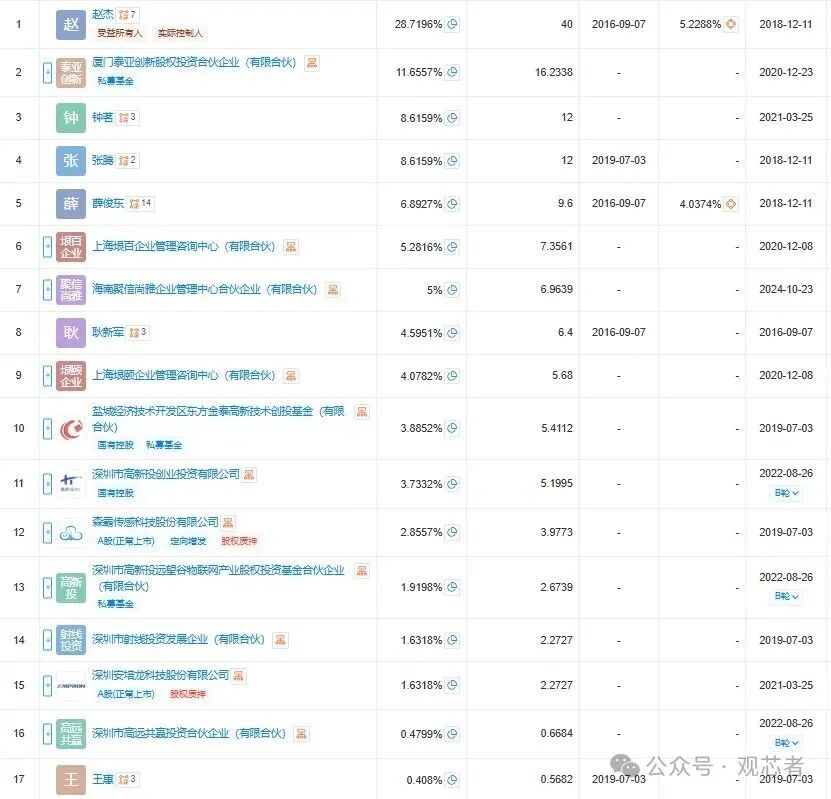 Industrial Capital: Amperex Technology and Senba Sensors, two A-share listed companies, entered the fray, betting on its technological industrialization potential;Institutional Capital: Well-known institutions such as Wenhua Juxin, Shenzhen High-tech Investment, Gao Yuan Gongying Investment, Yueda Shanda Mother Fund, Taiya Investment, and Shanda Investment all took action, focusing on the domestic substitution dividends in the sensor track.At that time, Haina Micro’s financing process was seen as part of the industry barometer — the triple recognition of its technical route, customer resources, and team capabilities by capital made it a “star project” in the domestic sensor track.Cash Flow Break Triggers Liquidation, Domestic Sensor Entrepreneurship Bubble EmergesSince 2024, the winter of the capital market combined with intensified industry competition has quickly plunged Haina Micro, which lacks self-sustaining capabilities, into crisis:
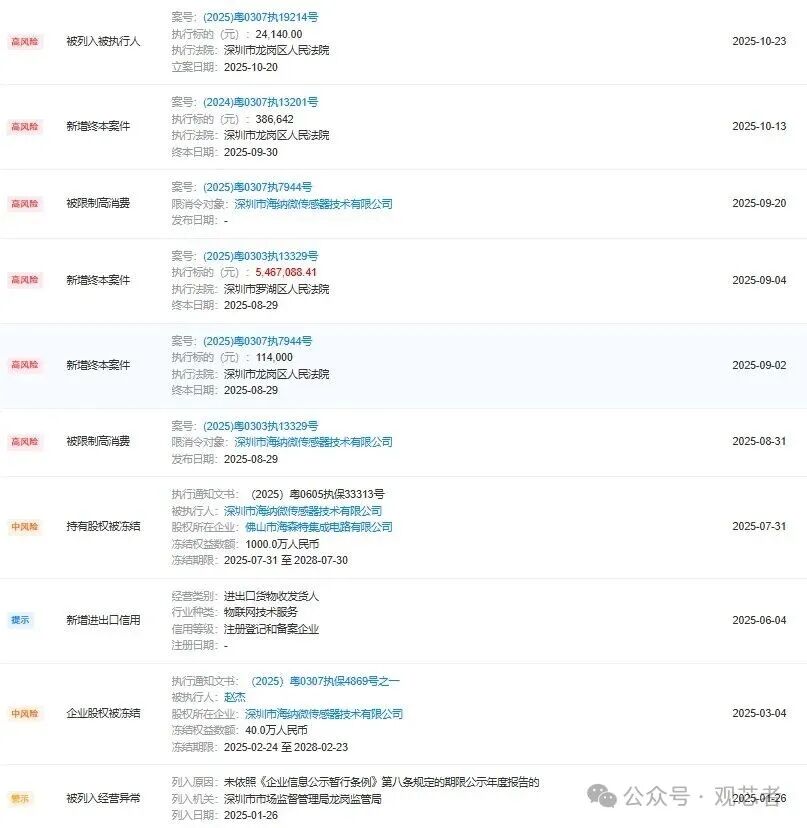 According to Amperex Technology’s 2024 annual report, Haina Micro has suspended operations due to operational funding difficulties and plans to liquidate;In 2025, the operating conditions continued to deteriorate, and in January, it was listed as operating abnormally for failing to timely disclose the annual report, restricted from high consumption in August, and entered the list of executors in October, ultimately triggering the bankruptcy review process.The bankruptcy liquidation of Haina Micro exposes the deep challenges in the domestic sensor industry:Balancing R&D and Commercialization Challenges: The sensor industry has a long R&D cycle and high investment. The conversion link from technical verification to customer bulk orders is lengthy, and companies need to find a precise rhythm between “deepening technology” and “commercial realization”; otherwise, they risk losing everything due to a broken cash flow;Supply Chain Barriers of Major Clients: Even if entering the supply chains of giants like Haier and Midea, the cycle from sample submission to stable orders often exceeds expectations, and the pressure of account periods further tests the company’s cash flow;Vulnerability of Capital Cycles: Companies relying on external financing are prone to survival crises during the winter of the capital market, and how to build self-sustaining capabilities becomes a long-term proposition.The rise and fall of Haina Micro is a microcosm of the entrepreneurial ecosystem in the domestic sensor industry. Currently, domestic sensor startups generally face challenges of “high R&D investment, long profitability cycles, and intense market competition,” and the “valley of death” from technological breakthroughs to large-scale commercialization still needs to be crossed.For entrepreneurs, it is necessary to find a balance between technical layout and commercialization rhythm, avoiding blind expansion that leads to cash flow break; for investors, it is essential to establish a more rational value judgment system, focusing on both technological innovation and the company’s commercialization path and cash flow management capabilities. Only in this way can the domestic sensor industry grow through trial and error, truly achieving an industrial upgrade from “following” to “leading”.—— END ——
Recommended Articles:
Revenue Exceeds 1.5 Billion! Bankruptcy of Huawei and ZTE PCB Suppliers
Subsidiary Bankruptcy + Performance Plummeting! Can Jin Hong Gas’s 61-Year-Old New Leader Save the Day?
65,000 Tons of New Production Capacity Pressing Down! The Nitrogen Trifluoride Industry Falls into the “More Production, More Decline” Dilemma
Breaking News! The Semiconductor Industry Sees a Repeat of the “Seizing the Company Seal” Drama
Bankruptcies and Exits Continue! The Third Generation Semiconductor Industry Winter Has Arrived