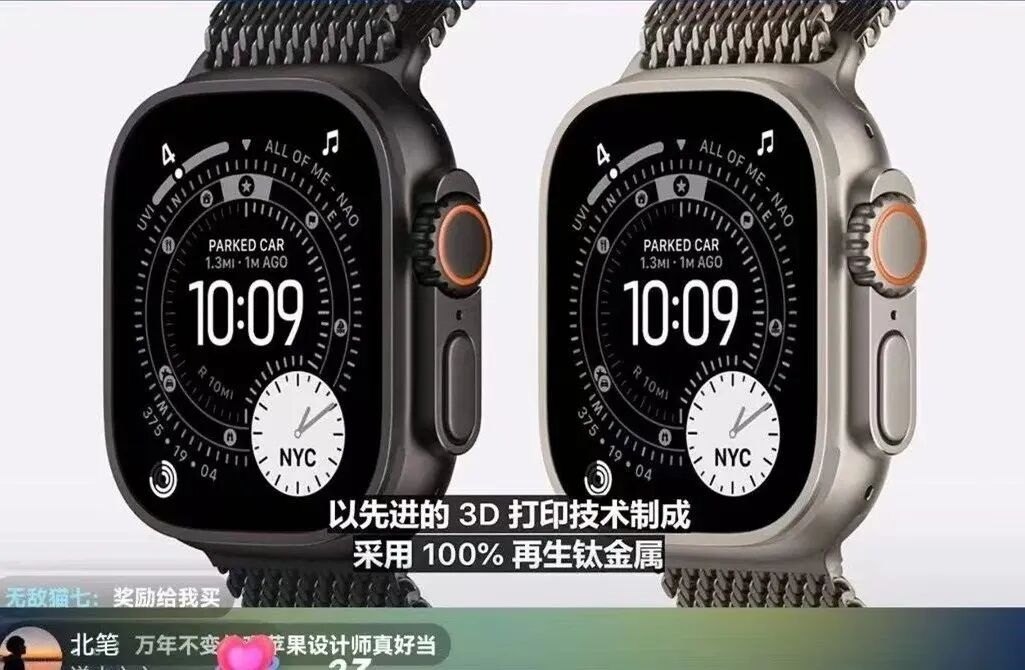
At the recent Apple product launch event, Apple made a significant announcement: the high-end models of the Apple Watch Ultra 3 and Apple Watch Series 11 feature cases made from 100% recycled titanium metal through 3D printing. This innovative process not only achieves the recycling of raw materials but also reduces the amount of titanium used to half that of previous models, significantly lowering material consumption and environmental impact during production while maintaining strength and lightweight properties. This advancement has quickly attracted high attention from the 3D printing industry and the sustainable technology sector, being seen as an important signal of the evolution towards greener and more refined materials and manufacturing processes in high-end consumer electronics.
In the simultaneously released iPhone Air press release, Apple also specifically pointed out that this is the thinnest iPhone ever, equipped with a titanium alloy USB-C port manufactured using 3D printing technology. Apple stated that compared to ports made using traditional forging processes, this 3D printed titanium alloy USB-C port has three major advantages: it is thinner, stronger, and reduces material usage by 33%, enhancing its environmental attributes. However, despite the innovation in manufacturing processes, the USB-C port on the iPhone Air still adheres to the USB 2.0 standard for wired data transfer, with a maximum transfer rate of only 480 Mb/s, which is relatively outdated in the current market.
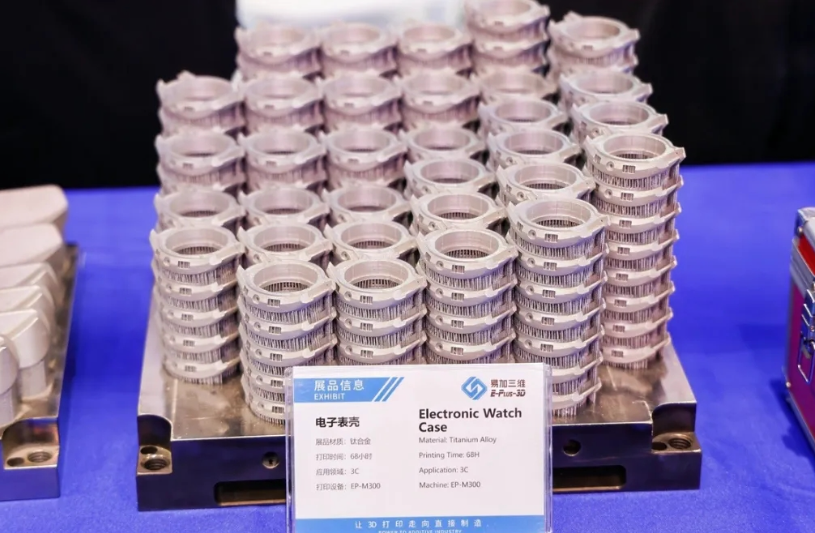 Using metal 3D printing for watch cases allows for the printing of dozens or even hundreds of units in a single batch, making production efficiency very high. (The image is not of the Apple Watch Ultra 3 case)
 Dual Drive of Material Revolution and Process Innovation
In recent years, as consumer demand for lightweight and portable electronic devices has increased, major manufacturers have sought breakthroughs in body design and internal structure. Last year, Apple’s M4 chip version of the iPad Pro, with an ultra-thin body of 5.1 mm, became a focal point in the industry, as the placement of the USB-C port was nearing physical limits. The thickness of the iPhone Air is 5.64 mm, and Apple’s engineering team has achieved a new low in port thickness through 3D printed titanium alloy technology, perfectly adapting to the ultra-thin body.
This 3D printed titanium alloy USB-C port is a key component in the redesigned structure of the iPhone Air. The new structure significantly reduces material usage while maintaining the structural strength of the device. Apple pointed out that compared to traditional forging processes, this titanium alloy port saves 33% in material consumption, aligning with its strategy of promoting sustainability and improving material utilization across its product line.
Although Apple has previously introduced titanium materials in high-end iPhone models and the Apple Watch, this is particularly significant: it marks Apple’s first application of additive manufacturing technology in functional structural components in devices aimed at the mass market, providing a new direction for the evolution of consumer electronics manufacturing processes.
 iPhone 17 Pro Max Returns to Aluminum Structure
Previously, the 3D printing industry had high hopes that the iPhone 17 would use titanium alloy across the board. However, in June, foreign tech blogger Majin Bu revealed that after two generations of high-end titanium metal usage, the new iPhone 17 Pro Max has chosen to return to an aluminum structure. It is reported that the iPhone 17 Pro series will adopt an aluminum structure, positioning it as an environmentally friendly flagship product. The Air version will partially use titanium alloy to maintain its appeal to high-end users.
This change in material choice is not only due to cost considerations but also a crucial step for Apple in advancing its “Apple 2030” carbon neutrality goal. Material science data shows that the carbon footprint of aluminum production is 67% lower than that of titanium. Although titanium has a strength-to-weight ratio of 6:1, far superior to aluminum’s 4:1, aluminum’s high recyclability gives it a significant advantage in sustainability.

 Bridging the Gap from Technical Validation to Scaled Application
According to supply chain information, Apple’s core supplier for 3D printed parts is the Chinese 3D printing leader, Plater. International analyst Ming-Chi Kuo confirmed: “Plater has upgraded from equipment supplier to component manufacturer, responsible for providing Apple with 3D printed titanium alloy parts. Currently, the 3D printed titanium alloy port is only applied to the iPhone Air model, while the iPhone 17 series continues to use traditional ports. However, Kuo predicts that as production scales up, the shipment of 3D printed parts will continue to grow, and it is expected to expand to more product lines such as the Apple Watch case.” This has already been validated at the launch event.
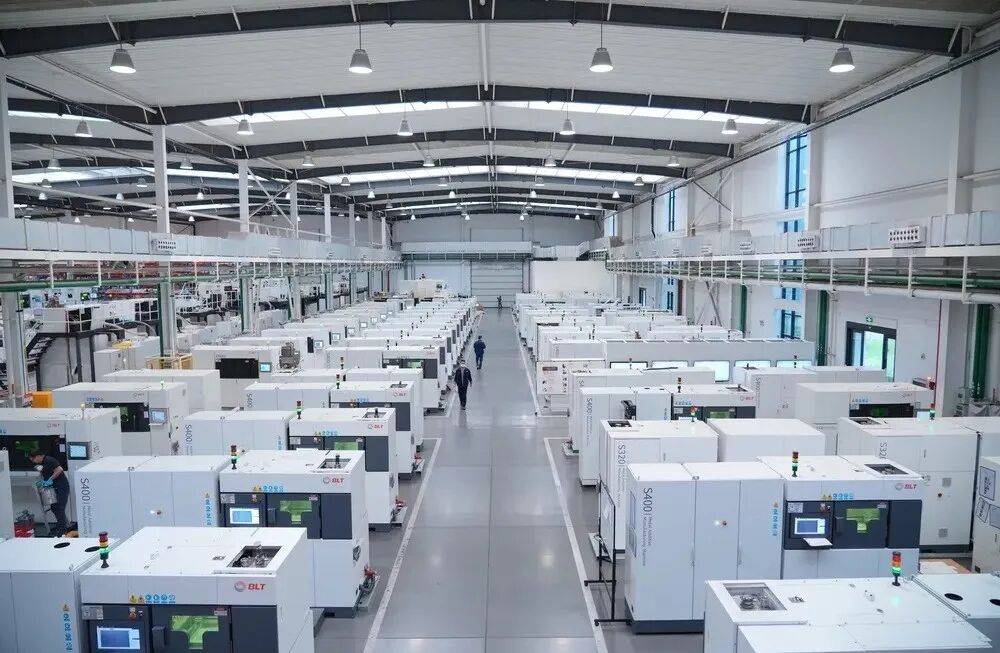 Plater has deployed hundreds of metal 3D printers for the production of components in aerospace, consumer electronics, and other fields.
In the mobile 3C field, the application of titanium alloy is accelerating from concept to large-scale production, gradually becoming a new trend in high-end manufacturing. In this process, metal 3D printing equipment and material manufacturers play a key role: currently, several companies have successfully secured important orders in the mobile 3C industry. Some of these companies have completed the deployment of dozens or even hundreds of metal 3D printing devices specifically for large-scale production of titanium alloy structural parts, hinges, and other precision components. Meanwhile, powder material companies are committed to providing high-quality titanium alloys and 100% recycled titanium alloy powders to meet the industry’s demand for lightweight, high-strength, and environmentally friendly attributes. Some manufacturers have successfully entered the supply chain of leading brands like Apple, achieving bulk material delivery.
The collaborative development of this industry chain marks a critical stage in the large-scale application of titanium alloy 3D printing technology in the consumer electronics field.
 The Dawn of a New Era in Precision Manufacturing
Apple’s layout in titanium alloy 3D printing technology has been well-prepared. According to research firm PatentlyApple, Apple has accumulated 8 patents related to titanium alloy materials, laying a foundation for the intellectual property of this technology’s implementation. This forward-looking investment is quietly reshaping the technical standards of the consumer electronics manufacturing industry.
The industry has already shown interest in the combination of titanium alloys and 3D printing. The Honor Magic V2 foldable phone was the first to adopt a titanium alloy 3D printed hinge, and Huawei and Samsung have also introduced similar processes in smartwatch cases, indicating that the industry is experiencing a wave of material innovation.
From a broader perspective, Apple’s move signifies that the industry is gradually shifting from traditional “subtractive manufacturing” to more efficient “additive manufacturing.” 3D printing not only significantly improves material utilization but, more importantly, liberates the freedom of structural design, making previously difficult-to-achieve complex lightweight components possible.
With the official launch of the iPhone Air, the 3D printed titanium alloy USB-C port it features will face a comprehensive market test. Whether this technology can become a new industry benchmark like the Retina display or Face ID depends not only on its technological advancement but also on its ability to achieve a delicate balance between performance, cost, and user experience. It is certain that Apple has once again pointed out an important direction for the consumer electronics industry—innovation in materials and processes will be the key breakthrough in the challenge of device miniaturization.
END Pre-registration for Visits
TIEXPO—An International Trade and Cooperation Platform for the Entire Industry Chain
For inquiries and cooperation, please contact: 010-6860 1449

[ Disclaimer: The source of this article is the internet, for sharing purposes only. Copyright belongs to the original author, and the content does not represent the position of this public account. If there are any copyright issues, please contact us for immediate removal]