
 The French newspaper “Le Figaro” reported that since last year, remote robotic surgeries have continuously set world firsts. The emergence of a new generation of surgical robots from China has broken the U.S. monopoly in the medical robot market.
On July 15, the 2025 World Robotic Surgery Conference opened in Strasbourg, France, with a live-streamed surgery as its kickoff. What was special about this event was that the surgeon at the control console was in the hall of the Ircad (Research Institute against Digestive Cancer) in Strasbourg, while the patient undergoing surgery was far away in Kobe, Japan, with the robot executing the doctor’s commands, resulting in a successful operation—similar to multiple remote surgeries conducted over the past two years.
The choice of Strasbourg for the World Robotic Surgery Society (SRS) conference was not coincidental, as Ircad is a global authority in robotic surgery. Its founder and president, Professor Jacques Marescaux, completed the world’s first remote surgery back in 2001—the famous “Lindbergh Operation.” At that time, Professor Marescaux remotely controlled a U.S. medical robot from New York to remove a gallbladder from a patient in Strasbourg.
01 Controlled via 5G, WiFi, or Satellite
Professor Marescaux recalled at the 2025 World Robotic Surgery Conference that the Lindbergh operation relied on a dedicated high-speed line provided by French Telecom, which was “extremely expensive,” making it difficult to promote. Until 2023, this experiment remained an isolated case.
However, telecommunications technology has made rapid advancements in the past two decades, significantly reducing costs, and robotic technology has matured. Now, robotic arms can be controlled via 5G, WiFi, or even satellites. The telecommunications bottleneck has been lifted, and the remaining aspects are similar to conventional robot-assisted surgeries. The only difference is that “the surgeon’s control console is no longer five meters from the patient, but thousands of kilometers away,” explained urologist Richard Gaston. A local team remains with the patient to assist the robot if necessary.
Since last year, remote surgeries have developed rapidly, continuously setting world firsts. In June 2024, a Chinese surgeon remotely operated from Rome, Italy, to remove a cancerous prostate from a patient in Beijing, marking the first intercontinental prostatectomy. Two months later, at the European Urological Robotics Conference in Bordeaux, Spanish doctor Alberto Breda performed the first intercontinental nephrectomy in real-time before over a thousand peers, removing a kidney tumor from a patient hospitalized in Beijing. Twenty-four hours later, Gaston performed a prostatectomy for another patient also in China.
These surgeries were completed in collaboration with Chinese surgical robot company Edge Medical. Another company, Shanghai Minimally Invasive Robotics (MEDBOT), completed the world’s first “onboard remote surgery” in October 2024 with its Toumai laparoscopic surgical robot. In Cotonou, Benin, a local patient underwent surgery on a Chinese medical ship, remotely controlled by doctors in Shanghai.
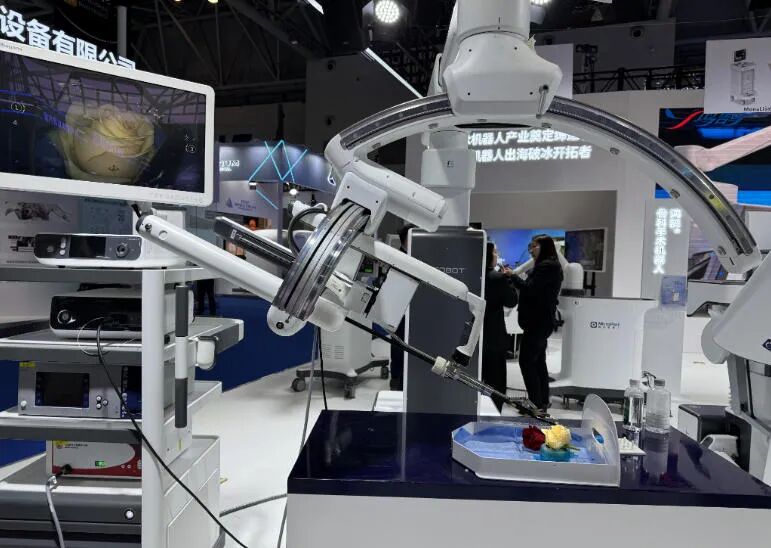
▲ This photo was taken on March 15 at the 2025 China Medical Equipment Exhibition, showcasing a surgical robot developed by Shanghai Minimally Invasive Medical Robotics (Group) Co., Ltd. (Xinhua News Agency)).
Professor Marescaux emphasized at the Strasbourg World Robotic Surgery Conference: “Over 50% of the global population cannot access safe surgeries. For them, the only solution is remote surgery.” He added, “Currently, less than 5% of eligible stroke patients can receive complex neurointerventional treatments.”
02 Advantages of Minimally Invasive Surgery
Remote surgery also shares the common advantages of robotic surgery: less damage due to more precise operations. “The flexibility of the robot’s arms exceeds that of human hands, allowing scissors and suturing needles to operate in 360 degrees,” Gaston pointed out. Moreover, robotic surgery does not require large incisions, making it minimally invasive: the four slender robotic arms of the multi-arm system can enter the body through natural passages or small incisions of just a few millimeters.
A few years ago, a new generation of “single-port” robots emerged in the U.S. that only require one incision, with four flexible robotic arms and instruments that can be inserted and deployed through a diameter of 3 to 4 millimeters. This technology is now also appearing in Europe.
With these advantages and the addition of artificial intelligence, robotic surgery is developing rapidly. “In the coming years, catheters inserted into arteries are likely to be automated. Similarly, augmented reality technology will soon overlay on doctors’ screens to assist in surgeries. This is remarkable, and the development is in full swing,” Gaston said excitedly.
03 Chinese Surgical Robots Bring New Hope
Reports indicate that technological advancements are continuously expanding the boundaries of remote surgery. Some robots are now equipped with five robotic arms to allow two surgeons to operate collaboratively. At this World Robotic Surgery Conference in Strasbourg, the first demonstration of “multi-console remote surgery” was presented: multiple control consoles in Strasbourg Ircad and Beijing, with several surgeons collaboratively performing prostate cancer surgeries for two patients located in southern China and Kazakhstan under the guidance of an expert. This world first also came from a Chinese surgical robot company, Sagebot.
Reports indicate that Edge Medical and Shanghai Minimally Invasive Robotics’ surgical robots received CE certification in Europe a few months ago, allowing them to be sold in the European market. Meanwhile, the U.S. robotic surgery pioneer, Intuitive Surgical’s “Da Vinci” robot, which has dominated the market for the past thirty years, has yet to venture into remote surgery due to a lack of relevant regulations.
“Le Figaro” believes that the entry of competitors brings hope to the surgical robot field: prices will decrease, and remote surgery will become more widespread. “A multi-arm robot costs about 2 million euros, while a Chinese robot only costs half that,” Gaston added. “In Europe, Italy and Spain are likely to be the first to adopt it. In Africa, there is significant demand in Morocco.” Meanwhile, countries like China, India, and Brazil are also striving to become centers for remote surgery. The next challenge will be to establish a comprehensive regulatory and ethical framework for this practice.
(European Times / Yuan Ye, translated)
Editor: Dou
Tapto seeshare good articles
