01

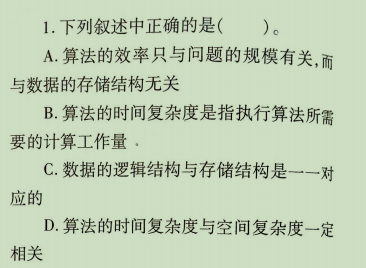

Answer: B
Analysis:
For option A: Different storage structures lead to different data processing efficiencies.
For option B: The time complexity of an algorithm measures the time required for execution on a computer, while space complexity measures the storage space required during execution; the two are not necessarily related.
For option C: The logical structure of data in a computer’s storage space is referred to as the data storage structure.
For option D: The space complexity and time complexity of an algorithm are not necessarily related.
02
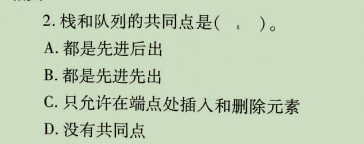
Answer: C
Analysis: Stacks and queues are both special types of linear lists with restricted operations, allowing insertion and deletion only at the endpoints. The difference is that a stack allows insertion or deletion only at one end, following a “last in, first out” (LIFO) principle, while a queue allows insertion at one end and deletion at the other, following a “first in, first out” (FIFO) principle.
03
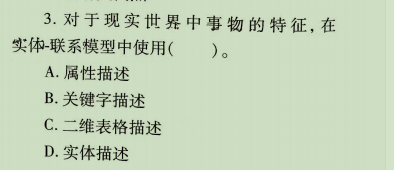
Answer: A
Analysis: In the entity-relationship model, attributes are used to describe the properties, characteristics, and behaviors of objects represented in the real world.
04
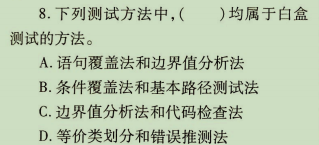
Answer: B
Analysis: White-box testing, also known as structural testing or logic-driven testing, tests the program according to its internal structure, verifying whether the internal actions of the product operate normally according to the design specifications, and checking whether every path in the program works correctly as intended. White-box testing methods include logical coverage methods (including statement coverage, basic path coverage, decision coverage, condition coverage, and judgment-condition coverage), and basic path testing methods. Black-box testing, also known as functional testing or data-driven testing, focuses on the external structure of the program, disregarding the internal logic structure, mainly testing the software interface and functionality. Black-box testing methods include equivalence partitioning, boundary value analysis, error guessing, and cause-effect graphing.
05
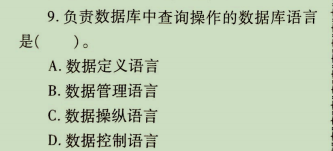
Answer: C
Analysis: Data manipulation language is responsible for manipulating data, including querying and operations such as insert, delete, and update.
06
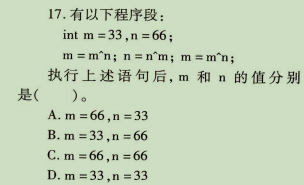
Answer: A
Analysis: ^ represents the bitwise XOR operation.
07
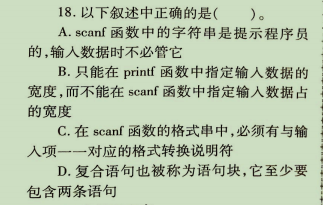
Answer: C
Analysis: For option B: In both printf() and scanf() functions, data width can be specified.
08
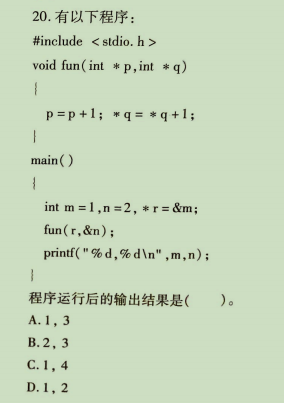
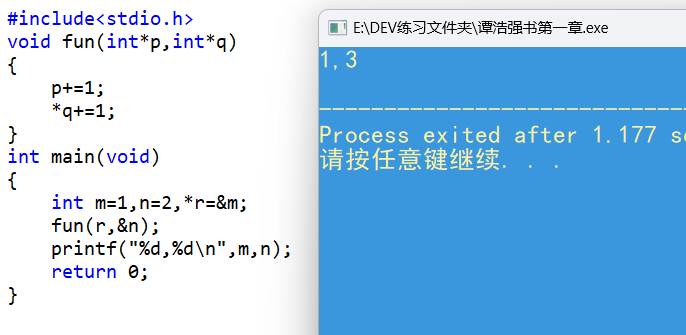
Answer: A
Analysis: Omitted.
09
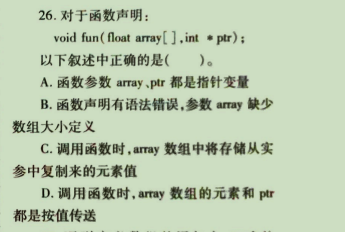
Answer: A
Analysis:
For option A: The function parameters array and ptr are both pointer variables.
For option B: C language allows arrays to omit size, and the compiler does not check boundaries.
For option C: When the array name is passed as a parameter, the address value is passed, not all element values are copied.
For option D: When calling the function, ptr is passed as a pointer, and array degenerates into a pointer, passing the address.
10
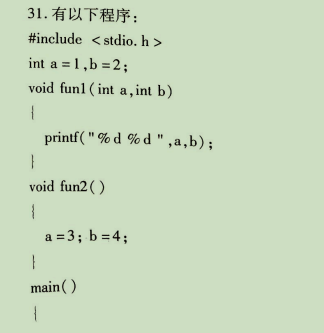
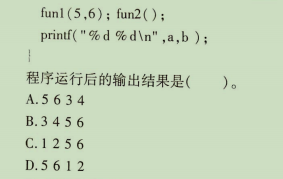
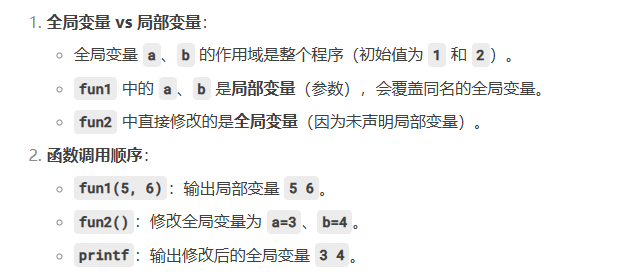
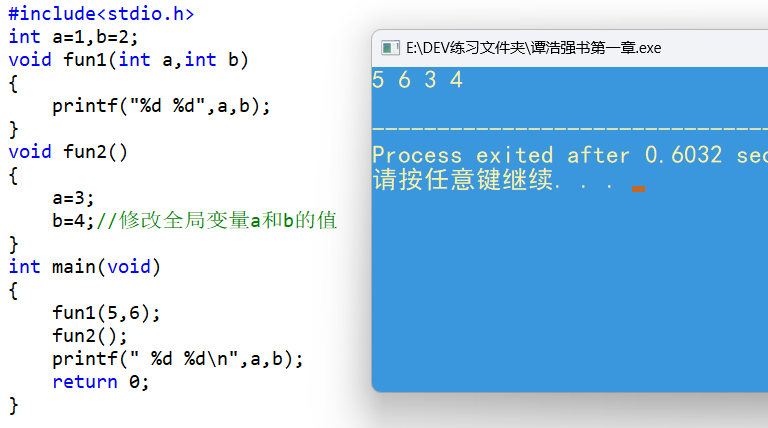
Answer: A
Analysis:
11
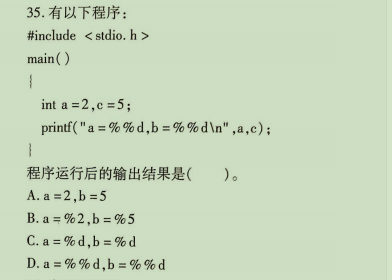
Answer: C
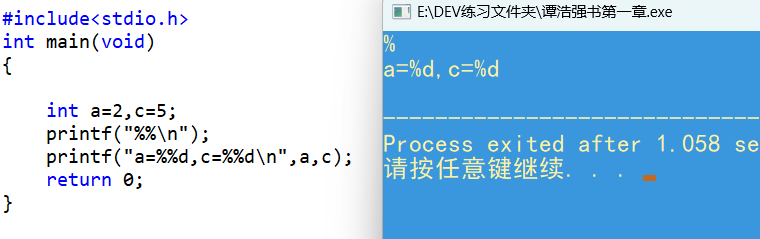
Analysis: In C language, %% is used to output the character %, so %%d outputs %d as two ordinary characters, rather than interpreting it according to the meaning of the control character %d.