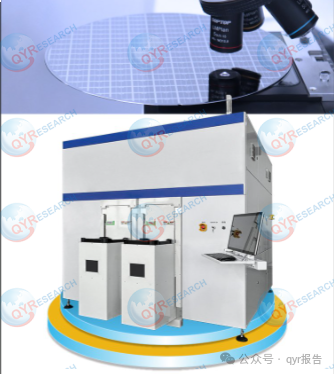
The Semiconductor Rapid Thermal Annealing Furnace is a key piece of equipment in the semiconductor manufacturing process, achieving extremely fast heating rates of 300℃-1200℃ through halogen infrared lamps or laser sources, eliminating internal defects in wafers and optimizing material performance. The core technology lies in controlling thermal field uniformity and millisecond-level temperature response, which directly affects the yield and performance of integrated circuits. As a core equipment in the front-end process of semiconductors, this device accounts for 69% of applications in fields such as thin-film transistors, logic chips, and power semiconductors, making it a critical infrastructure for mass production of advanced processes (such as below 7nm).
II. Supply Chain Structure and Upstream-Downstream Interaction
- Upstream: Core Components and Materials
Light Source System: According to the latest research report by QYResearch, halogen lamps (accounting for 35% of equipment costs) and high-power lasers (28%) are the main heat sources. Domestic manufacturers such as Foshan Guoxing Optoelectronics and Wuhan Raycus Laser have achieved partial domestic substitution.
Vacuum System: Dry screw pumps and molecular pumps rely on imports (such as Edwards and Pfeiffer Vacuum), with a domestic substitution rate of less than 15%.
Temperature Control Module: PID algorithm controllers and high-precision sensors (±1℃ error) are dominated by American Omron and German Siemens.
- Midstream: Equipment Manufacturing and Integration
The global market presents a “three super, many strong” pattern:
First Tier: Applied Materials (USA) and ASML (Netherlands, through its subsidiary Mattson Technology) occupy 42% of the global market share, leading in 12-inch wafer processing technology.
Second Tier: Centrotherm (Germany), Ulvac (Japan), and Ultratech (USA, now part of Veeco) collectively account for 28%, focusing on 8-12 inch compatible equipment.
Domestic: Companies like Lianghuo Semiconductor, Wuxi Yiweng, and Shenzhen Laplace Energy Technology Co., Ltd. have achieved breakthroughs in domestic substitution in the 6-8 inch equipment field through a “reverse generational development” strategy (expected to reach 37% by 2024).
- Downstream: Application Scenarios and Demand Drivers
Integrated Circuits: Account for 69%, with demand driven by 5G base stations, AI servers, and automotive electronics (such as Tesla’s Dojo chip), with global wafer fab capital expenditure expected to grow by 18% year-on-year in 2024.
Third Generation Semiconductors: The annealing demand for SiC/GaN materials is expected to have a CAGR of 22.32%, mainly applied in new energy vehicles (such as BYD’s IGBT modules) and 5G RF devices.
Special Applications: Emerging fields such as aerospace-grade radiation-resistant chips and quantum computing superconducting circuits are expected to see demand growth exceeding 30%.
III. Analysis of Major Manufacturers’ Competitive Landscape
- Global Leaders’ Technical Barriers and Market Strategies
Company Name Technical Advantages 2024 China Market Share Strategic Direction
Applied Materials 12-inch wafer dynamic thermal field control technology 38.2% Acquired Italian BGT to strengthen laser annealing layout
Mattson Technology Ultra-fast heating (≤0.1 seconds) patented technology 19.7% Co-established a joint laboratory with SMIC
Centrotherm Low-cost vacuum system integration solutions 14.5% Established an Asia-Pacific R&D center in Wuxi
Ulvac Multi-chamber parallel processing technology 10.3% Jointly developed EUV lithography compatible equipment with Tokyo Electron
- Pathways for Breakthroughs by Domestic Enterprises
Lianghuo Semiconductor: Achieved import substitution in the 6-inch SiC annealing equipment field through a “modular design + rapid iteration” strategy, with a year-on-year shipment growth of 210% in 2024, serving clients including Sanan Optoelectronics and China Resources Microelectronics.
Shenzhen Laplace Energy Technology Co., Ltd.: Focused on the annealing process for photovoltaic N-type batteries, improving equipment efficiency by 15%, securing orders exceeding 500 million yuan from Longi Green Energy and Tongwei Co., Ltd.
Wuxi Yiweng: Developed a laser annealing prototype suitable for 8-inch wafers, achieving a temperature uniformity of ±1.5℃, breaking foreign technology monopolies.
IV. Policy Environment and Industry Support
- National Strategic Drive
The “14th Five-Year Plan”: Includes rapid thermal annealing furnaces in the special equipment for integrated circuits, providing a 20% price subsidy for companies purchasing domestic equipment.
Big Fund Phase II: Cumulatively invested over 12 billion yuan in the equipment sector, focusing on supporting companies like Lianghuo Semiconductor and Zhongwei Company.
Tax Incentives: The proportion of R&D expenses that can be deducted has increased to 120%, and the tax exemption list for key imported components has expanded to 32 items.
- Local Supporting Measures
Yangtze River Delta: Shanghai Lingang New Area has established a semiconductor equipment industrial park, providing policies for factory construction and talent settlement.
Pearl River Delta: Shenzhen has introduced a “20+8” industrial cluster plan, providing up to 50 million yuan in funding for annealing furnace R&D companies.
Midwest: Chongqing Liangjiang New Area is building a 12-inch wafer annealing equipment production line, with land costs 40% lower than in the east.
V. Market Development Trends and Investment Opportunities
- Technology Iteration Directions
Light Source Upgrade: The proportion of laser annealing equipment is expected to increase from 12% in 2024 to 28% in 2029, mainly driven by EUV lithography support demand.
Intelligent Control: AI algorithms will achieve real-time optimization of temperature fields, increasing equipment utilization rates by 15%-20%.
Green Manufacturing: New insulation materials will reduce energy consumption by 18%, complying with EU carbon tariff requirements.
- Submarket Explosive Points
Automotive Electronics: By 2025, the global demand for automotive-grade chip annealing equipment is expected to reach 420 million USD, with a CAGR of 24.7%.
Storage Chips: The number of stacking layers for 3D NAND has exceeded 300 layers, with the unit price of deep hole annealing equipment rising to 8 million USD per unit.
Advanced Packaging: Chiplet technology is driving demand for 2.5D/3D annealing equipment, with the market size expected to reach 170 million USD by 2026.
- Risk Warnings and Responses
Technical Blockade: The US has upgraded export controls on EUV lithography-related annealing technologies, necessitating strengthened R&D on alternative solutions such as laser direct imaging (LDI).
Price Wars: Domestic companies may trigger a decline in gross margins to capture market share (expected average industry gross margin to drop to 32% by 2025).
Talent Gap: Senior process engineers earn over 800,000 yuan annually, requiring collaboration between schools and enterprises (such as Tsinghua University and Lianghuo for joint training) to alleviate the shortage.
VI. Industry Outlook (2025-2029)
- Market Size Forecast
According to QYR data, the market size of China’s semiconductor rapid thermal annealing furnace is expected to reach 323 million USD by 2029, with a CAGR of 9.64% from 2023 to 2029. Among them:
Light tube source equipment: accounting for 74.19%, benefiting from the expansion of mature processes.
Laser source equipment: accounting for 25.81%, mainly driven by advanced processes and third-generation semiconductors.
- Competitive Landscape Evolution
Domestic Substitution Rate: Expected to increase from 22% in 2024 to 41% in 2029, with domestic companies forming a dominant advantage in the 6-8 inch equipment field.
Global Position: China is expected to surpass Japan by 2028, becoming the second-largest annealing furnace market in the world (after the USA).
- Strategic Recommendations
Investors: Focus on companies with laser annealing technology reserves and automotive electronics customer bases, such as Mattson Technology and Lianghuo Semiconductor.
Equipment Manufacturers: Increase investment in differentiated technologies such as AI temperature control and green manufacturing to avoid homogenized competition.
Policy Level: Improve equipment validation standards system to promote the mass application of domestic equipment in 12-inch wafer fabs.
Conclusion: The Chinese semiconductor rapid thermal annealing furnace industry is at a critical period of technological breakthroughs and market expansion. With the triple drive of policy support, demand pull, and local innovation, it is expected to achieve a substantial leap in global industrial chain status by 2027. Investors should seize the explosive window of sub-sectors while being wary of risks from technological blockades and price competition.
The “2025 Global and China Semiconductor Rapid Thermal Annealing Furnace Business Development Planning and Strategy Research Report” by QYResearch analyzes the production capacity, output, sales volume, sales revenue, prices, and future trends of semiconductor rapid thermal annealing furnaces in the global and Chinese markets. It focuses on the product characteristics, specifications, prices, sales volumes, sales revenues, and market shares of major manufacturers in the global and Chinese markets. Historical data covers 2020 to 2024, while forecast data spans 2025 to 2031.

For more free market data in the industry, please follow the WeChat public account:qyr report
QYResearch (Beijing Hengzhou Bozhi International Information Consulting Co., Ltd.) is headquartered in Los Angeles, USA, and Beijing, China. Since its establishment in 2007, it has focused on providing professional market research reports, industry research reports, feasibility studies, industrial chain analysis research, IPO consulting, market share research, customized surveys, business plans, and applications for manufacturing industry champions and specialized and innovative “little giants”.