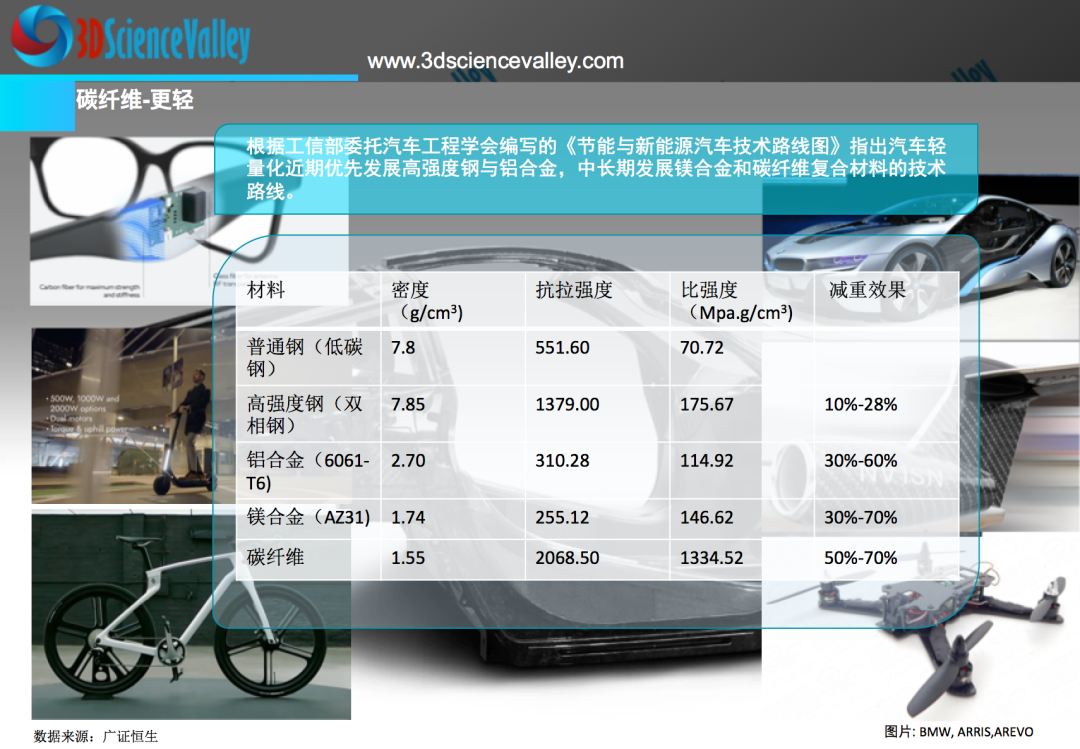
With the integration of low-altitude economy and 3D printing technology, optimizing the impact resistance of polymer-based composites has become a key issue. Commonly used polymer matrix materials often lack sufficient ductility, making it difficult to meet the dynamic mechanical performance requirements of aircraft components. In the research paper shared in this issue, Professor Yan Li’s team from Tongji University proposed a universal toughening and energy-dissipating strategy that significantly enhances the performance of 3D printed polymer-based composites in terms of impact resistance, ductility, and strength-ductility balance, making them particularly suitable for impact protection applications. This strategy provides insights for upgrading 3D printed composites for low-altitude aircraft.
“ 3D Science Valley White Paper Illustrated Analysis
”
1. Research Background
3D printed polymer-based composites have advantages such as lightweight, high strength, and design flexibility, making them widely used in aerospace and medical device fields. However, commonly used matrix materials like polylactic acid (PLA) and epoxy resin can lead to low fracture elongation and susceptibility to failure under dynamic loads. Current toughening and energy-dissipating methods include blending with flexible polymers, introducing rigid particles to construct multiphase systems, and grafting or copolymer modification, but these methods often face issues such as complex processes, poor compatibility, and limited toughening effects. Therefore, developing a universal, simple, and significant toughening and energy-dissipating strategy holds important scientific significance and application value.
2. Article Overview
Recently, Professor Yan Li’s team at Tongji University proposed a universal toughening and energy-dissipating strategy for 3D printed polymer-based composites based on B-O dynamic coordination bonds. The research team introduced shear-thickening gel (SSG) into the PLA matrix, resulting in a high-toughness smart impact-resistant composite (PLA/SSG) that achieved a 40-fold increase in fracture elongation and a 330% increase in impact energy absorption while maintaining the tensile strength. Further studies indicated that the high ductility of the composite is attributed to the multiple cracking and local plastic yielding induced by SSG in the PLA matrix, while the significantly enhanced impact performance is due to the energy absorption mechanism triggered by the B-O bonds in SSG causing a “soft-hard” phase transition. This strategy is applicable to most brittle polymer matrices and provides a new approach for optimizing the mechanical properties of 3D printed impact-resistant composites.
3. Illustrated Guide
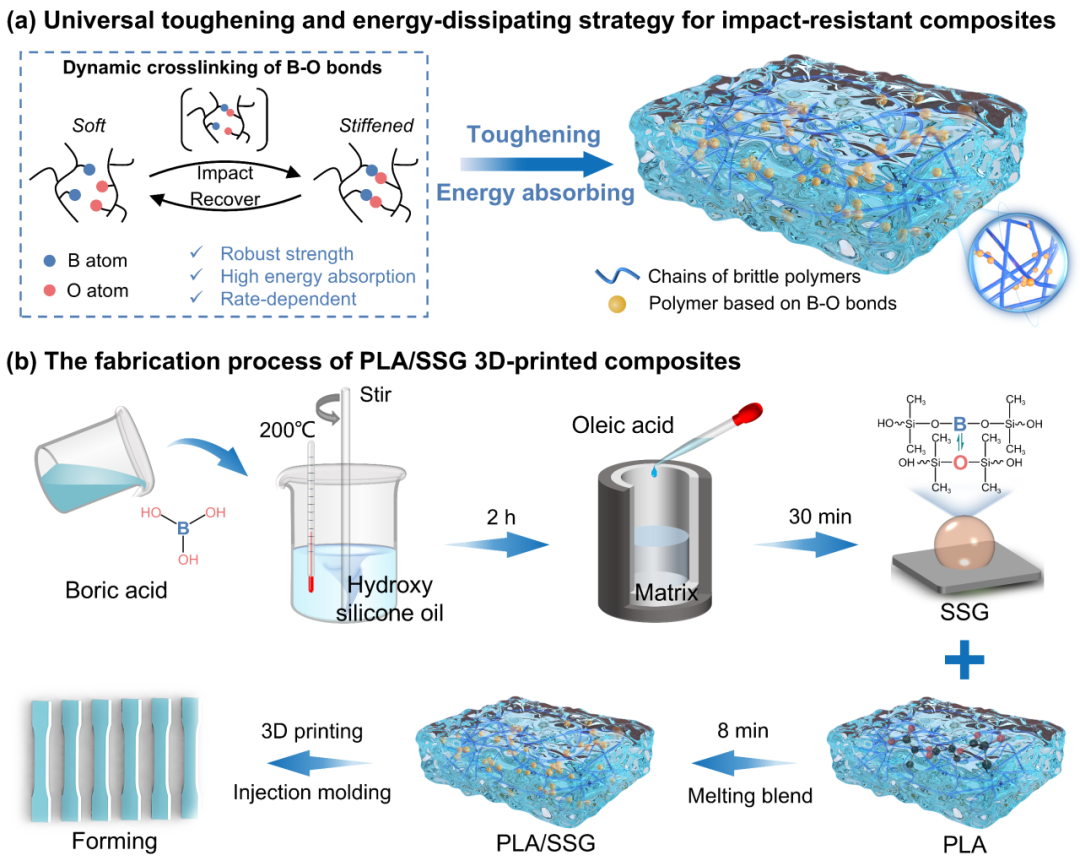
Figure 1 A universal toughening and energy-dissipating strategy for composites. (a) Introducing B-O dynamic crosslinked polymers as secondary fillers into brittle polymer matrices to enhance the toughness and impact energy absorption of the composites; (b) Schematic diagram of the preparation process of PLA/SSG (SSG synthesis → melt blending → 3D printing forming).
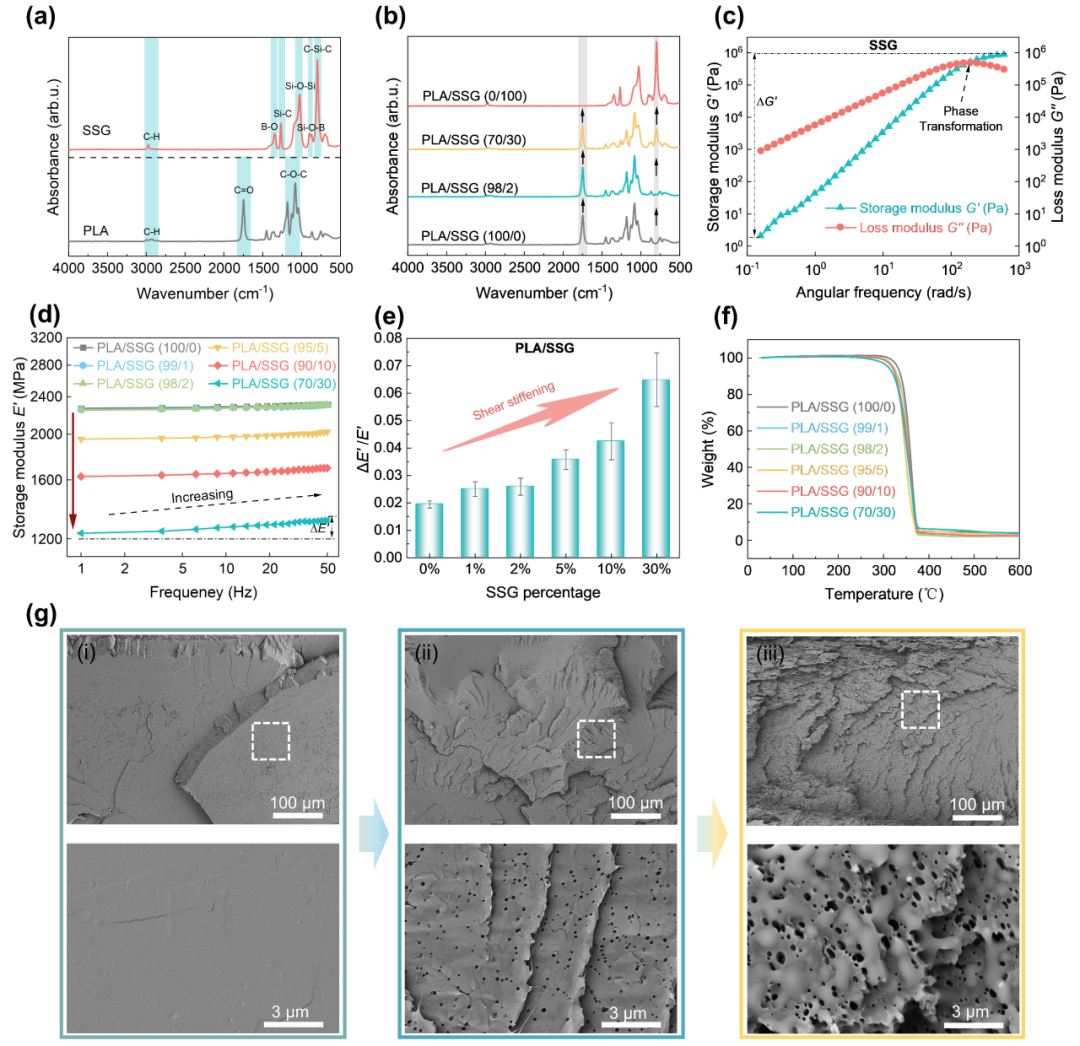
Figure 2 Shear-thickening effect and microstructural characteristics of SSG and PLA/SSG. (a-b) FTIR spectra; (c) Rheological curve of SSG; (d) Frequency scanning curve of PLA/SSG; (e) Positive correlation response of ∆E’/E’ induced by shear-thickening effect with SSG content; (f) Thermogravimetric curve; (g) Cross-sectional morphology of PLA/SSG after cryogenic fracture (i. PLA/SSG (100/0), ii. PLA/SSG (98/2), iii. PLA/SSG (70/30)), exhibiting a typical “island” structure.
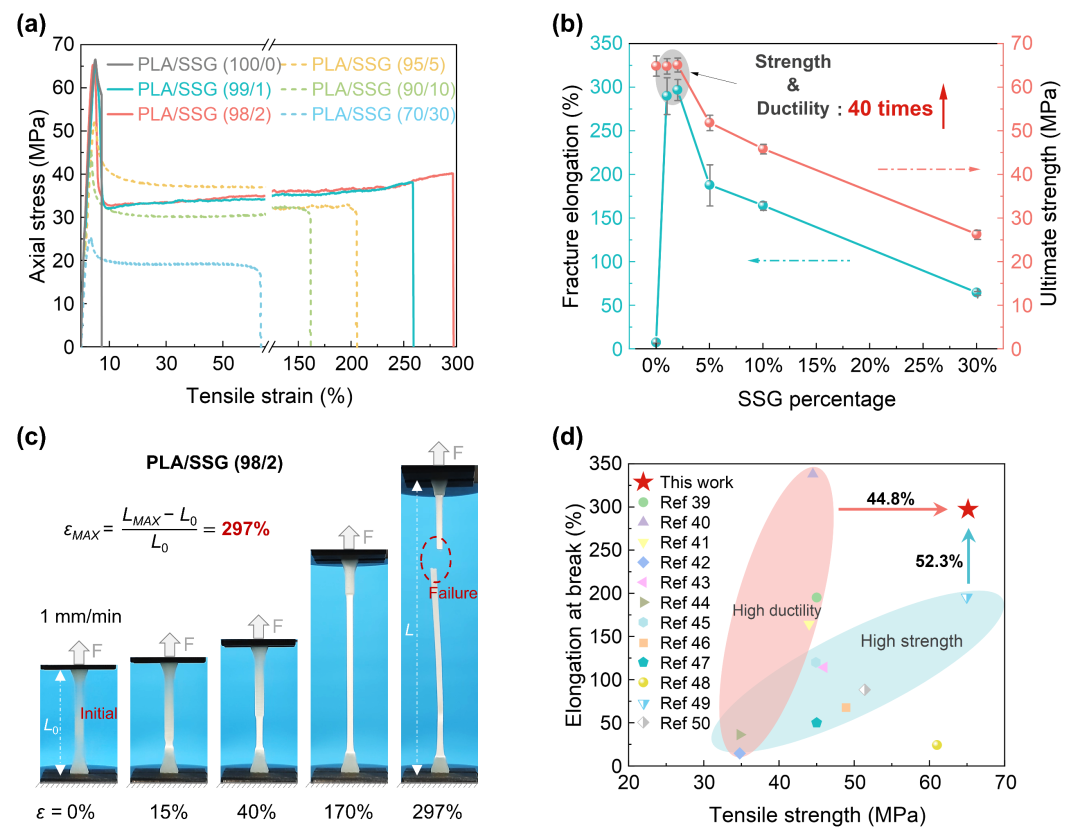
Figure 3 Strength-ductility balance at low strain rates. (a) Quasi-static tensile stress-strain response; (b) Fracture elongation and ultimate tensile strength of different types of PLA/SSG, with a 40-fold increase in ductility when the mass fraction of SSG is 2%; (c) Evolution process of necking during fracture; (d) Balance of strength and ductility, with a 44.8% increase in ultimate strength and a 52.3% increase in ductility.
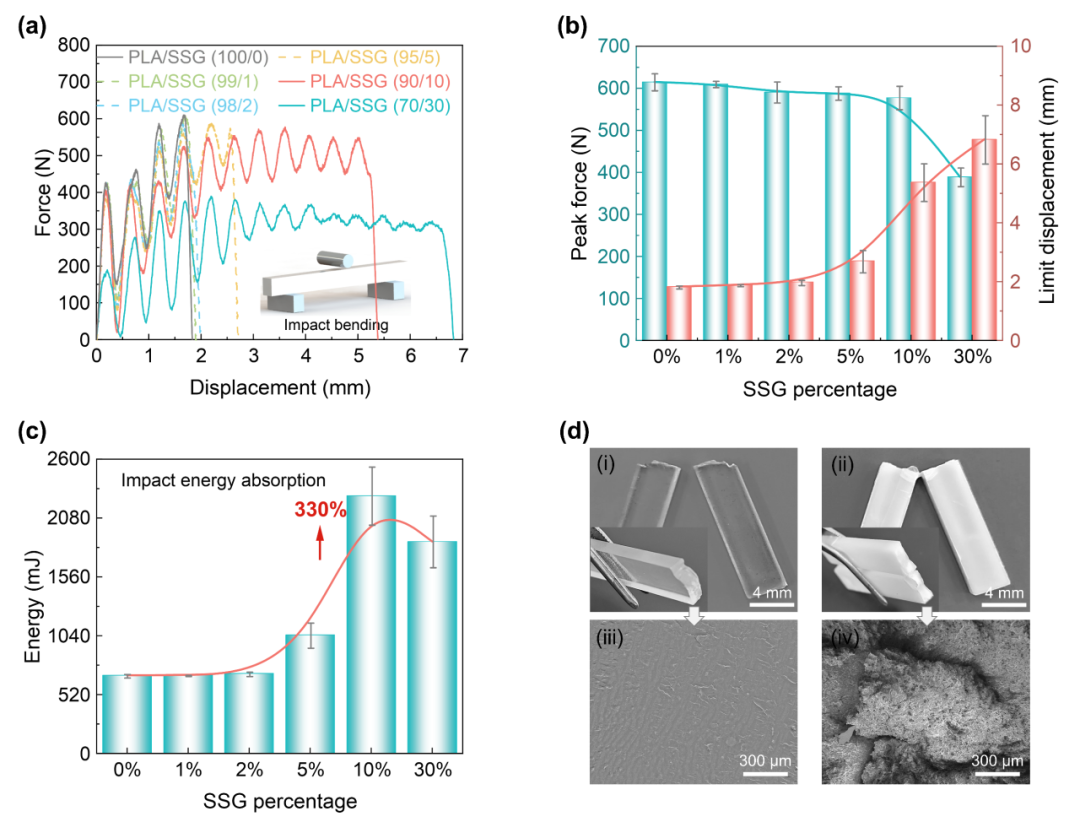
Figure 4 Impact performance at high strain rates. (a) Impact bending load-displacement curves of different types of PLA/SSG; (b) Peak load and ultimate displacement curves; (c) Comparison of impact energy absorption; (d) Comparison of fracture morphology (PLA brittle fracture i, iii; PLA/SSG ductile fracture ii, iv).
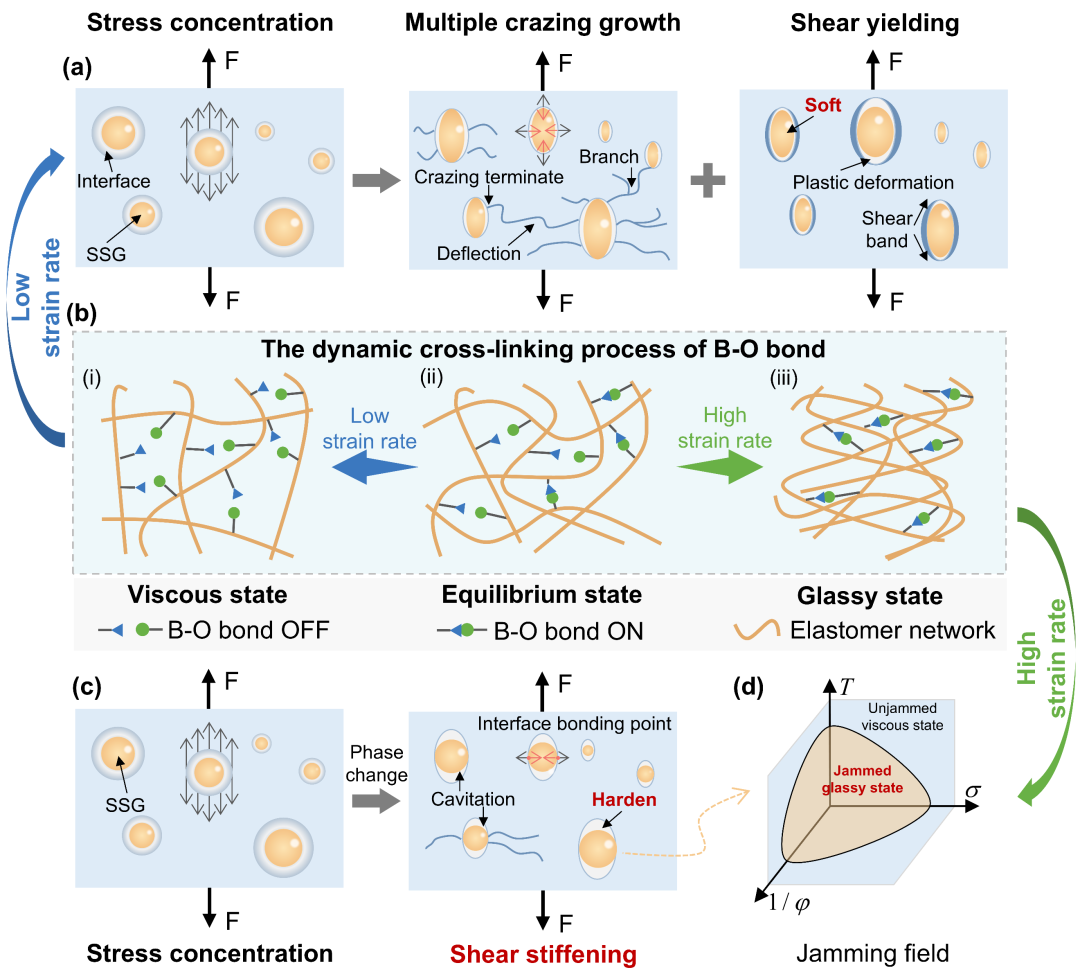
Figure 5 Toughening and energy absorption mechanisms. (a) Toughening mechanism of PLA/SSG at low strain rates (cooperation of multiple silver streaks and shear yielding); (b) Strain rate response of SSG molecular chain entanglement and disentanglement; (c) Energy absorption mechanism of PLA/SSG at high strain rates (shear thickening); (d) Jamming phase diagram of SSG.
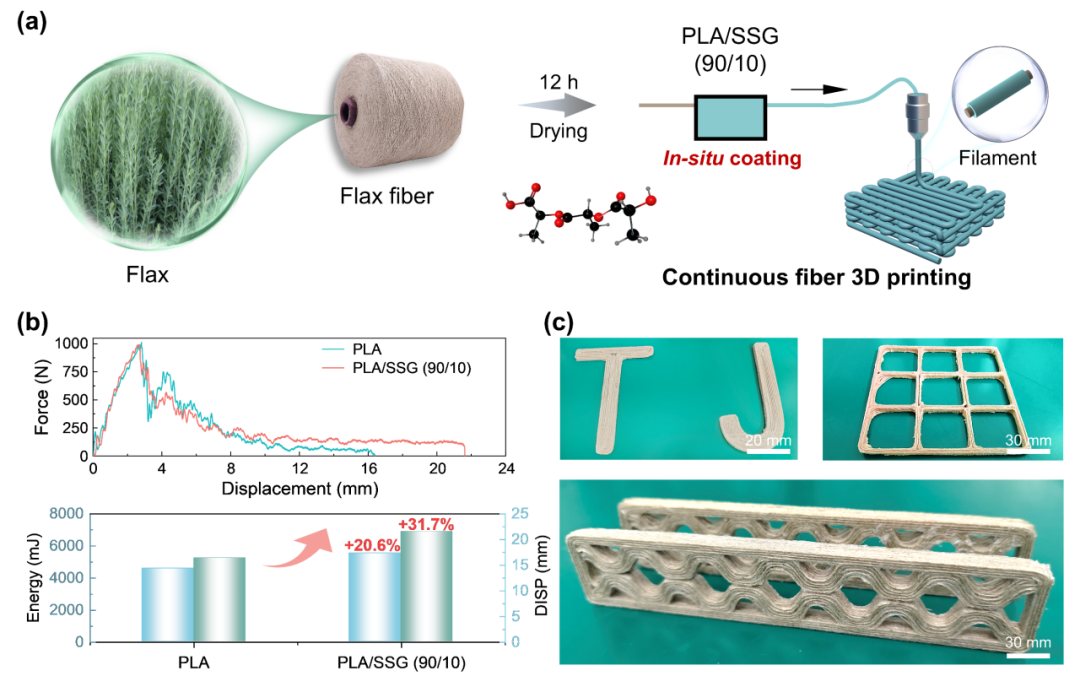
Figure 6 Impact-resistant structural design and performance characterization based on PLA/SSG: (a) In-situ “offline” impregnation process and continuous fiber 3D printing process schematic; (b) Impact performance testing of flax fiber reinforced composites; (c) Physical display of 3D printed structures.
4. Conclusion:
The team proposed a universal toughening and energy absorption strategy for 3D printed polymer-based composites inspired by B-O dynamic coordination bonds. By encapsulating shear-thickening materials (SSG) within a PLA matrix, they developed a smart impact-resistant composite (PLA/SSG) with adaptive mechanical response, achieving a 330% increase in impact toughness, a 40-fold increase in ductility, and significantly improved strength-ductility balance. This material also exhibits excellent thermal stability and processability, supporting the customized forming of complex structures, with the energy dissipation of the produced PLA/SSG-based flax fiber reinforced composites improved by 20.6% compared to traditional composites. This strategy provides a new pathway for the development of high-performance 3D printed impact-resistant composites.
This project was supported by the National Natural Science Foundation of China (No. 12132011), the National Key R&D Program (No. 2022YFB000), and the Zhiyuan Research Institute (No. ZYL2024009a), for which we express our gratitude.
Paper Information:
A Universal Toughening and Energy-Dissipating Strategy for Impact-Resistant 3D-Printed Composites
Xiang Hong, Peng Wang,* Yu Ma, Weidong Yang, Junming Zhang, Zhongsen Zhang, and Yan Li*
Advanced Science
DOI:10.1002/advs.202501450
Click the lower left corner “Read the original text” to view the original paper.
Source:

The research team at Southern University of Science and Technology achieves 3D printing of composites with ultra-high filler content.
Topology optimization of quadrotor drones based on continuous fiber additive manufacturing…l 【Focus l Low-altitude economy】

 ▌3D Science l Infinite PossibilitiesSubmission丨[email protected]
www.3dsciencevalley.com