While global tech giants are fiercely competing for cloud AI large models, a quiet revolution is taking place at the edge. AMD, once overshadowed by NVIDIA in the AI chip sector, is seizing its moment in the spotlight in the robotics era, leveraging its unique advantages in edge AI hardware.
From “Challenger” to “Leader”: AMD’s Comeback in Edge AI
In 2025, when AMD releases its latest generation of Versal AI Edge series chips, the entire semiconductor industry will be shaken. This chip, known in the industry as the “edge AI accelerator,” not only surpasses its peers in performance specifications but also perfectly meets the core demands of edge computing in the robotics era.
“AI is not just about data centers; the focus of AI development has shifted from model training to inference applications, evolving from multimodal understanding to actively executing tasks.” This statement by AMD’s Senior Business Associate, Huang Weiqiao, encapsulates the core of AMD’s strategic transformation—bringing AI capabilities from the cloud to the edge, extending from the virtual world to the physical world.
The “Secret Weapon” of AMD’s Edge AI Chips
Let’s first look at the core technical specifications of the AMD Versal AI Edge series:
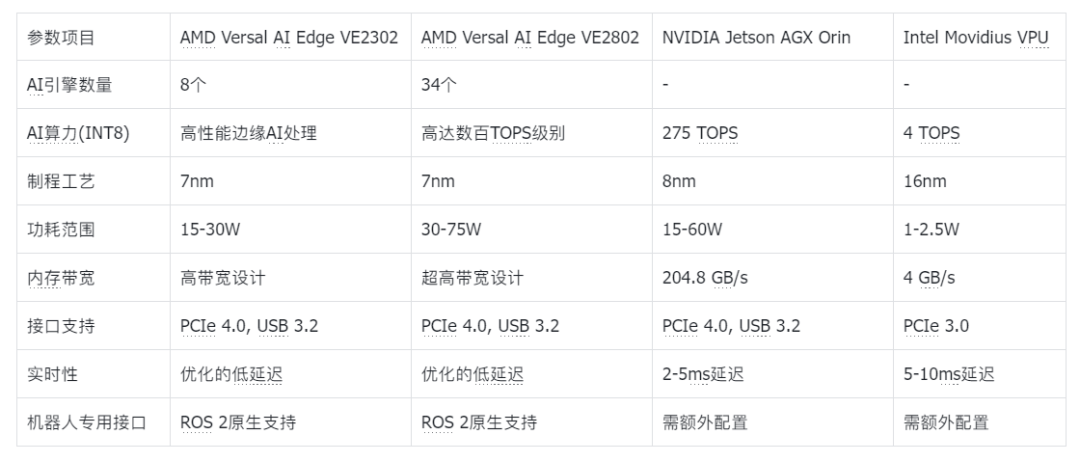
Data Source: AMD Official Technical Documentation, NVIDIA Jetson Specifications, Intel Movidius Technical White Paper
From the table, it is evident that the AMD Versal AI Edge series holds significant advantages in AI computing power, memory bandwidth, and real-time performance. Particularly noteworthy is its adaptive AI engine design, which can dynamically adjust resource allocation based on different application scenarios, a crucial feature for robotics applications.
AMD Ryzen Embedded 8000 Series: The “Swiss Army Knife” of Edge AI
If the Versal AI Edge is AMD’s “spearhead” in the high-end robotics market, then the Ryzen Embedded 8000 series is its “Swiss Army Knife” in the industrial edge AI field. This processor integrates an NPU based on the AMD XDNA architecture, officially confirmed to provide up to 39 TOPS of AI computing power.
“Based on the AMD XDNA architecture, it provides up to 16 TOPS of computing power. Combined with the CPU and integrated GPU, the Ryzen Embedded 8000 can deliver up to 39 TOPS of AI computing power,” describes AMD’s official blog.
More importantly, the Ryzen Embedded 8000 series employs advanced process technology, with power consumption controlled between 35-54W, making it “tailor-made” for robots that need to operate under limited space and cooling conditions.
The “New Battlefield” of the Robotics Era: Why Edge AI is So Important?
To understand AMD’s rise, one must first grasp why edge AI is so crucial in the robotics era.
“Autonomous vehicles and humanoid robots need to perform edge inference calculations on the body, rather than relying on cloud computing from 500 kilometers away,” noted an expert from the University of Hong Kong’s China Business School in a deep-dive opinion piece in January 2025. This statement highlights the core value of edge AI—real-time performance and reliability.
Edge AI vs Cloud AI: A Battle of “Time”
In robotics applications, time is of the essence. An industrial robot needs to react within milliseconds, a service robot must understand human commands in real-time and respond, and an autonomous vehicle must instantly recognize obstacles and make decisions. None of these can rely on cloud computing.
Comparison of Edge AI and Cloud AI in Robotics Applications
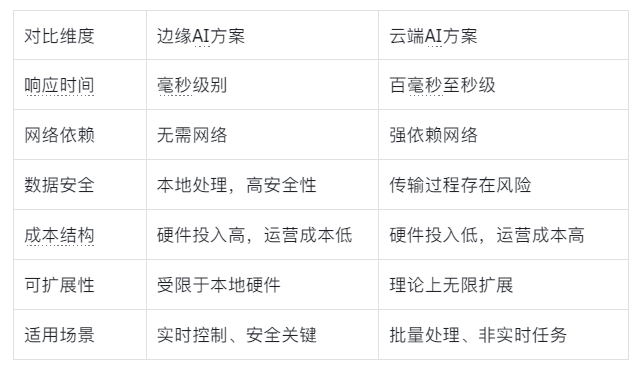
Li Yicheng, Senior Product Director at Advantech, shared data at the 2025 Shanghai Edge Computing & Edge AI Forum: “The global edge AI market is expected to exceed $143.6 billion by 2032, with manufacturing accounting for the highest share (30%), followed by healthcare, smart cities, and automotive sectors.”
AMD’s Edge AI Strategy: A Comprehensive Layout from Chips to Systems
AMD’s intelligence lies in its choice not to directly compete with NVIDIA in the cloud AI training market but to carve out a niche by focusing on the integration of edge AI and robotics applications.
“AMD’s chiplet strategy has paid off in the edge AI era; chiplet technology allows different types of processing units to be integrated on a single chip, while adaptive computing provides the flexibility that robotics applications require,” the statement continues.
AMD’s edge AI strategy is primarily reflected in three aspects:
-
Heterogeneous Computing Architecture: Integrating different types of computing units such as CPU, GPU, AI engines, and FPGA on a single chip to achieve optimal resource allocation.
-
Low Latency Design: To meet the extreme real-time requirements of robotics applications, AMD has specifically optimized data paths and memory access latencies in chip design.
-
Open Ecosystem: Compared to NVIDIA’s closed CUDA ecosystem, AMD has chosen a more open route, supporting various AI frameworks and development tools.
Real-World Cases: How AMD’s Edge AI Chips are Transforming the Robotics Industry?
Theory is one thing, but real-world cases are far more convincing. Let’s look at the performance of AMD’s edge AI chips in actual robotics applications.
Case 1: The “Brain Upgrade” of Industrial Robots
In the industrial manufacturing sector, AMD’s KR260 Robot Starter Kit is helping developers quickly build the next generation of industrial robots. This development kit, priced at only $349, integrates high-performance industrial interfaces and natively supports ROS 2.
“The KR260 Robot Starter Kit enables rapid development of hardware-accelerated applications for robotics and industrial automation—offering significant productivity, unit power performance improvements, and latency advantages compared to GPU-based solutions,” describes AMD’s official press release.
Engineers at a well-known automotive manufacturing plant have seen significant improvements in response times and production efficiency after adopting AMD technology, with defect rates decreasing. AMD’s adaptive AI engine allows them to dynamically adjust computing resources based on different production tasks.
Case 2: The “Emotional Understanding” of Service Robots
In the service robotics field, AMD’s Ryzen Embedded 8000 series chips are helping robots achieve more natural “emotional understanding.” Advantech’s latest products equipped with AMD Ryzen Embedded 8000 series processors have become ideal choices for edge applications.
These features make these solutions ideal for edge applications, including human-machine interfaces (HMI), machine vision in industrial automation, intelligent management and interactive services in smart city systems, and ultrasound devices in medical applications.
A well-known service robotics company, after adopting Ryzen Embedded processors, has leveraged 39 TOPS of AI computing power to run complex emotional recognition models on the robot body, while the low-power design allows the robot to operate continuously for extended periods.
Case 3: The “Safety Guardian” of Autonomous Driving
In the autonomous driving sector, AMD’s Versal AI Edge chips are becoming the “safety guardians.” The second generation of Versal AI Edge series is dedicated to meeting the central computing needs of advanced driver-assistance systems (ADAS) and autonomous driving (AD).
The second generation of Versal AI Edge devices features diverse functionalities and excellent scalability, capable of meeting the requirements of various L2/L2+ systems and supporting redundancy-critical L3 and L4 systems.
A certain autonomous driving company has adopted Versal AI Edge chips as the core of its onboard computing platform, achieving high-level autonomous driving functions. Particularly under conditions of unstable network connectivity, the ability for local AI computation becomes especially important.
What Impact Will Edge AI Have on the Robotics Industry?
To gain deeper insights into the impact of edge AI on the robotics industry, I have compiled comments from several domestic and international experts.
Domestic Expert Opinions
Li Yicheng (Senior Product Director at Advantech): “The integration of edge AI and robotics technology will accelerate the digital transformation across various industries, with future trends focusing on cloud collaboration, real-time decision-making, and cross-industry standardization. Advantech is building an open ecosystem that integrates chips, sensors, software, and more.”
Huang Weiqiao (Senior Business Associate at AMD): “AI is not just about data centers; the focus of AI development has shifted from model training to inference applications, evolving from multimodal understanding to actively executing tasks. The value of edge AI in industrial scenarios is being re-recognized.”
Pan Xiaoming (AMD Senior Vice President, President of Greater China): “In the past, we focused on creating the fastest single chip, but now we are more focused on how to combine chips with software to meet the most demanding computing needs of AI.”
Experts from the University of Hong Kong’s China Business School: “Autonomous vehicles and humanoid robots need to perform edge inference calculations on the body, rather than relying on cloud computing from 500 kilometers away. The rise of edge AI does not signify the disappearance of cloud AI, but rather promotes a more intelligent distribution of AI workloads.”
International Expert Opinions
Morgan Stanley Analyst: “From concept to reality, investments in physical AI are accelerating. After attending NVIDIA’s GTC conference, we reassessed the investment prospects in the robotics and physical AI sectors.”
Chief Analyst at TIRIAS Research: “The Ryzen Embedded 7000 series processors integrate key functional features with scalable designs, making them suitable for a wide range of applications from advanced robotics and instrument design to power control and video surveillance.”
Technical Comparison: AMD vs NVIDIA vs Intel, Who is the True King of Edge AI?
In the edge AI chip market, AMD, NVIDIA, and Intel are the three major players. Let’s delve into a technical comparison of their products.
AI Performance Comparison
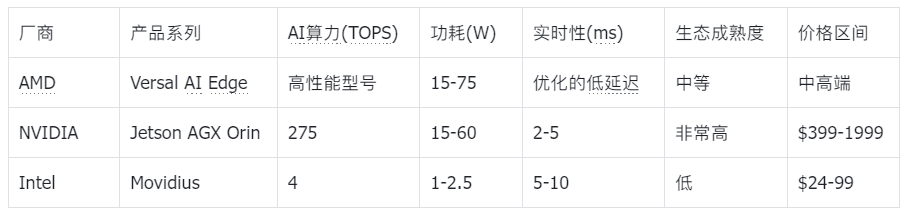
Data Source: Official Technical Documentation from Various Manufacturers, Third-Party Evaluation Reports
From the table, it can be seen that:
-
AMD leads in computing power and real-time performance, suitable for high-end robotics applications
-
NVIDIA has the most mature ecosystem and the most complete development tools, suitable for rapid prototyping
-
Intel has advantages in power consumption and price, suitable for low-cost simple AI applications
Comparison of Ecosystems
While AMD has hardware performance advantages, NVIDIA’s CUDA ecosystem remains its biggest “moat.”
NVIDIA’s CUDA ecosystem is indeed very mature, with many existing algorithms and models optimized based on CUDA, requiring extra work to port to AMD platforms. However, AMD’s ROCm ecosystem is rapidly improving, narrowing the gap.
Comparison of Application Scenarios: Each Has Its Strengths
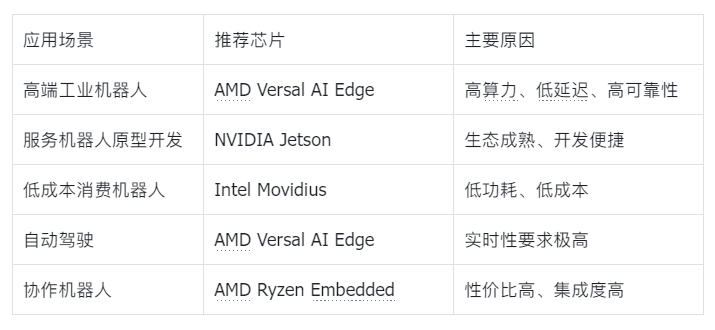
Market Data: Explosive Growth of Edge AI
The edge AI market is experiencing explosive growth. According to data from several market research firms:
Global Edge AI Market Size Forecast

Data Source: GM Insights, Gelonghui, OFweek Industry Research Institute
The market analysis report from Gelonghui indicates that the core manufacturers of global edge AI chips include NVIDIA, Intel, and AMD Xilinx, with the top three companies holding about 45% of the market share.
AMD CEO Lisa Su made a remarkable prediction at the 2025 “Advancing AI” event: the global AI data center accelerator market will surge from $71 million to $500 billion within three years.
How Will Edge AI Develop?
As we stand at the 2025 timeline, what does the future hold for edge AI and the robotics industry?
From “Point Intelligence” to “System Intelligence”
AMD states that future edge AI will no longer be a competition of individual chips but rather a collaboration of entire systems. In the past, we focused on creating the fastest single chip, but now we are more focused on how to combine chips with software to meet the most demanding computing needs of AI.
Future edge AI will exhibit the following trends:
-
Heterogeneous Integration: Different types of computing units such as CPU, GPU, NPU, and FPGA will be more tightly integrated.
-
Memory-Compute Integration: The boundaries between memory and computation will blur, and memory-compute integrated chips will significantly enhance energy efficiency.
-
Photonic Computing: Photonic computing technology is expected to provide higher energy efficiency than electronic computing in specific scenarios.
-
Quantum-Classical Hybrid: Hybrid architectures of quantum and classical computing will bring new possibilities for edge AI.
From “Blue Ocean” to “Red Ocean”
The edge AI market is rapidly transitioning from a blue ocean to a red ocean. Market research firms predict that by 2032, the global edge AI market size will reach several hundred billion dollars, with a compound annual growth rate exceeding 25%.
In this rapidly growing market, traditional chip giants like AMD, NVIDIA, and Intel will face challenges from startups. At the same time, Chinese manufacturers such as Huawei and Cambricon are also rising rapidly.
The applications of edge AI are rapidly expanding from industrial sectors to everyday life. From smart appliances to wearable devices, from smart homes to smart cities, edge AI is changing our way of life.
The ultimate goal of edge AI is to make AI omnipresent yet invisible, just like electricity; we do not need to know where it comes from, only that it serves us when we need it.
AMD’s Future
AMD’s rise in the edge AI field is a testament to its technical strength and strategic vision. By focusing on the niche market of robotics applications, AMD has successfully avoided direct competition with NVIDIA in the cloud AI training market, finding its blue ocean.
However, challenges remain. NVIDIA’s CUDA ecosystem remains robust, Intel’s accumulation in low power consumption cannot be underestimated, and the rapid rise of Chinese manufacturers also poses pressure on AMD.
More importantly, the edge AI market itself is still rapidly evolving, with uncertainties in technology routes and business models. Whether AMD can maintain its leading position depends on its ability to continue innovating and building its ecosystem.
Nonetheless, AMD’s rise has brought new vitality to the edge AI and robotics industries. In this era where AI transitions from virtual to physical, we look forward to seeing more “invisible champions” like AMD, using technological innovation to drive industry progress and making robots truly effective assistants for humanity.
The above content is sourced from a user submission to the Suan Ni community.
If you are a researcher deeply engaged in computing technology, a frontline practitioner, or an observer with unique insights into the computing ecosystem, industry trends, and technology applications, we welcome you to share your thoughts and results in writing, and send them to the email [email protected] for submission.
END
Welcome to join the Suan Ni developer community! Here, there are cutting-edge discussions on AI large models, algorithms, and computing power, mutual assistance among developer peers, and comprehensive support from learning to implementation—looking forward to growing together in the AI world!