CAA Intelligence Sets Sail for a Shared Future
This is a gift from Jensen Huang to the robots.

On Monday, NVIDIA officially launched its next-generation robotics-specific chip, Jetson Thor. Compared to the previous generation Jetson Orin, the new generation aims to significantly enhance computing power to accommodate embodied intelligence algorithms, supporting various forms such as humanoid robots.
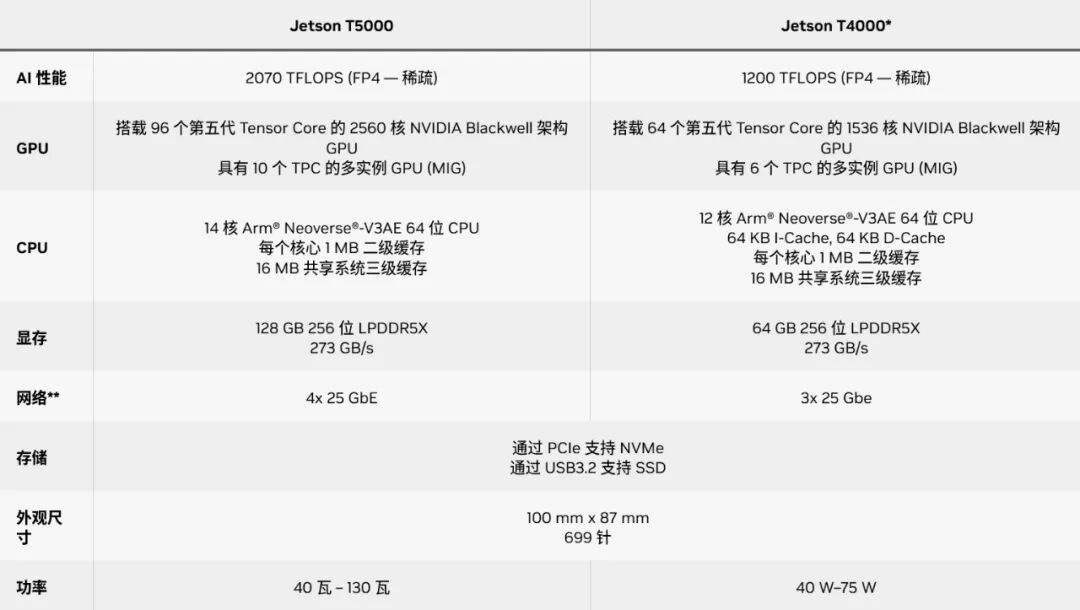
NVIDIA stated that the AI computing capability of the latest Blackwell architecture GPU in Jetson Thor is 7.5 times that of the previous generation, reaching up to 2070 FP4 TFLOPS, with a power consumption of 130W, and energy efficiency 3.5 times that of the previous generation. Additionally, Thor’s memory capacity has doubled to 128GB, with a memory bandwidth of 273GB/s.
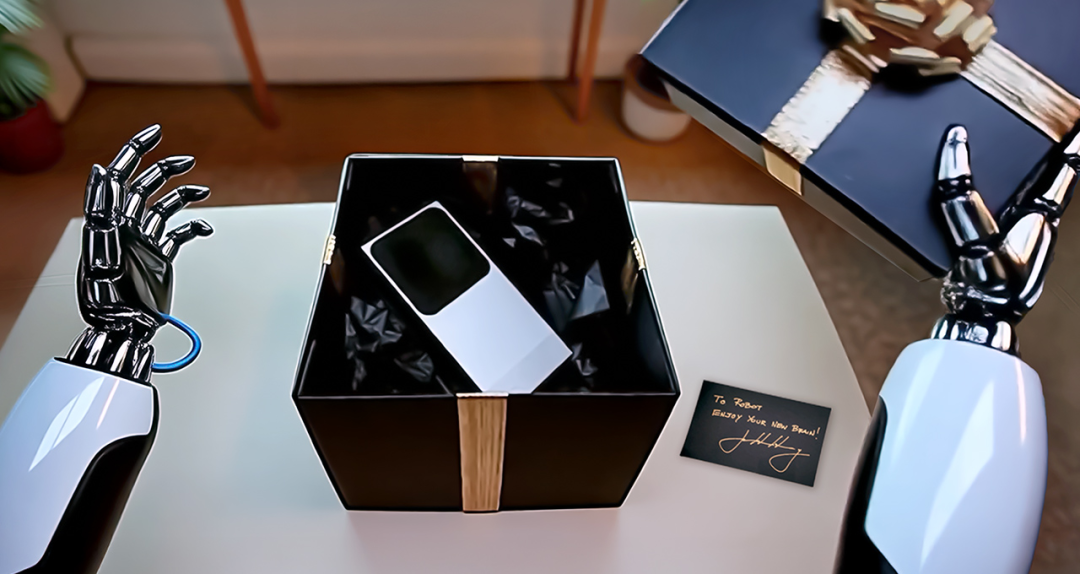
All these new features are designed to unlock high-speed sensor data and visual reasoning based on edge processing, enabling humanoid robots to better observe, move, and make decisions autonomously.
More specific configurations are as follows:
Jetson Thor is designed for inference of generative AI models, supporting the next generation of “physical AI” agents. These agents are powered by large transformer models, visual language models (VLM), and visual language action models (VLA), capable of running in real-time on the edge, minimizing reliance on the cloud.
On the software stack side, the tools accompanying Jetson Thor meet the demands of real-time applications for low latency and high performance, supporting all mainstream generative AI frameworks and AI inference models, with significant real-time performance advantages. These models include general models such as Cosmos Reason, DeepSeek, Llama, Gemini, Qwen, and robot-specific models like Isaac GR00T N1.5, allowing developers to quickly conduct model experiments and run inferences locally.
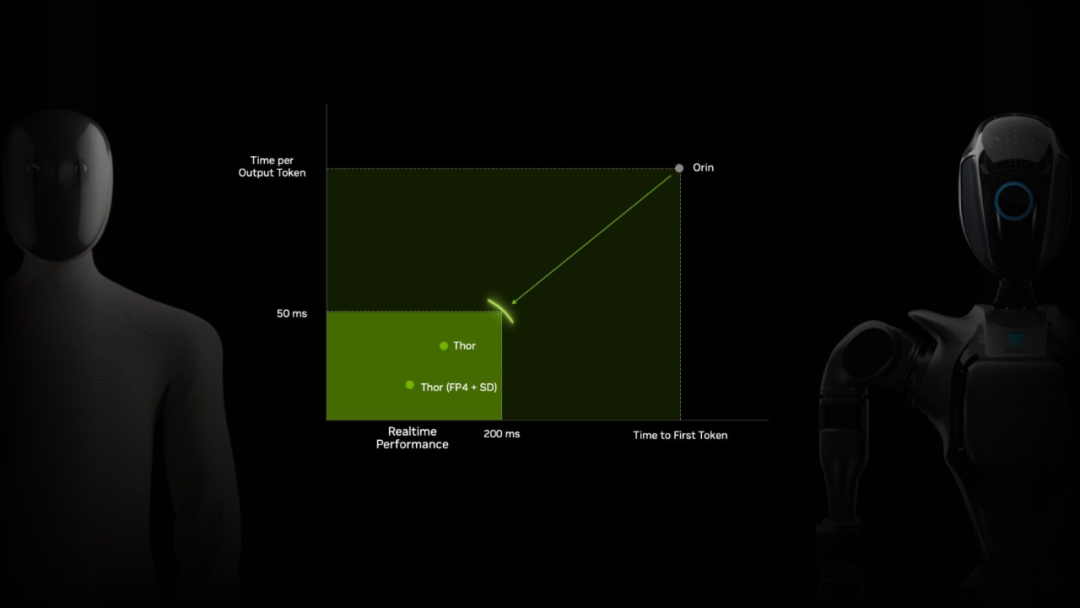
NVIDIA stated that through FP4 precision and speculative decoding optimization, the performance of Jetson Thor is expected to be further enhanced.
Jetson Thor also supports running the complete NVIDIA AI software stack, accelerating nearly all physical AI workflows, covering platforms such as NVIDIA Isaac for robotics, NVIDIA Metropolis for video analysis AI agents, and NVIDIA Holoscan for sensor processing.
In NVIDIA’s vision of three computing solutions, DGX is responsible for training AI models in the cloud, Omniverse is responsible for synthetic data generation and simulation, while AGX is responsible for the actual operation of edge AI. The release of Jetson Thor can be seen as equipping the edge landscape with the latest and most powerful computing power.
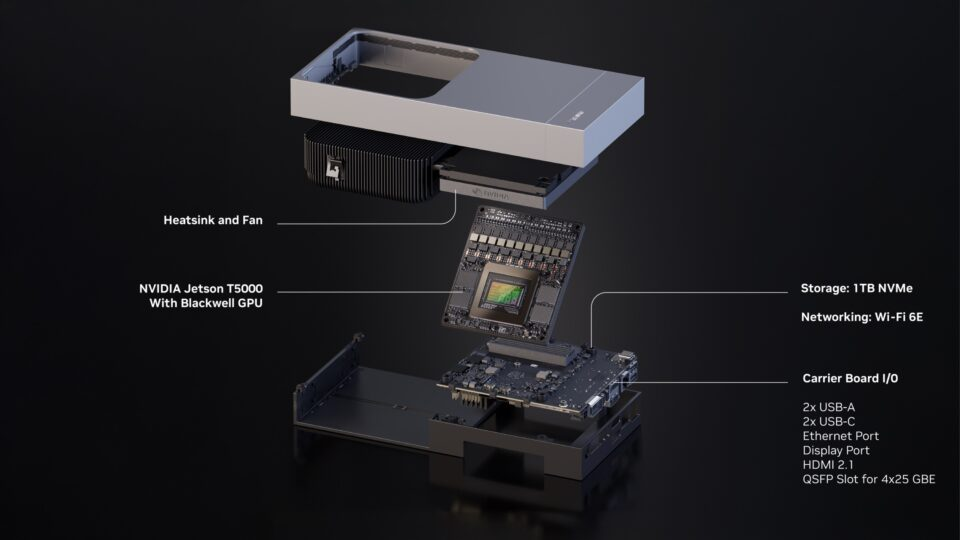
The Jetson Thor product includes a developer kit and production-grade modules. The developer kit NVIDIA Jetson AGX Thor includes the Jetson T5000 module, reference carrier board, power supply, and an active cooler with a fan, which is currently available for purchase on the company’s website, starting at $3499 (approximately 25,000 RMB), while the price for the NVIDIA Jetson T5000 module is $2999 for orders over 1000 units (approximately 21,400 RMB).
With the rise of embodied intelligence and the large-scale revolution of robotic algorithms, NVIDIA’s new computing power has already attracted significant attention from many manufacturers. Previously, at the World Robot Conference, leading domestic robotics companies such as Yushu Technology and Galaxy General Robotics announced that they would be the first to equip NVIDIA’s latest Jetson Thor chip. The Galaxy General robot Galbot showcased a series of industrial applications at the conference.
Domestic companies such as United Imaging Healthcare, Wanji Technology, UBTECH, Zhongqing Robotics, and Zhiyuan Robotics have also announced that they will be among the first to use the new generation of edge robotics computing power.
In terms of product ecosystem, hardware partners such as Advantech, Aetina, ConnectTech, Miwen Power, and Tianzhun Technology are building complete Jetson Thor systems; sensor and actuator companies such as Analog Devices, e-con Systems, Infineon, Leopard Imaging, RealSense, and Senyun Intelligent are constructing corresponding sensor components.
Meanwhile, the Nvidia Drive AGX Thor, aimed at autonomous vehicles, is also set to launch soon, with pre-orders now open, and the kit is expected to start shipping in September.
In the field of artificial intelligence, NVIDIA not only provides the foundational computing power but is also continuously producing new research. On Monday, NVIDIA researchers proposed Jet-Nemotron, a series of new hybrid architecture language models that outperform advanced open-source full attention models such as Qwen3, Qwen2.5, Gemma3, and Llama3.2, while significantly improving efficiency—achieving a 53.6 times increase in throughput on H100 GPUs.
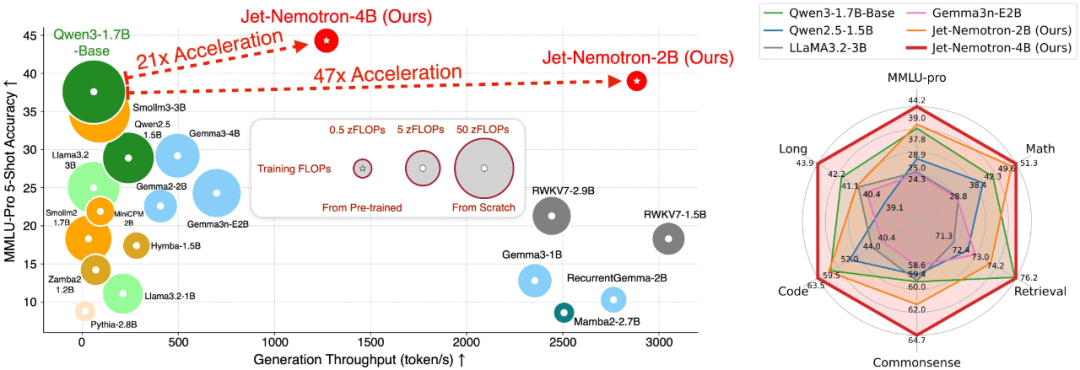
The paper “Jet-Nemotron: Efficient Language Model with Post Neural Architecture Search” can be found at: https://www.arxiv.org/abs/2508.15884
This Wednesday, NVIDIA is set to release its latest quarterly financial report, and its core position in AI development makes it a market bellwether. Currently, 40% of NVIDIA’s revenue comes from tech giants like Meta, Microsoft, Google, and Amazon, with its cloud AI chips being ubiquitous. Looking ahead, NVIDIA is betting on future trillion-dollar markets such as robotics and autonomous driving.
In June of this year, Jensen Huang stated that the future will be a decade for autonomous vehicles, robots, and automated machines. Besides AI technology, robotics will also bring the greatest growth to the company, and the combination of the two represents “trillions of dollars in growth opportunities.”
However, NVIDIA’s direction in helping people build AI has not changed. Deepu Talla, NVIDIA’s Vice President of Robotics and Edge AI, stated in a phone conference with reporters yesterday: “We do not manufacture robots or cars, but we support the entire industry with infrastructure computing and related software.”
Reference content:
https://gizmodo.com/nvidia-unveils-high-tech-brain-for-humanoid-robots-and-self-driving-cars-2000647946
https://blogs.nvidia.cn/blog/jetson-thor-physical-ai-edge/
Disclaimer:
This article is reprinted from other media for the purpose of transmitting and sharing more information. It does not mean that this platform agrees with its views and is responsible for its authenticity. The copyright belongs to the original author. If there is any infringement, please contact us to delete it.
END
Content source|机器之心Editor|高天慧Editor-in-charge|曹艺华 New media channels of the CAA

Website

Membership

Bilibili

Douyin


iQiyi

Conference

CAC
Contact Us
Address: No. 95, East Zhongguancun Road, Haidian District, Beijing
Postcode: 100190
Tel:
010-82544542 (for general affairs)
010-62522472 (for membership)
010-62522248 (for academic events)
010-62624980 (for financial affairs)
Fax: 010-62522248
E-mail: [email protected]