
Overview
The microcomputer device market mainly includes desktop computers, laptops, tablets, all-in-one computers, and embedded microcomputers, serving as the core infrastructure of the digital economy era. With the evolution of computing technology, the industry has rapidly developed from traditional personal computing devices to diversified and intelligent solutions.
Industry Characteristics
-
Driven by Technological Innovation: Improvements in processor performance, integration of artificial intelligence, and lightweight design have become key drivers for product iteration.
-
High Globalization of Supply Chains: Core components (such as CPUs, memory, displays) rely on global supply chains and are significantly affected by the international economic and trade environment.
-
Regional Manufacturing Concentration: Production capacity is highly concentrated in Guangdong, Chongqing, Sichuan, and other western and coastal provinces, forming a significant industrial cluster effect.
-
Diverse Application Scenarios: There are significant differences in demand across consumer electronics, enterprise office, education, and industrial control sectors, leading to an increase in customized products.
Market Status
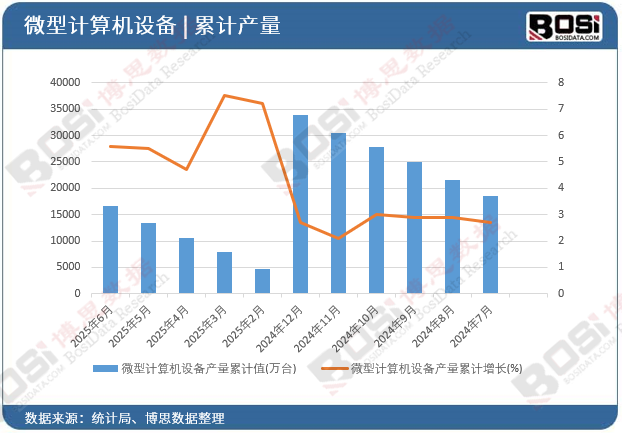
According to the report titled “Analysis of the Current Status and Investment Prospects of the Chinese Microcomputer Market from 2025 to 2031” published by Bosi Data, the cumulative production of microcomputer devices in China reached 16,645.1 million units in the first half of 2025, with a total increase of 5.6% compared to the previous year.
| Indicator | June 2025 | May 2025 | April 2025 | March 2025 | February 2025 |
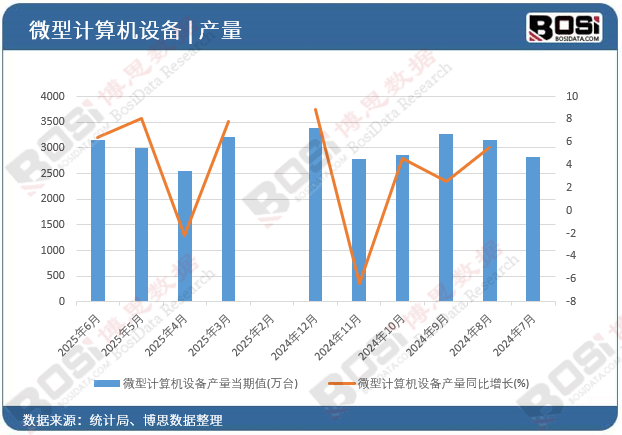
| Current Production Value of Microcomputer Devices (10,000 units) | 3159.1 | 2993.5 | 2549.1 | 3211.7 | |
| Cumulative Production Value of Microcomputer Devices (10,000 units) | 16645.1 | 13484.1 | 10491.5 | 7955.6 | 4700.1 |
| Year-on-Year Growth of Microcomputer Device Production (%) | 6.4 | 8.1 | -2.2 | 7.8 | |
| Cumulative Growth of Microcomputer Device Production (%) | 5.6 | 5.5 | 4.7 | 7.5 | 7.2 |
| For more data, please visit 【Bosi Data Official Website http://www.bosidata.com】 | Data Source: Bosi Data Compilation |
-
Steady Production Growth: The cumulative production reached 166 million units in the first half of 2025, with a year-on-year growth of 5.6%. The production in March reached 32.117 million units (current value), slightly dropping to 31.591 million units in June, but still maintaining a positive growth of 6.4% year-on-year, indicating overall robust market demand.
-
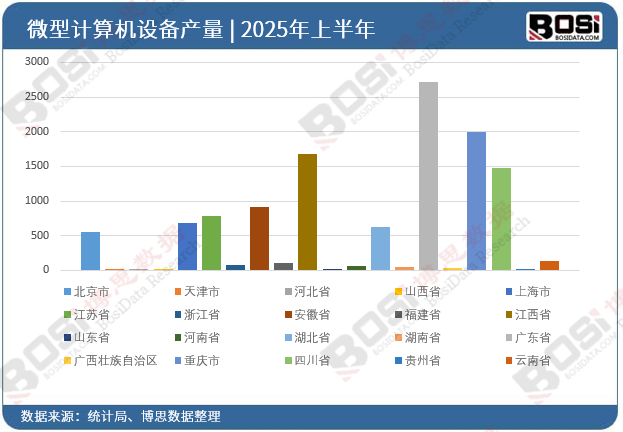
High Regional Production Concentration: Guangdong Province (7.3993 million units in June), Chongqing City (5.6930 million units in June), Sichuan Province (4.4216 million units in June), and Jiangxi Province (3.1995 million units in June) are the main production bases, collectively accounting for over 60% of the national production, with significant growth in production capacity in the central and western regions.
-
Structural Differentiation in Growth: The commercial market (such as enterprise procurement and educational informatization) shows stable growth, while the consumer side is affected by extended replacement cycles, resulting in subdued performance, although demand for AI-integrated devices is rising.
Future Trends
-
AI Integration Becomes Standard: Integration of NPUs and enhanced edge AI processing capabilities are driving the rapid adoption of AI PCs and smart tablets.
-
Application of Flexible Display and Foldable Screen Technology: Accelerating penetration in high-end laptops and tablets, creating new growth points.
-
Continued Advancement of Domestic Innovation: The application ratio of self-controlled chips (such as Loongson and Kunpeng) and operating systems (such as Tongxin UOS and Kirin) is increasing.
-
Green Computing and Energy-Efficient Design: Low-power architectures and the use of recycled materials are becoming important selling points, responding to carbon neutrality policies.
Challenges and Opportunities
-
Challenges:
-
Global chip supply fluctuations and high-end technology restrictions pose supply chain risks.
-
Weak consumer demand and extended replacement cycles suppress short-term growth momentum.
-
Intense industry competition leads to a trend of narrowing profit margins.
-
Opportunities:
-
Continuous advancement of domestic substitution in the information technology sector, with sustained demand from government, finance, and energy industries.
-
Normalization of hybrid work and online education drives stable growth in the commercial sub-market.
-
Cooperation under the Belt and Road Initiative and expansion of exports to emerging markets bring potential for external demand.
Conclusion
The Chinese microcomputer device market is at a critical transformation stage, with AI and domestic innovation becoming core driving forces. In this process, Bosi Data will continue to monitor industry dynamics, providing accurate and timely market analysis and recommendations for related enterprises and investors.
The “Analysis of the Current Status and Investment Prospects of the Chinese Microcomputer Market from 2025 to 2031” is meticulously compiled by the authoritative industry research institution Bosi Data, comprehensively analyzing the industry status, competitive landscape, market trends, and future investment opportunities in the Chinese microcomputer market from multiple dimensions. This report aims to provide precise market insights and investment advice for investors, corporate decision-makers, and industry analysts, helping to mitigate market risks and fully grasp industry dynamics.
For the complete table of contents of the report, please click on “Read the Original” below.