Understanding the Development Requirements of Unmanned Intelligent Warfare
Written by | Xu Yatao, Kong Lingjuan
Introduction
As intelligent technology increasingly integrates into military applications, unmanned intelligent warfare is rapidly developing, profoundly changing the landscape of modern warfare. This evolution triggers comprehensive changes in combat concepts, force composition, and operational methods, accelerating its evolution into a primary mode of future warfare and reshaping the fundamental nature of war. A deep analysis of the underlying logic and multiple relationships inherent in the development of unmanned intelligent warfare is crucial for understanding its evolutionary trends and constructing a new type of combat system for the future.
From a technical essence perspective, it is essential to grasp the symbiotic evolutionary relationship between “unmanned” and “intelligent” as a unified entity.
Unmanned operations represent the external form of unmanned intelligent warfare, while intelligence is its intrinsic attribute. The two are not only the two core dimensions of future combat systems but are also highly coupled and unified in combat tasks, resulting in an exponential enhancement of combat effectiveness.
Unmanned operations focus on the utilization of combat platforms, which is about “what equipment to use in battle.” This is primarily achieved through key technologies such as power systems and remote control, enabling the unmanned operation of combat platforms, reducing or even eliminating reliance on direct human control, and replacing humans in high-risk reconnaissance, frontline assaults, and nuclear-biological-chemical zones, thereby reducing casualties and expanding the operational space.
Intelligent operations focus on the penetration of intelligent capabilities, which is about “how to fight smarter.” This is mainly achieved through key technologies such as intelligent algorithms and models, enabling combat systems to possess or enhance battlefield perception, environmental adaptation, analytical decision-making, and collaborative combat capabilities, making operations more efficient, precise, and flexible. For example, intelligent algorithms can enable unmanned equipment to autonomously identify targets and dynamically adjust tactics, and can also support command systems in quickly processing vast amounts of information to generate optimal combat plans.
“Unmanned” is a significant identifier of “intelligent.” The iterative evolution of machine intelligence allows unmanned platforms to highlight the existence and value of intelligence more than manned platforms; intelligence is the inherent meaning of unmanned operations. “Unmanned” is the body, “intelligent” is the brain; “unmanned” is the form, “intelligent” is the spirit. Discussing “unmanned” without “intelligent” is merely talking about enhanced machines and mechanization without qualitative improvement. Intelligence is the core driving force behind the development of unmanned operations. The network collaboration and autonomous decision-making technologies of intelligence make unmanned swarm operations possible; unmanned operations continuously accumulate practical combat data to support the ongoing iteration of intelligent algorithms, promoting the rapid development of intelligent warfare.
From a developmental path perspective, it is essential to grasp the ladder-like leap relationship between “+intelligence” and “intelligence+” in empowering the combat system.
“+intelligence” represents a gradual “enhancement” of combat applications through the integration of intelligent technology, while “intelligence+” signifies a revolutionary “restructuring” of combat applications driven by intelligent technology. The two represent two stages and levels of the development of unmanned intelligent warfare, together forming a progressive development path from additive enhancement to core driving force.
The essence of “+intelligence” is “old system + new technology,” focusing on embedding intelligent technology into the existing combat system, processes, and equipment to enhance efficiency, precision, and autonomy. For example, equipping existing unmanned reconnaissance aircraft with image recognition algorithms allows them to quickly filter valuable targets from vast amounts of imagery. “+intelligence” emphasizes solving problems at specific points, optimizing combat effectiveness incrementally without fundamentally changing existing organizational structures and combat concepts, resulting in minimal impact on existing combat systems, especially organizational forms, and quick results, representing a common form of the initial stage of intelligent warfare.
The essence of “intelligence+” is “new technology driving new systems,” with the core being the complete reconstruction of combat systems, organizational forms, and combat concepts centered around intelligent technology as the origin and new driving force. In this model, intelligence is no longer a tool attached to the old system but becomes the core driving force of the entire system’s operation. For instance, “algorithm warfare” shifts the command center from traditional hierarchical command to an “intelligent hub” composed of data, algorithms, and “cloud brains,” where unmanned systems no longer operate independently or simply collaborate but form a vast, self-organizing “intelligent network.”
The transition from “+intelligence” to “intelligence+” is a process of quantitative change leading to qualitative change. “+intelligence” lays the groundwork for “intelligence+”; without the technological, data, and talent accumulation from the previous stage, there can be no comprehensive transformation in the latter stage. “Intelligence+” is the inevitable destination of “+intelligence”; once intelligent technology deeply penetrates various individual “points,” it will inevitably trigger structural revolutions on a “surface” and even “body” level.
From a force composition perspective, it is essential to grasp the gradual evolution relationship from “embedded” to “institutionalized” combat forces.
Embedded composition serves as a supplement and enhancement to manned combat forces by unmanned intelligent forces, while institutionalized composition signifies that unmanned intelligent forces become independent combat entities. These two modes reflect the gradual evolution of unmanned intelligent forces from auxiliary to dominant forces.
“Embedded” refers to using unmanned systems or intelligent units as enhancing forces, assigned or reinforced to traditional manned combat units. For example, assigning a drone platoon to an infantry battalion for reconnaissance and surveillance tasks, or equipping a tank company with unmanned vehicles for supply transport and frontline reconnaissance. The advantage of this model lies in its rapid integration, quickly compensating for the shortcomings of manned forces, forming an immediate combat capability of “1+1>2.” However, its limitation is that unmanned systems must adapt to the rules and rhythms of manned systems, constrained by the needs and boundaries of the supported manned forces, making it difficult to fully utilize the unique advantages of unmanned systems in sustained operations, high-risk breakthroughs, and swarm collaboration.
“Institutionalized” refers to the establishment of independent combat forces centered around unmanned systems, such as forming specialized unmanned combat brigades, unmanned boat squadrons, or even robot units composed entirely of intelligent unmanned systems. This model signifies the elevation of unmanned forces from auxiliary tools to combat entities. Its advantage lies in the ability to tailor new tactics, command processes, training outlines, and support systems around the characteristics of unmanned systems, focusing on leveraging the disruptive potential of unmanned swarms, autonomous collaboration, and distributed operations, enabling specialized and systematic construction and application.
“Embedded” and “institutionalized” will coexist in the current and future periods. As the reliability and intelligence of unmanned systems improve and costs decrease, their combat tasks will expand from support to main combat roles, transitioning from scattered assignments to organized deployments. In the long run, “institutionalization” will be the inevitable direction.
From a system operation perspective, it is essential to grasp the relative coupling relationship between the “small system” of unmanned intelligent warfare and the “large system” of joint operations.
Unmanned intelligent warfare can form an internally circulating, highly collaborative “small system” while deeply integrating into the joint operations “large system” to maximize system effectiveness. Its “independence” and “integration” are key to constructing future new combat systems.
The “small system” of unmanned intelligent warfare operates relatively independently. A typical unmanned combat system composed of various unmanned aerial vehicles and ground unmanned vehicles can construct an agile collaborative combat loop supported by a cyber information system, far exceeding traditional cross-service coordination. It can operate independently when performing specific tactical tasks without necessarily integrating into the joint operations “large system.” However, before the proportion of unmanned intelligent forces reaches a high level, the “small system” often has a high dependency on the “large system.” For example, its intelligence needs to be fused and verified with multi-source reconnaissance data from satellites, early warning aircraft, etc., its actions require precise coordination in time and space with manned aircraft, ships, and ground forces, and its survival relies on the protection of the joint operations system, necessitating integration into the “large system.”
The “small system” of unmanned intelligent warfare layers into the joint operations “large system.” This is primarily marked by its collaboration types with manned combat forces. Shallow integration involves planning collaboration with other manned combat forces, while deep integration allows for frontline tactical collaboration with manned combat forces. Deep integration is not only a physical cyber link but also involves deep interaction of data, algorithms, and command authority, requiring the dismantling of “silos” and the establishment of unified, open data standards and human-machine interaction interfaces, enabling the data obtained by unmanned systems to seamlessly integrate into the joint operations situational map, and their actions to be perceived and adjusted in real-time by joint operations commanders.
The ideal future state is “dispersed in form but unified in spirit,” where the “small system” of unmanned intelligent warfare maintains high autonomy and flexibility at the tactical level, but at the operational and strategic levels, its actions are fully integrated into the intentions and combat plans of joint operations commanders, becoming an agile, intelligent, and indispensable organic component of the joint operations “large system.”
From an evolution of confrontation perspective, it is essential to grasp the iterative game relationship between “unmanned” operations and “anti-unmanned” operations as spear and shield.
Unmanned operations and anti-unmanned operations represent the offense and defense of the intelligent era, developing according to the general law of mutual promotion in the evolution of war offense and defense, forming a cyclical evolution of “spear upgrade – shield improvement – spear breakthrough again.”
As the “spear,” unmanned systems are evolving their offensive capabilities towards greater concealment, intelligence, and clustering. Stealth penetration, low-altitude breakthroughs, and silent cruising significantly increase the difficulty of detecting unmanned platforms; intelligent empowerment enables them to possess intelligent path planning, autonomous threat avoidance, and adaptive attack capabilities targeting enemy defense weaknesses; swarm tactics, as a typical manifestation of current unmanned offense, leverage scale, cost, and dynamic dispersal advantages, placing traditional point-to-point defense systems in a dilemma of “cost imposition for countermeasures” and “saturation of firepower channels.”
As the “shield,” anti-unmanned systems have also developed diversified countermeasures, including early warning detection, a combination of soft and hard measures, and layered interception. Early warning detection integrates various means such as radar, electro-optical, radio detection, and acoustic sensors, and can quickly identify and classify drone targets using intelligent algorithms in complex background noise, forming the core foundation of anti-unmanned operations; soft kill measures include electromagnetic interference, navigation deception, and network intrusion, which are cost-effective and can simultaneously address multiple targets, making them effective against unmanned swarms; hard kill measures include laser weapons, high-power microwave weapons, and traditional kinetic weapons that can physically destroy unmanned systems, representing the ultimate means of anti-unmanned operations.
In the future, the offensive and defensive game between unmanned and anti-unmanned operations will increasingly focus on intelligent confrontation. Anti-unmanned systems will intelligently predict swarm movements, intelligently identify command nodes, and intelligently allocate interception means, while unmanned systems will rely on quantum communication encryption and swarm intelligence collaboration to form “resilient swarms” for breakthroughs. The advantage positions of both offense and defense will dynamically shift, and only by continuously seizing the high ground of intelligent technology can one maintain the initiative in the spiraling confrontation between spear and shield.
▽ This article was publishedon November 4in the PLA Daily07 edition
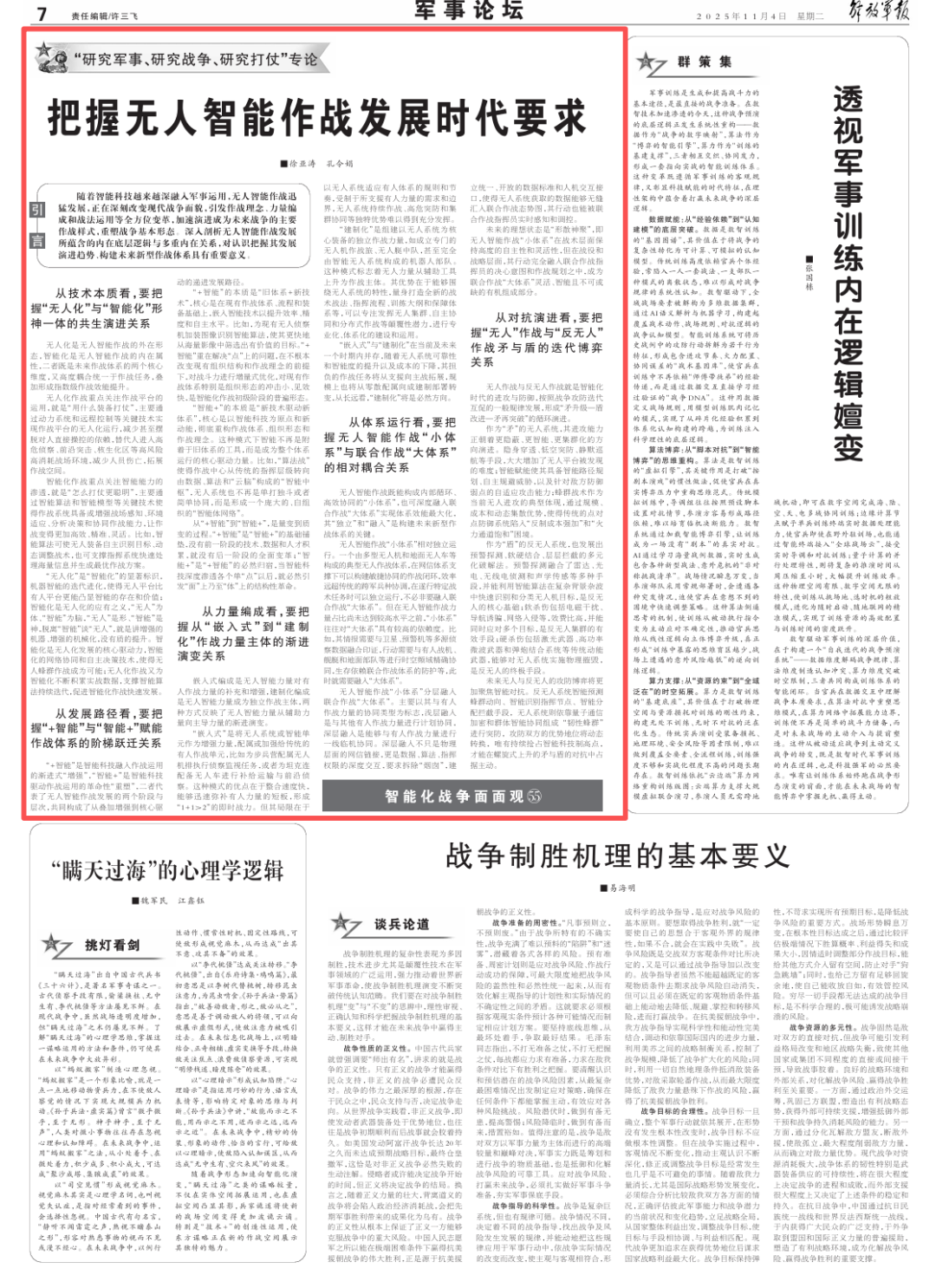
Source: PLA Daily
Editor: Xu Sanfei
WeChat Duty: Ma Yiman, Wang Chi
Review: Sun Weishuai, Zhao Zhenxue