
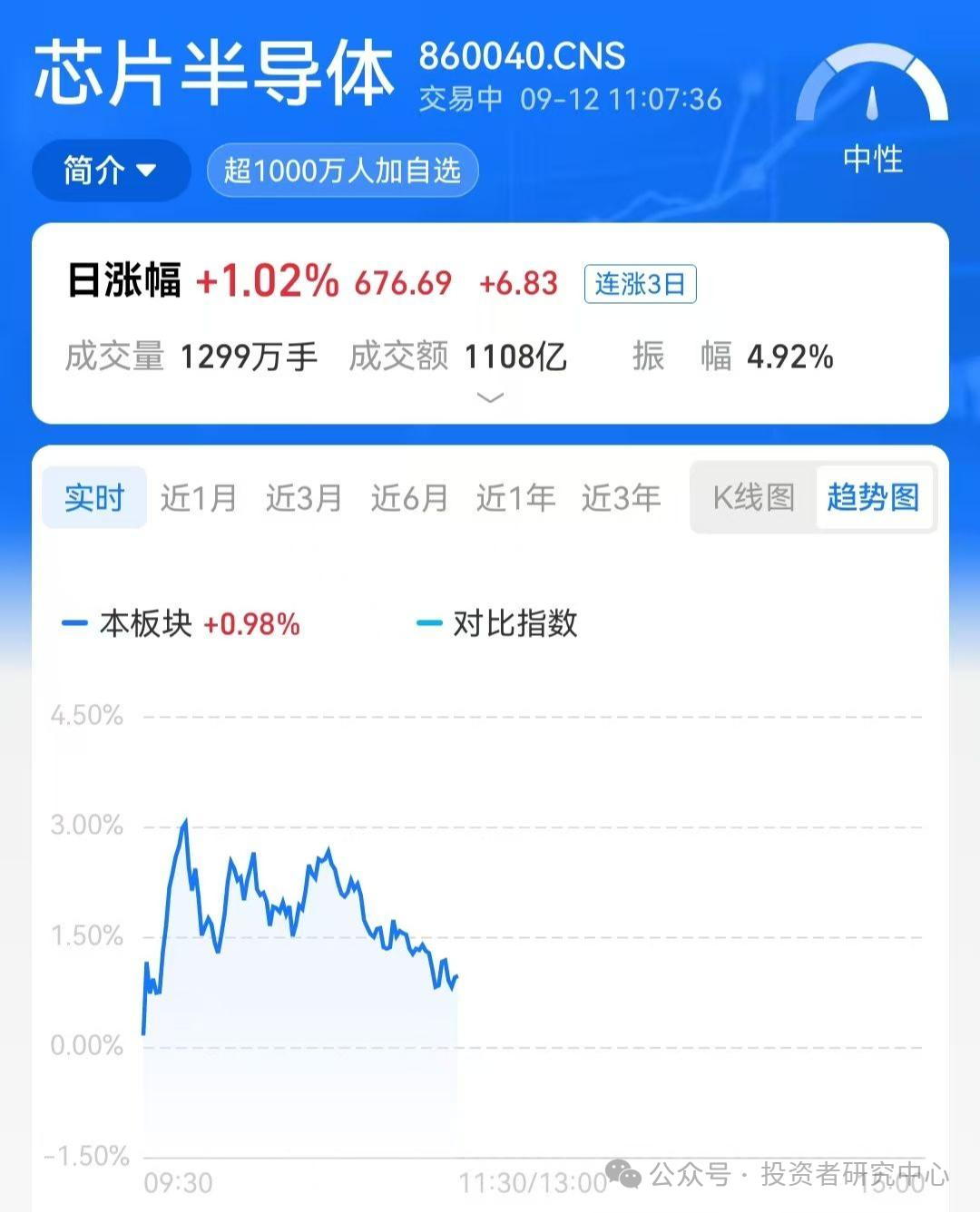
Recently, the semiconductor sector has become active again in the A-share market, with many related stocks showing strong performance, attracting considerable attention. Today’s surge is not coincidental; it is supported by the global trend of technological transformation and the reality of domestic industrial breakthroughs, intertwined with the urgency of geopolitical competition.
Globally, AI is becoming the strongest growth engine in the semiconductor industry. Chip companies represented by NVIDIA are achieving record highs in performance due to the enormous demand for high-performance computing power driven by AI training. Recently, Oracle’s financial report also showed significant growth in its cloud business revenue, benefiting from continuous investments by enterprise customers in AI infrastructure. As a key global database and cloud computing service provider and chip manufacturer, the performance of Oracle and NVIDIA indirectly confirms the strong demand from enterprises for computing power and the underlying support of semiconductors. This positive feedback loop, from chips to software and then to cloud services, is forming a more solid growth cycle, providing continuous momentum for the entire semiconductor industry chain.
However, at the same time, the uncertainty of the global supply chain is intensifying. On one hand, the forces blocking our domestic semiconductor industry are continuously escalating, from restricting high-end chip exports to tightening the supply of equipment, materials, and EDA tools, aiming to create a “chokehold” effect at critical points. This external pressure has made domestic substitution no longer an “optional choice” but a “must-answer question” concerning the security of the industrial chain.
Our market is the largest chip consumer in the world, but the dependence on imports for high-end chips, core equipment, and key materials remains very high. For example, the import dependence of some advanced process chips exceeds 90%. This structural contradiction of “large market, weak independence” has been a chronic issue for many years. Now, with the high level of attention at the national level, semiconductor self-sufficiency has risen to a strategic core, with continuous policy support—national funds are continuously invested, local support is following up, and financing channels for enterprises are also being expanded. The approval of Cambrian’s private placement and the integration of subsidiaries by SMIC are sending clear signals: industrial support is being implemented.
Moreover, it is encouraging that various links in the industrial chain are gradually achieving substantial breakthroughs. Northern Huachuang’s etching equipment has entered the international supply chain, Zhongwei’s equipment shipments have exceeded 5,000 units, Nanda Optoelectronics has achieved mass production of ArF photoresist, Jingrui Materials has made progress in photoresist technology, and SMIC has achieved a yield rate of over 98% for 14nm processes, with 28nm and above processes achieving mass production. Although these advancements may not always be in the spotlight, they reflect the true “hard work” of domestic substitution.
Of course, the semiconductor industry itself is a highly cyclical industry. Demand is influenced by multiple factors such as the macro economy, inventory cycles, and technological iterations, making fluctuations inevitable. The dramatic price fluctuations of memory chips are a typical example. Additionally, the high technical barriers, significant R&D investment, and long cycles also expose enterprises to risks such as slower-than-expected R&D progress and changes in technological routes. These factors can amplify fluctuations in the capital market.
Therefore, it is necessary to maintain a sense of calm in the face of the current enthusiasm in the sector and the “ups and downs” during the growth process. In the long run, the three major logics of AI, new productive forces, and self-sufficiency remain solid. The growth space of the semiconductor industry is undoubtedly vast, but short-term emotions may be overheated, and the back-and-forth struggle between domestic and overseas industrial forces requires psychological preparation. Of course, we can also pay more attention to the real technological progress of enterprises, the implementation of production capacity, and profitability, rather than simply chasing concepts. Against the backdrop of a positive outlook on the overall direction and trends, we can attempt to layout in batches, diversify risks, and find more stable ways to participate.
In summary, this hard battle for domestic substitution is destined to be a long-term endeavor. However, every solid breakthrough lays the foundation for the future.