Click the mini-program card below to view the original post for more content
Continuous networking refers to users obtaining wireless network access anytime and anywhere; in the case of multiple APs networking simultaneously, the network can provide seamless and continuous signal coverage. However, traditional wireless networks in campuses face issues such as coverage holes, co-frequency interference, and easy disconnections during roaming, making it impossible to achieve continuous wireless networking. Additionally, wireless data transmission often suffers from unclear transmission images due to long cable distances and low transmission rates. Huawei’s cloud campus network solution provides Wi-Fi 6 continuous coverage technology to enable Wi-Fi 6 networking, utilizing optical-electrical hybrid cables and RTU Licenses to offer long-distance, high-speed WLAN data transmission.
1. Wi-Fi 6 Continuous CoverageHuawei’s cloud campus network solution employs intelligent antennas, smart roaming technology, and multimedia intelligent scheduling technology to address the issue of continuous coverage in traditional Wi-Fi networks, achieving high-density continuous networking with no blind spots, zero dead angles, and uninterrupted roaming switching, providing industry-leading roaming performance.
2. Intelligent AntennaThere are three prominent challenges in Wi-Fi network coverage. First, edge coverage, where coverage for users at the edge of the AP is a significant challenge that needs to be overcome. Currently, most APs use omnidirectional antennas, which have limited gain; they can provide good service for nearby users but cannot serve mid to long-distance users or can only provide low throughput service. Second, covering users obstructed by obstacles and providing high throughput service is another challenge to overcome. Third, high-density scenario coverage, where multiple concurrent users in a high-density networking environment significantly increases link interference. Although downlink multi-user MIMO was introduced in 802.11ac to enhance downlink transmission throughput, providing even higher downlink transmission throughput remains a challenge.To address these three challenges, Huawei has innovatively developed intelligent antennas. Huawei’s intelligent antennas consist of multiple antennas forming an antenna array, which selects a subset of antennas for signal transmission and reception based on an antenna selection algorithm. Different combinations of antennas can create various signal radiation directions, allowing the best antenna to be selected for STAs in different positions, improving signal reception quality, enhancing system throughput, and providing better coverage service.3. Smart RoamingSmart roaming technology refers to guiding terminals to APs with better signals by collecting terminal information in mobile scenarios, thereby enhancing user experience. As shown in Figure 1, if the terminal does not switch to a better signal AP in time, the Wi-Fi signal will deteriorate, and the rate will decrease.
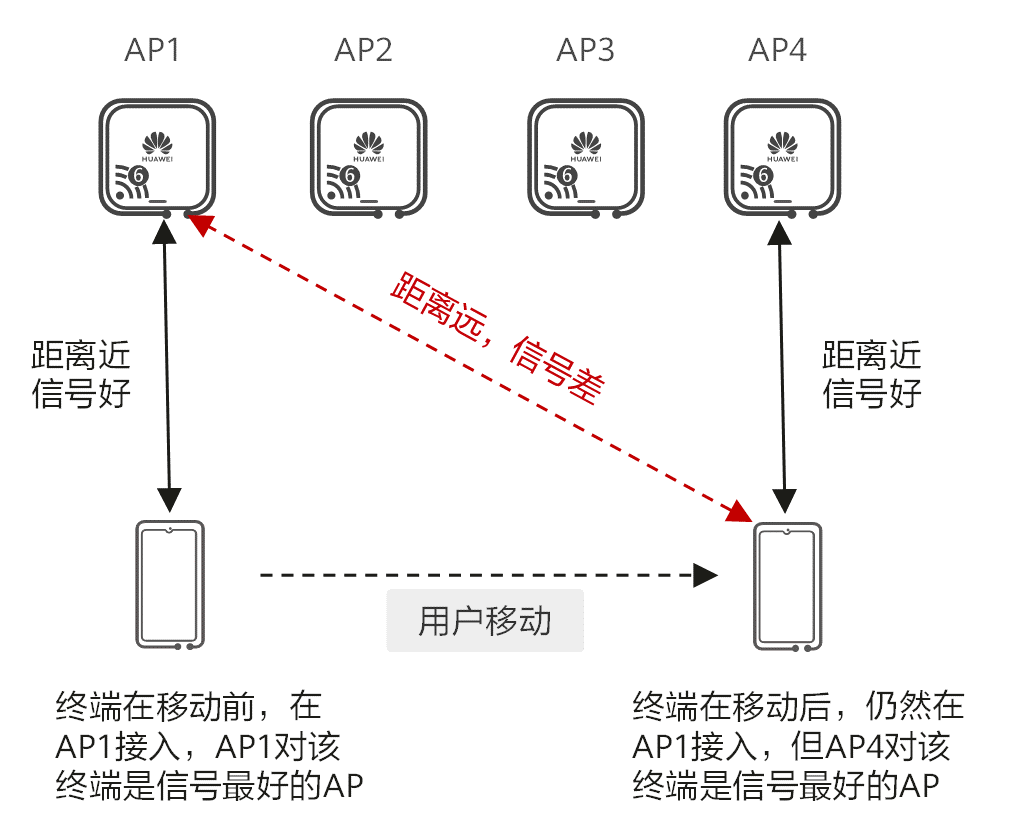 Figure 1
Smart roaming technology will switch the AP to a better signal AP through five steps when roaming occurs, as shown in Figure 2.
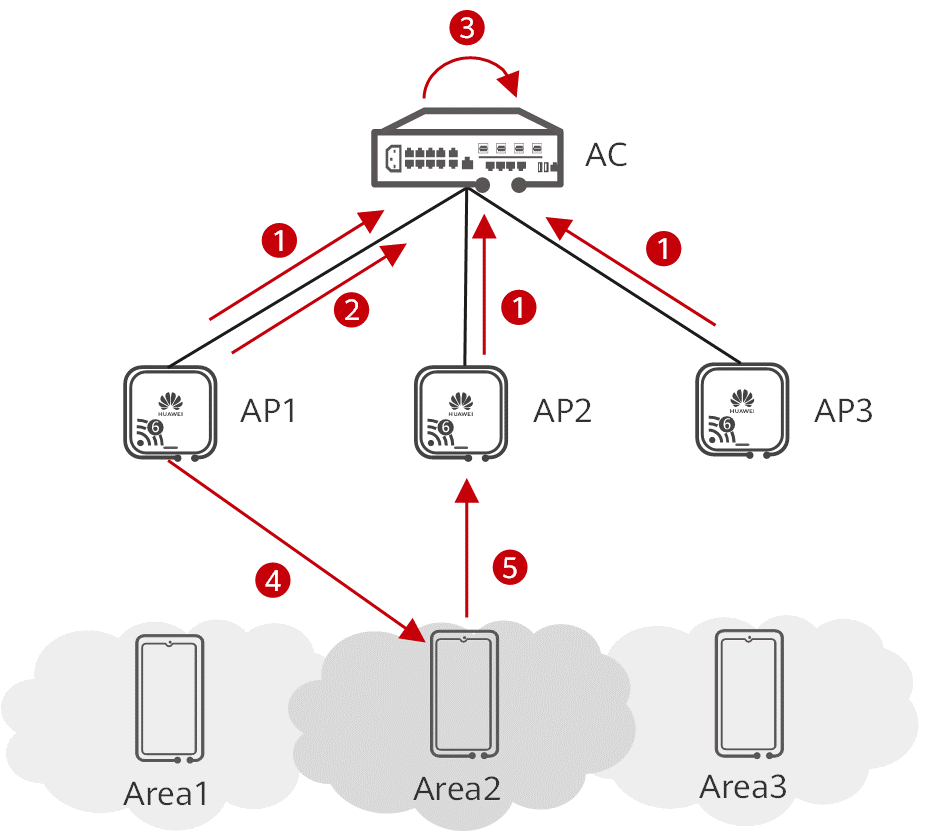 Figure 2
1) The AP reports the collected terminal information to the AC (if there is no AC, it automatically selects one AP as the Leader AP to perform the AC’s functions), and the AC records the neighboring APs and corresponding signal strengths for each terminal.2)AP1 reports the terminal’s signal information to the AC in real-time.3)The terminal moves from Area 1 to Area 2, and the AC detects that the terminal’s signal is below the threshold, determining that the optimal associated AP is AP2.4)The AC notifies AP1 that the optimal AP is AP2, and AP1 forces the terminal to go offline.5)The terminal roams to the optimal AP2, completing smart roaming and obtaining a better signal.
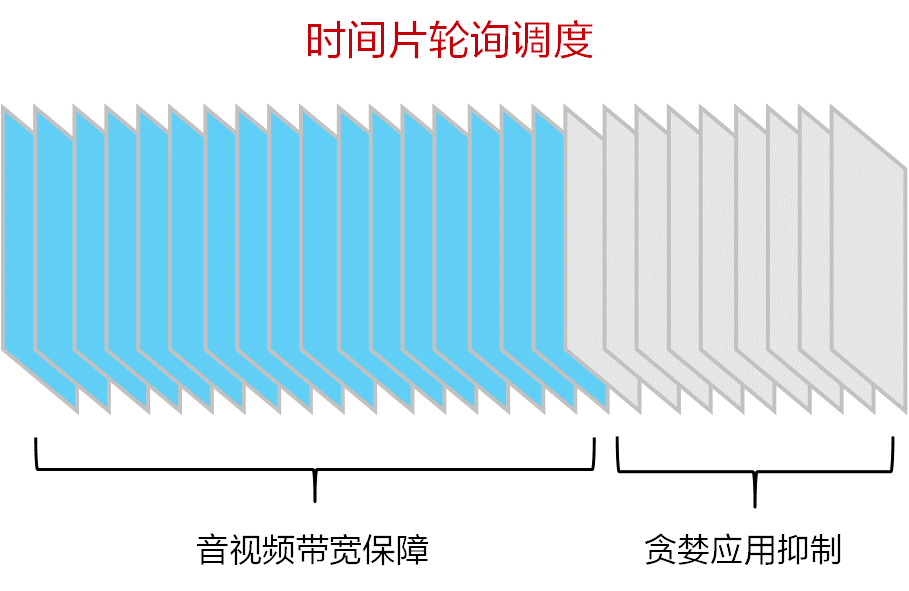
5. Multimedia Intelligent SchedulingMultimedia intelligent scheduling, also known as multimedia slicing, primarily involves dividing time-domain resources into different time slices and ensuring user experience through reasonable scheduling. In networks, there are often greedy services with no bandwidth demand boundaries, long durations, group effects, and scheduled triggering characteristics, or low-speed terminals with negotiated rates. To suppress “greedy services” from occupying large bandwidth resources and low-speed terminals from lowering the overall network rate, users will employ air interface rate limiting strategies. However, a one-size-fits-all air interface rate limiting strategy sacrifices user service experience, failing to utilize air interface resources effectively under low network load, and under high network load, it cannot distinguish between high and low user or service priorities, failing to effectively guarantee critical services.As shown in Figure 3, multimedia intelligent scheduling divides time-domain resources into different time slices, using time slice polling scheduling to suppress greedy services and low-speed terminals, ensuring bandwidth for critical services. For example, download services require a large amount of bandwidth; to ensure that time-sensitive audio and video services do not stutter, download services are rate-limited through time slice polling.
 6. Wi-Fi Data TransmissionWhen an AP connects to the campus network, it typically requires PoE power supply from the access switch using network cables, with a maximum power supply distance of 100 meters. If the distance between the AP and the access switch exceeds 100 meters, power supply will not be possible. Additionally, the maximum transmission rate of ordinary network cables is only 1 Gbps, which cannot meet the high-speed data transmission requirements of certain applications. To enhance PoE power supply distance and data transmission rates, Huawei has innovatively developed the industry’s only optical-electrical hybrid cable. As shown in Figure 4, the optical-electrical hybrid cable combines optical fibers and power lines into a single cable, allowing one optical-electrical hybrid cable to simultaneously provide PoE power supply and high-speed data transmission to the AP. The power line in the optical-electrical hybrid cable is solely for supplying power to the AP from the switch and does not transmit data; one end connects to the MultiGE port of the switch, and the other end connects to the PoE_IN power interface of the AP. The optical fiber in the optical-electrical hybrid cable is used for data transmission between the switch and the AP, with one end connecting to the SFP+ Ethernet optical interface of the switch and the other end connecting to the SFP+ Ethernet optical interface of the AP.
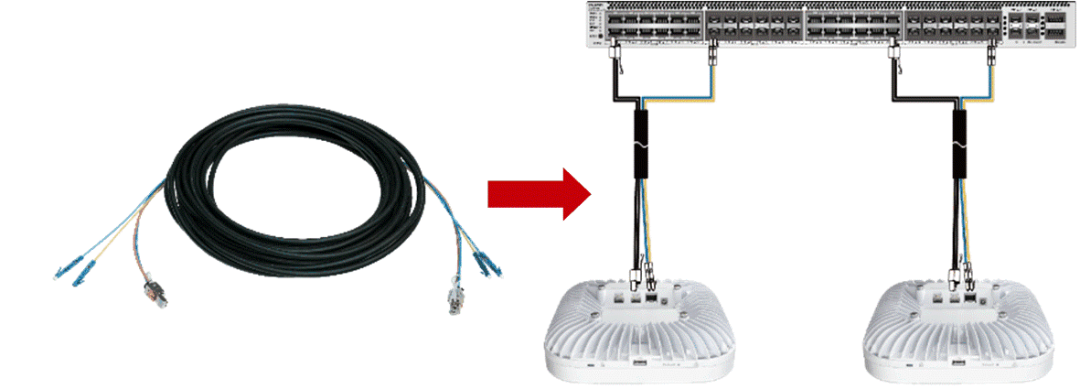 Figure 4
Furthermore, to enhance the AP spatial streams and port rates for Wi-Fi 6 data transmission, Huawei also offers the RTU License business model. Upgrading AP spatial streams and port rates only requires purchasing a software license, eliminating the need to replace hardware, thus reducing enterprises’ CAPEX. The RTU License business model can be simply described as buying a three-bedroom apartment for the price of a two-bedroom apartment, where one room is locked, and when you have the funds, you can buy the key to use it. This reduces early investment pressure and alleviates concerns about moving in the future. For enterprises, as shown in Figure 5, if previously the enterprise required a 1GE Wi-Fi uplink port and 2 AP spatial streams, as the business upgrades, the enterprise Wi-Fi uplink port needs to be upgraded to 2.5GE, and AP spatial streams upgraded to 4. At this point, the enterprise only needs to purchase the RTU License without replacing hardware devices.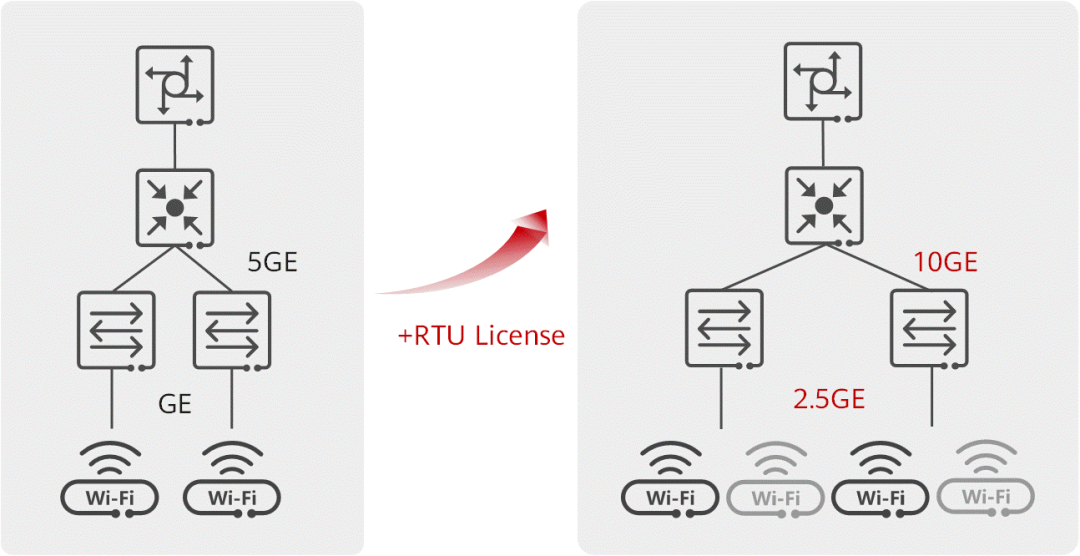
This article was originally published by Qian Kun Wei Ding QQ in the community. Reproduction without the author’s permission is prohibited.