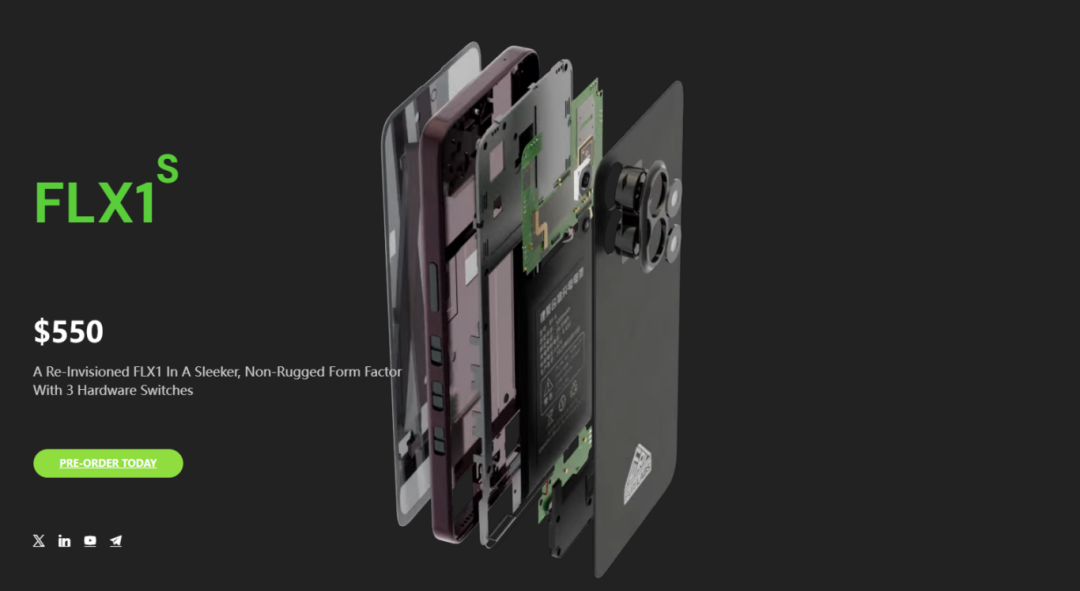
In the smartphone market dominated by iOS and Android for many years, FuriLabs has ignited interest in the niche of “Linux phones” with the launch of the FLX1s, which comes pre-installed with the Debian-based FuriOS. It supports multi-system and Android application compatibility, priced at $550, and is currently open for the second round of pre-orders, with shipments expected later this year.
What It Is: A ‘Truly Usable’ Linux Phone
The FLX1s is not a development board-style experimental device, but a phone designed for daily use: it features a MediaTek Dimensity 900 processor, 8GB of RAM, and 128GB of storage, a 6.7-inch 1600×720/90Hz display, a 5000mAh battery, dual SIM 5G, Wi-Fi 6, Bluetooth 5.2, and all mainstream connectivity specifications.
Privacy Hardware: Three ‘Physical Disconnect’ Switches
This is the most striking selling point of the FLX1s—on the side of the device, there are three hardware switches that can directly cut off the power supply to the microphone, camera, and baseband/cellular (including GPS), ensuring sensitive components are “completely muted” at the hardware level. For privacy-conscious individuals, this is more reliable than software switches.
System and Ecosystem: Debian Heritage + Multi-System/Virtualization
FuriOS is based on Debian, and the manufacturer claims it supports multi-boot (such as Ubuntu Touch),Android application compatibility, and can run other environments through KVM virtualization. The official website also promotes a unified app store experience, attempting to address the “app scarcity” issue. It is important to note that the FLX1s uses Android drivers through Halium/Libhybris, rather than a “mainline kernel” solution—this is worth understanding in advance for purists or specific peripheral support.
Key Specifications Overview
-
Processor: MediaTek Dimensity 900 (2×A78 + 6×A55)
-
Storage/Memory: 8GB LPDDR4X + 128GB UFS, supports microSD up to 1TB
-
Display: 6.7″ 1600×720, 90Hz, Dragontrail glass
-
Camera: Rear 20MP + 2MP macro; Front 13MP
-
Battery and Interface: 5000mAh, USB-C 2.0 (wired charging)
-
Network and Connectivity: Dual SIM 5G, Wi-Fi 6, Bluetooth 5.2
-
Security and Privacy: Three hardware disconnect switches (microphone/camera/baseband)
Trade-offs with the Previous Generation FLX1
If you have been following the FLX1 in 2024, you will notice that the FLX1s is thinner and lighter, with memory upgraded from 6GB to 8GB, but in many areas, it has been “downgraded”:
-
The display has changed from FHD+/120Hz to 720p/90Hz;
-
USB 3.0 → USB 2.0, limiting video output and transfer rates;
-
Removal of the 3.5mm headphone jack and IP68 protection;
-
The battery is no longer removable;
-
The camera specifications have also been downgraded. These differences are highlighted by media and comparison specifications, and if you value wired audio, durability, and high-speed data ports, you need to weigh the trade-offs.
Who Is It Suitable For?
-
Privacy Advocates: Three hardware switches + open-source stack provide a more “reliable” way to disconnect from the network/microphone/camera.
-
Linux/Development Enthusiasts: Debian ecosystem, container/virtualization, multi-boot, suitable for tinkering and customization.
-
General Consumers: If you prioritize photography, display resolution, multimedia, and peripheral compatibility, mainstream Android flagship/mid-range devices will still be more hassle-free. Media also reminds that its hardware specifications are not the strongest in the same price range.
Release and Pricing
The official price is $550, the first batch has sold out, and the second batch is now open for pre-orders; multiple media outlets report that the first batch of shipments is expected to start in October after production is completed. It is advisable to pay attention to batch and logistics arrangements before placing an order.