The Evolution of the 10.1-Inch MIPI Interface Screen Protocol
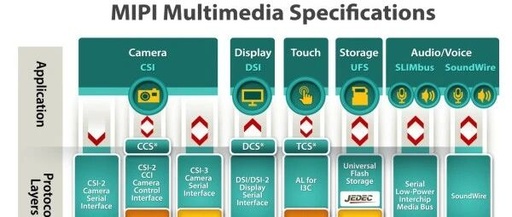
The Evolution of the 10.1-Inch MIPI Interface Screen Protocol

Old Chen is very pleased that many friends have recently added him on WeChat to express their gratitude, stating that they have benefited from his articles. Old Chen feels quite confused; as a newcomer to the screen industry, he encounters many specialized terms he does not understand; he sees many technical parameters he does not … Read more
Comparison of MIPI Physical Layer Protocols

Comparison of MIPI Physical Layer Protocols

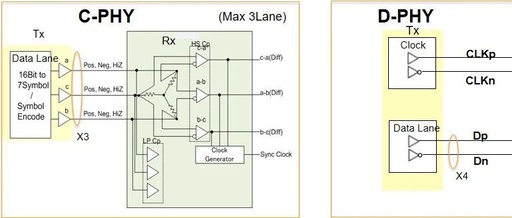
Comparison of MIPI Physical Layer Protocols D-PHY & C-PHY (3-phase) The parallel bus uses slow edge signals at low bit rates to reduce EMI (the edge rate and EMI compliance need to be verified in ATE testing). The 3-phase encoding of C-PHY requires testing for inter-symbol interference (ISI) and eye diagram symmetry. The protocol specification … Read more

Analysis of Introspect MIPI D-PHY & C-PHY DSI CSI Protocol Analyzer

Analysis of Introspect MIPI D-PHY & C-PHY DSI CSI Protocol Analyzer

The Introspect MIPI D-PHY and C-PHY Analyzer is an ultra-portable high-performance instrument that supports characterization and validation of MIPI D-PHY and C-PHY transmitter ports on the same device. The analyzer operates at speeds of up to 8.5 Gbps for MIPI D-PHY and 6.5 Gsps for C-PHY, combining analog signal measurement capabilities with complex capture and … Read more

Analysis of MIPI C-PHY/D-PHY Combination Technology

Analysis of MIPI C-PHY/D-PHY Combination Technology

Analysis of MIPI C-PHY/D-PHY Combination Technology 🚀 MIPI C-PHY and D-PHY are two PHY physical layer interface technologies used for high-speed serial data transmission, widely applied in cameras (CSI-2) and display interfaces (DSI). The C-PHY/D-PHY combination (CPHY-DPHY) can simultaneously support both standards, providing higher bandwidth, lower power consumption, and reduced system overhead. 🌟 Main Differences … Read more

Understanding MIPI: Mobile Industry Processor Interface

Understanding MIPI: Mobile Industry Processor Interface

Table of Contents: http://blog.chinaaet.com/justlxy/p/5100052503 MIPI stands for Mobile Industry Processor Interface. The MIPI protocol was introduced to address the growing demand for high-definition image (video) transmission with high bandwidth requirements, while resolving the conflicts with the low-speed rates of traditional interfaces. It aims to provide a unified standard for the entire industry, thereby shortening the … Read more

Integrated C-PHY/D-PHY IP for Camera and Display SoCs

Integrated C-PHY/D-PHY IP for Camera and Display SoCs

To meet the needs of high-definition video and images, designers of display and camera SoCs need to use high-bandwidth interfaces to allow data to be transmitted at extremely fast speeds. MIPI D-PHY and C-PHY each have advantages in meeting these requirements, but if designers can use an integrated IP solution that operates in C-PHY mode … Read more

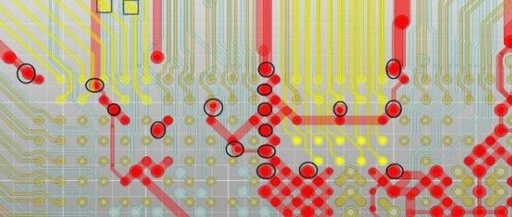
PCB Layout and Routing Requirements for MIPI-D/C PHY

PCB Layout and Routing Requirements for MIPI-D/C PHY

MIPI (Mobile Industry Processor Interface) is an industry specification designed for mobile devices such as smartphones, tablets, laptops, and hybrid devices. The common physical (PHY) layers are MIPI D-PHY and C-PHY. MIPI D-PHY: It is more commonly used for the cameras and displays of smartphones due to its flexibility, high speed, low power consumption, and … Read more