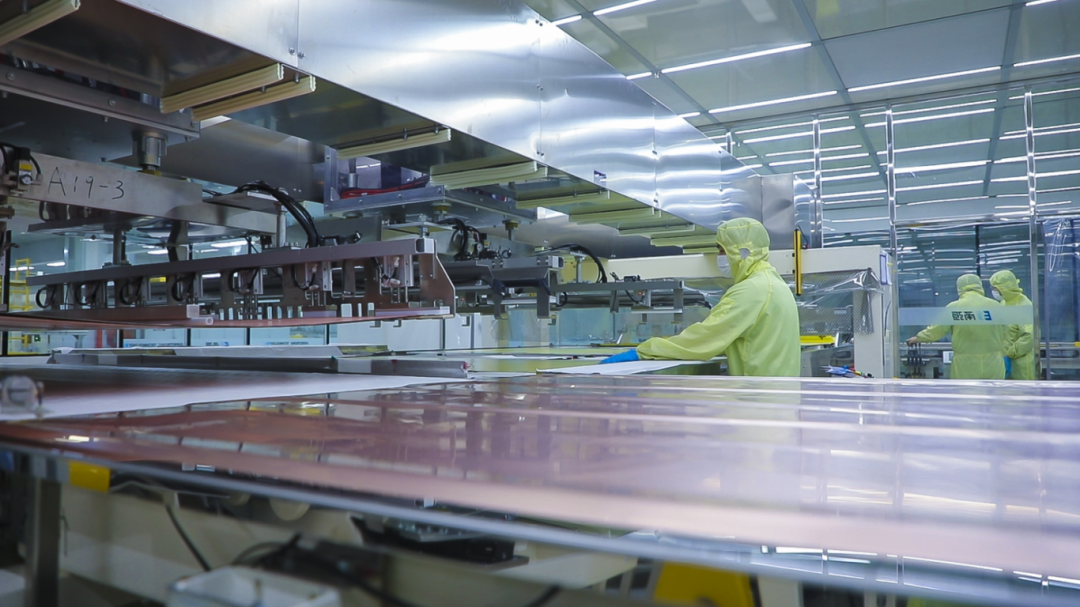
(Above) In the production workshop of Yongqiang Technology, staff combine electronic-grade copper foil, prepreg, and steel plates, sending them into the press for lamination.
As a primary functional material for electronic device motherboards, high-frequency and high-speed copper-clad laminates act like a precise “nervous system,” bearing the responsibility for information transmission in fields such as 5G communication, artificial intelligence, and data centers. Their performance directly determines the speed and quality of signal transmission—just a high-frequency and high-speed copper-clad laminate with a thickness comparable to that of A4 paper can significantly impact the communication efficiency of the entire system.
Ningbo Yongqiang Technology Co., Ltd. (hereinafter referred to as “Yongqiang Technology”) has been deeply engaged in the high-end copper-clad laminate market since its establishment in 2019, earning the title of “highway designer” in the chip field. Through continuous innovation, the company has independently developed low-loss and ultra-low-loss high-speed/high-frequency integrated circuit board materials with internationally leading levels, covering key areas such as IC substrates, high-end display substrates, and high-speed high-frequency substrates, and has been recognized as a national-level specialized and innovative “little giant” enterprise and a provincial-level innovative enterprise.
After six years of dedicated research and innovative breakthroughs, Yongqiang Technology has delivered impressive results in the field of high-frequency and high-speed copper-clad laminates.
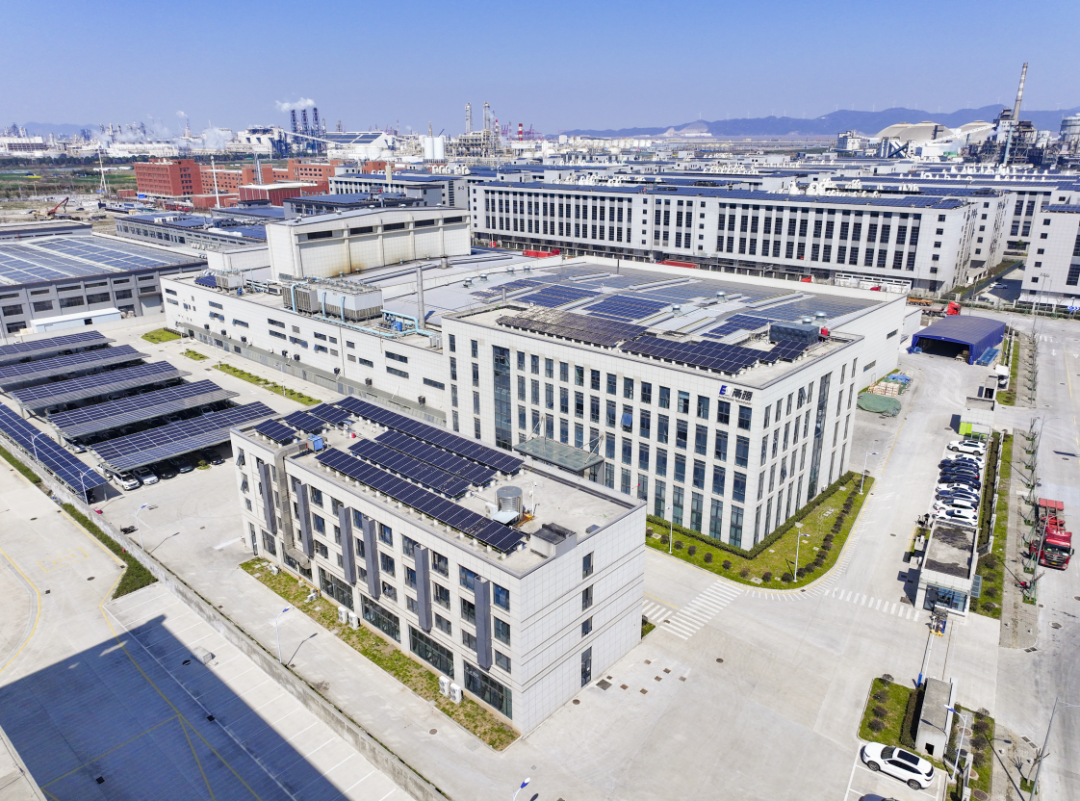
(Above) The exterior of Yongqiang Technology.
Breaking BarriersCarving a “New Path” in the Patent Jungle
In Yongqiang Technology’s dust-free workshop, production lines operate at high speed, with rolls of glass cloth and copper foil undergoing dozens of processes such as coating, combining, and laminating, transforming into shiny high-frequency and high-speed copper-clad laminates.
High-frequency and high-speed copper-clad laminates are materials made by impregnating special resins into a reinforced material matrix, covering one or both sides with copper foil, and then processed through precision hot-pressing techniques to create a partially insulated, partially conductive material.
“The high-speed material we are currently producing is called ‘Gallop 8Q’, with a dielectric loss of less than one-thousandth, and a signal transmission speed of up to 224 gigabits per second, which is four times that of ordinary materials, allowing for the download of a 4K movie in one second, placing it at the forefront internationally,” said Tang Yanchun, Chief Scientist of Yongqiang Technology and a PhD in Materials Science from the University of Tokyo, with pride in his voice. This star product not only boasts superior performance but also significant cost advantages. Compared to foreign products with similar performance, Gallop 8Q is approximately 30% cheaper, and since its market launch last December, it has received considerable customer recognition.
Tang further explained that dielectric loss is a characteristic of high-frequency and high-speed copper-clad laminates. It can be likened to the friction coefficient of a car on a highway—the smaller this value, the less resistance the signal “vehicle” encounters, allowing for faster transmission “speed”.
However, this glittering market has long been dominated by Japanese and Taiwanese enterprises—they have built formidable walls with deep technical foundations and thousands of core patents.
In 2019, Yongqiang Technology emerged in response to this situation. The company’s founder recalled, “At that time, the domestic high-end copper-clad laminate market was heavily reliant on imports, especially for key materials required for high-performance servers and AI chip substrates, which were almost entirely controlled by foreign giants.” The young team at Yongqiang Technology faced a perilous path blocked by patent thorns. Tang likened it to, “They hold the majority of the ‘highway design blueprints’ for high-end copper-clad laminates, and we can only carve out our own path in the mountains and valleys.”
The resin formulation is the core battlefield of this breakthrough. “The formulation for high-frequency and high-speed copper-clad laminates involves dozens of compounds such as resins, curing agents, and fillers, and the proportion and interaction of each component can lead to exponential changes,” Tang explained. Finding the optimal combination is like navigating a chemical maze, often requiring 1 to 3 years to achieve breakthroughs.
In the early days of the startup, the laboratory was less than 100 square meters, with more than ten R&D personnel engaged in a needle-in-a-haystack approach to problem-solving. Dozens of variables and tens of thousands of permutations and combinations meant that each trial and error had to go through the complete process of “formulation—coating—hot pressing—cutting—testing,” which was tedious and lengthy.
“Behind every performance parameter are countless failed attempts,” Tang recalled. To bypass patent barriers, the R&D team not only had to thoroughly understand existing technologies but also engage in original molecular structure design and material interface innovation. “For example, in developing low-loss resins, we had to reduce dielectric loss while overcoming interface defects caused by uneven dispersion of inorganic fillers during high filling—this directly relates to the product’s electrical performance and mechanical stability.”
After overcoming numerous challenges, the dawn began to appear. In 2021, Yongqiang Technology achieved a significant breakthrough—the mass production of the S30G-A copper-clad laminate developed for the next-generation EagleStream server platform. This product reached the “ultra-low loss” level of dielectric loss and gained recognition from end customers. This marked a major breakthrough for Yongqiang Technology in the high-end high-speed materials field, achieving a “from 0 to 1” milestone.
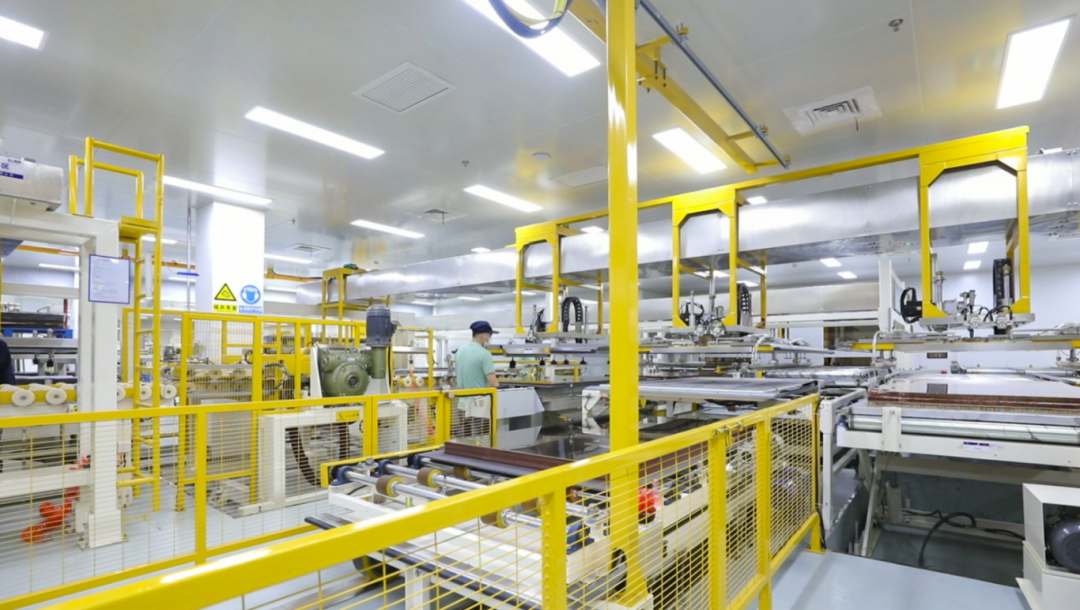
(Above) In the production workshop of Yongqiang Technology, staff separate the laminated copper-clad boards from the mold steel plates and send them to the cutting machine to be cut to the required dimensions for customers.
Focusing on InnovationFrom “Single Point Breakthrough” to “Ecosystem Matrix”
Technological breakthroughs are just the prologue.
As China’s process of intelligentization and digitization accelerates, the demand for artificial intelligence computing power continues to grow, and the market’s requirements for signal transmission rates are constantly increasing. Against this backdrop, continuously reducing the dielectric loss of high-speed materials and conquering higher-level packaging substrate material technologies have become key areas of industry competition. Yongqiang Technology realized that a single product structure could not support sustainable development, and it was necessary to build a more resilient and broader product ecosystem.
The relentless pursuit of minimizing dielectric loss drives Yongqiang Technology to continually scale new performance heights. Tang told the author that the mechanical properties, water absorption, heat resistance, and electrical performance of materials can all affect dielectric loss. “For example, when the interface between organic resins and inorganic fillers is poorly bonded, it can not only lead to a decline in the material’s electrical and mechanical properties but also cause serious issues such as ‘delamination explosion’ during the hot pressing of high-frequency and high-speed copper-clad laminates or packaging substrates. It can be said that any technical shortcoming could become a bottleneck to development.”
In response, Yongqiang Technology organized a professional R&D team to conduct in-depth analyses of influencing factors, comprehensively and deeply studying various factors affecting dielectric loss, while increasing R&D investment, spending hundreds of millions to introduce intelligent production lines, utilizing the high precision, high stability, and automation characteristics of intelligent equipment to improve the control precision of the production process and the consistency of product quality, and actively recruiting R&D talent to enhance R&D capabilities, broadening the product pool and deepening application fields. Under a clear strategic layout, Yongqiang Technology’s product matrix is accelerating formation.
“In recent years, we have successively launched six high-speed copper-clad laminates, including Gallop 7D, achieving a transformation and upgrade from traditional equipment materials to high-end equipment materials. Currently, the company has established partnerships with many enterprises, including Founder Technology and Inspur,” Tang introduced. “From S30G-A to Gallop 8Q, the product’s signal transmission speed has increased nearly fourfold.”
Company development data corroborates this growth trajectory. Yang Ying, the office director of Yongqiang Technology, stated, “The company initially had only one customer, but now has over 80 strategic partners; when it was established, the annual production capacity was only 1 million square meters, but it has now surpassed 10 million square meters. We continue to delve into the field of high-frequency and high-speed materials, raising the product yield rate to an industry-leading level of 99.2%.”
Looking to the future, Yongqiang Technology has identified market opportunities brought by the widespread application of artificial intelligence, determining high-frequency and high-speed materials and IC packaging substrate materials as development directions. Currently, the company has established an R&D production line for IC packaging substrate materials, laying the foundation for subsequent technological innovation and market expansion. Yang revealed, “Last year, the company’s output value exceeded 300 million yuan. This year, our target is to surpass 600 million yuan.” To achieve this, Yongqiang Technology is striving to tackle the next generation of high-speed materials, Gallop 9Q, and IC packaging substrate materials, I50-22LE. These products will be applied in AI servers, supercomputers, data centers, and other fields, continuously pushing forward the development of information transmission technology.
▼
Source: Ningbo Communications
 ◇ Peng Jiaxue: Seizing the Opportunities of the Times to Accelerate AI Innovation and Development◇ Our city held a meeting to promote the digital transformation of small and medium-sized enterprises◇ The 10th “Maker China” Ningbo Small and Medium Enterprises Innovation and Entrepreneurship Competition Excellent Project Showcase | Robot Empowered Precise Shaping System for Corner Vertebrae◇ News | AI Empowerment, Digital Intelligence Towards New (Issue 342)