According to ZDNet
Source: ZDNet
Semiconductor company Xilinx has recently unveiled its software-programmable chip design for data centers, which Xilinx claims is part of a new category of computing.
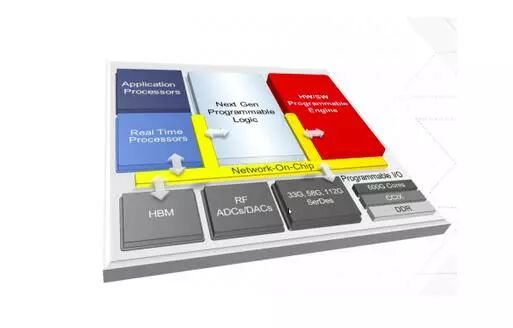
The software-programmable chip design for data centers is named the Adaptive Compute Acceleration Platform (ACAP). Xilinx states that ACAP will make highly programmable data center servers a reality, leading to exponential growth in data center performance. The technology behind ACAP may seem advanced to the average person, but Xilinx has compared the concepts used to existing chip designs.
According to Xilinx, ACAP differs from Field Programmable Gate Arrays (FPGAs) — a type of integrated circuit that can be reconfigured after manufacturing — as well as SoCs and GPUs, because “designers no longer need to use programmable logic to establish connectivity infrastructure. ACAP can be programmed using high-level languages, providing flexibility and ease of use, while offering performance and power efficiency advantages that are an order of magnitude better than CPUs. ACAP implements a software-centric design process that is fundamentally different, as all connectivity infrastructure is achieved through native software programming.”
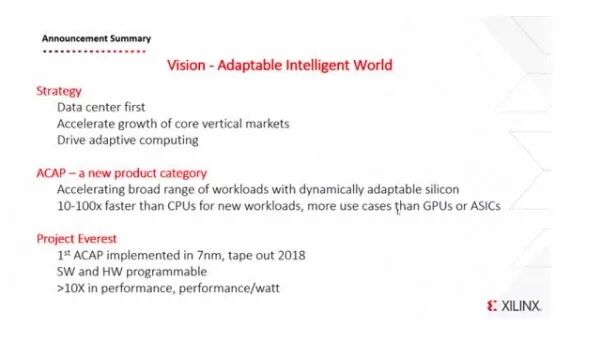
Xilinx CEO Victor Peng explained that while Xilinx’s past products have had a degree of adaptability and programmability, ACAP takes this further by allowing both software and hardware programming. This enables designers to program a wide range of applications on the same chip multiple times.
Strategically, Xilinx’s new platform targets data center customers, but the company believes that ACAP technology is also applicable to emerging markets, including 5G, automotive, aerospace, defense, and wired communications. Xilinx is aiming at future computing demands, such as those in the Internet of Things, machine learning, and artificial intelligence.
Xilinx’s move is significant. Intel’s Altera division is a competitor, with both companies developing programmable processors for edge computing, IoT, and 5G applications.
Peng stated, “Our strategy is to drive business growth in an adaptive and intelligent world. For us as a company, there is a lot of innovation in software development in data centers, and we want to support innovators in software. In the long run, focusing on developers will increase the usage of our products.”
Xilinx announced that the first ACAP product series, codenamed Everest, will be developed using TSMC’s 7nm process technology and will be launched later this year.
-END-
According to ZDNet
A platform for discussing new technologies and business models, dedicated to recording and promoting digital innovation, serving CIOs, CTOs, and other decision-makers and practitioners in technology and business.