 Banner Promotion
Introduction
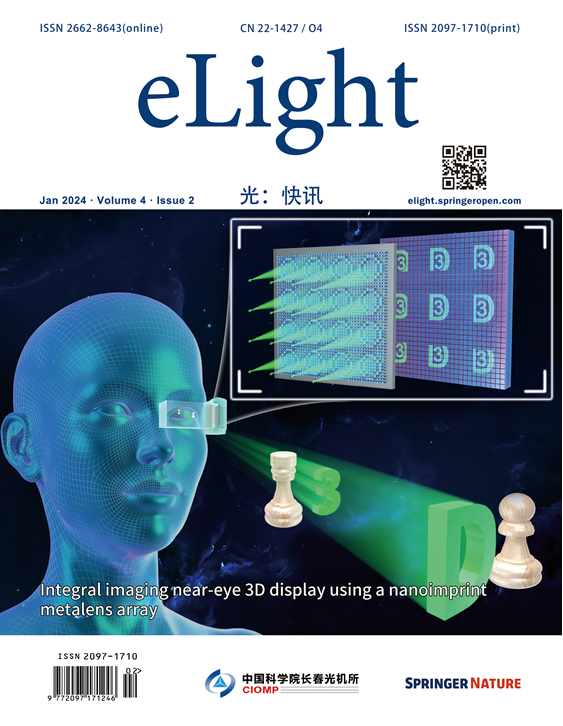
Professor Dong Jianwen and Associate Professor Qin Zong from Sun Yat-sen University reported an integrated imaging near-eye 3D display module based on a superlens array. This module adopts a novel architecture that combines a nanoimprint superlens array, a high pixel density micro-display, and a low-computation real-time image source algorithm, showcasing a perspective AR effect for video-grade true 3D near-eye display. It features monocular focus depth cues, eliminating the conflict between human eye convergence and accommodation, and is expected to advance the application of metamaterial optical technology in the next generation of VR/AR.
This achievement was published in the journal eLight, titled “Integral Imaging Near-eye 3D Display Using a Nanoimprint Metalens Array.”
Integrated Imaging Near-Eye 3D Display
Integrated imaging 3D display (Integral imaging, II) features full color, full parallax, quasi-continuous light fields, and hardware feasibility. More importantly, it can achieve true 3D display and more realistic depth perception by eliminating the vergence-accommodation conflict (VAC), making it one of the most promising true 3D display technologies. The integrated imaging technology consists of the recording process and the image reproduction process: the recording process typically samples the spatial and angular information of light emitted from objects simultaneously through a microlens array, with the recorded images referred to as the elemental image array (EIA). Currently, elemental image arrays are mostly generated using specific image source algorithms through computer ray tracing.
Elemental image arrays are displayed on micro-displays, and based on the principle of reversible light paths, 3D light emitted from the object can be reconstructed via the microlens array, allowing for the reproduction of realistic 3D images.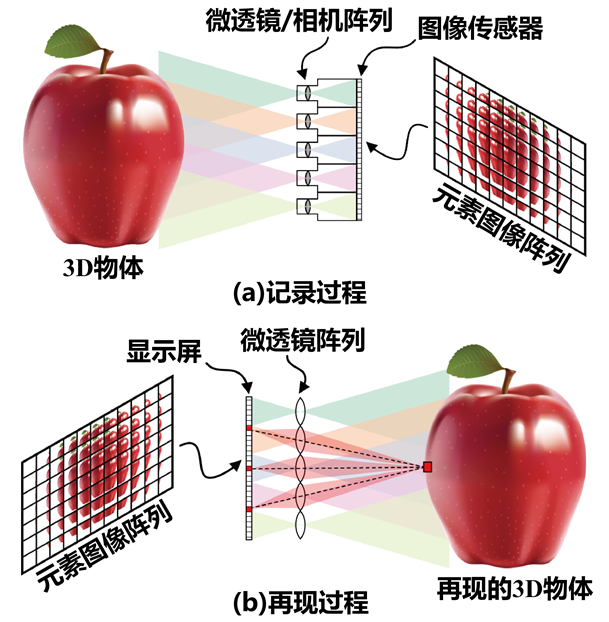
Figure 1: Schematic of Integrated Imaging Principle
The traditional optical architecture for integrated imaging near-eye 3D display usually employs microlens arrays as the core light control elements, which are limited in resolution, field of view, and depth of field. Especially with the development of existing commercial micro-displays, the pixel density of the screens is increasing, requiring light control elements to have more precise light control capabilities. However, traditional optical architectures based on microlens arrays face significant technical bottlenecks in pixel-level light field modulation. Metamaterial optics has the potential to break through these bottlenecks. A superlens array, as a new type of ultra-thin planar optical element, is a two-dimensional planar nano-array composed of many sub-wavelength micro-nano structures arranged in specific artificial combinations according to specific functional requirements, providing unprecedented design flexibility and the ability to perform pixel-level light field manipulation across multiple dimensions such as amplitude, phase, and polarization. The new integrated imaging near-eye 3D display architecture based on the superlens array (referred to as Meta-II near-eye display architecture) is expected to create more immersive experiences, advancing toward the next generation of virtual reality (VR) and augmented reality (AR).
However, to realize the new Meta-II near-eye display architecture and overcome the limitations caused by traditional optics, several key technical issues still need to be addressed. Firstly, the superlens array, as the key light control device of the Meta-II near-eye display, must not only match the high pixel density of existing commercial micro-displays in terms of focusing resolution but also match the size and optical extent (etendue) of commercial micro-displays. Currently, the superlens arrays are too small to combine with existing commercial micro-displays. Achieving large-area superlens arrays requires the integration of large-area high-precision nano-fabrication technology, with targeted design based on their process materials and line widths, while the development of nanoimprinting technology provides a good candidate. Secondly, the elemental image rendering algorithms for integrated imaging displays require ray tracing calculations for each viewpoint, which are computationally intensive. Currently, parallel computing based on GPUs is typically used to accelerate real-time rendering. However, near-eye displays have a very high demand for convenience, especially for high-resolution wearable near-eye displays, making it difficult to apply GPU-based computing platforms. Therefore, optimizing the integrated imaging algorithm is also essential to achieve video-grade Meta-II near-eye displays. Fortunately, recent advancements in nano-manufacturing and integrated imaging algorithms have provided possibilities for the realization of Meta-II near-eye displays. With the resolution of these fundamental issues, Meta-II near-eye displays are expected to develop rapidly, offering a more realistic virtual reality experience and advancing the development of VR/AR display fields.
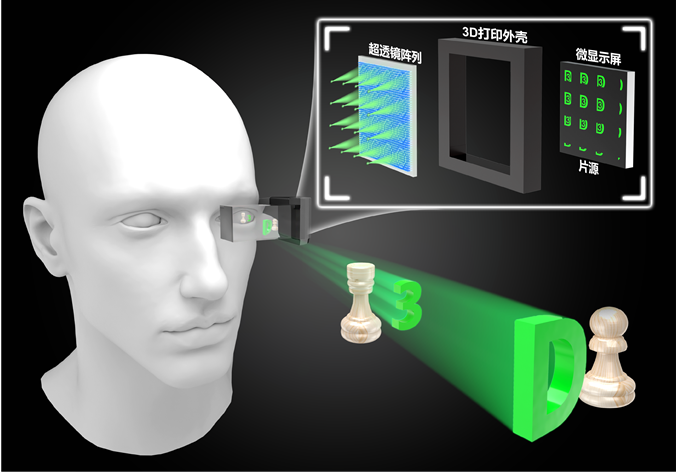
Figure 2: Schematic of Integrated Imaging Near-Eye 3D Display Based on Superlens Array
Integrated Imaging Near-Eye 3D Display Based on Superlens Array
To address the above issues, the superlens optical near-eye display team led by Professor Dong Jianwen and Associate Professor Qin Zong at Sun Yat-sen University has achieved a new Meta-II near-eye 3D display architecture, combining metamaterial optics and integrated imaging displays for the first time, developing the Meta-II near-eye display module for application in near-eye display fields. This Meta-II near-eye display module mainly includes a high pixel density commercial micro-display and a large-area superlens array. The superlens array is fabricated using high-precision large-area nanoimprinting technology, utilizing high refractive index imprinting materials, with a minimum line width of less than 100nm and a structural thickness of about 500nm. Compared to electron beam lithography, nanoimprinting technology can quickly mass-produce samples of superlens arrays, especially large-area samples. This low-cost large-area nanoimprinting manufacturing process also makes mass production of metamaterial lens arrays feasible. To match this Meta-II near-eye display architecture, the team developed a new real-time rendering algorithm that utilizes the invariant voxel-pixel mapping relationship, achieving an average rendering speed of 67 FPS without using additional computing devices such as GPUs. The Meta-II near-eye display module achieves perspective depth adjustment effects by fusing 3D images with surrounding objects, demonstrating its wide potential in the AR field.
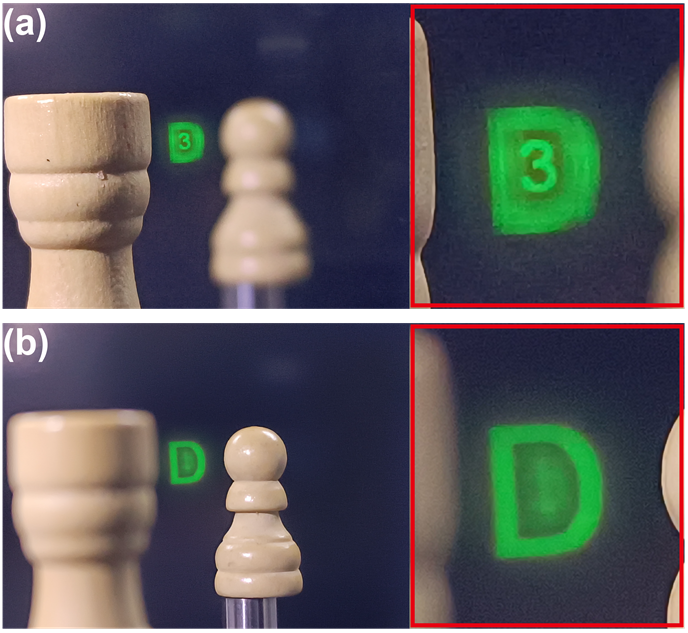
Figure 3: 3D Effect Diagram of Meta-II Near-Eye Display Module
Future Prospects
This research team was the first to develop a true 3D display Meta-II near-eye display by combining superlens arrays, micro-displays, and integrated imaging algorithms. Notably, the design flexibility of the superlens array is expected to solve several long-standing issues in traditional optical architectures. For instance, true 3D near-eye displays require clear 3D images to cover both the “personal space” from several centimeters away to the “far view space” several meters away. However, the optical depth of field of traditional microlens array architectures is very limited. In contrast, superlens arrays can utilize their polarization multiplexing light field control characteristics to greatly extend the depth of field. Furthermore, the Meta-II architecture can provide feasible solutions for near-eye display angle expansion, precisely compensating for aberrations in large-angle imaging through the free phase design of the superlens array. More importantly, compared to the Meta-II proposed in this study, both depth of field expansion and field of view expansion do not add extra complexity and cost in terms of computational complexity, system volume, and component fabrication. In summary, superlens arrays will contribute to the next generation of true 3D near-eye displays.
Paper Information
Fan, Z., Cheng, Y., Chen, Z. et al. Integral imaging near-eye 3D display using a nanoimprint metalens array. eLight 4, 3 (2023). https://doi.org/10.1186/s43593-023-00055-1Supervised by: Sun Tingting, Zhao YangEdited by: Zhao Wei
👇 Follow Me 👇
Light up “Like” and “See” so you won’t miss updates on the article