In 2014, Lenovo’s acquisition of IBM’s x86 server business and Motorola Mobility’s smartphone business attracted widespread attention in the industry. However, note that the acquisition amounts were only $2.3 billion and $2.9 billion, respectively. At the end of last year, a merger involving $16.7 billion did not receive much attention domestically. In fact, the acquirer was the renowned Intel, which acquired Altera, a leading FPGA manufacturer. What does this mean? What kind of sparks will the collision between FPGA and CPU create?
With such questions in mind, we conducted an exclusive interview with Mr. Andrew Walsh, Senior Director of Data Center Marketing at Xilinx, who shared his latest insights on the development of the FPGA industry with us. Previously, Walsh served as Senior Director of Enterprise and Data Center Marketing at Nvidia.
 Andrew Walsh, Senior Director of Data Center Marketing at Xilinx
Q: How do you view the future development changes in the FPGA market? Will FPGA still play the role of a coprocessor for Intel CPUs, Power, and ARM processors?
Walsh: Undoubtedly, FPGAs are increasingly being used in conjunction with CPUs to accelerate applications. Compared to the term “coprocessor,” the term “programmable accelerator” is a more accurate description of FPGA’s role.
FPGAs from Xilinx are increasingly targeting application scenarios in x86, POWER, and ARM server clusters. One benefit is that, depending on the type of application, multiple FPGAs can work simultaneously with a single CPU, significantly accelerating applications beyond what a coprocessor can achieve.
Q: Why are FPGAs widely regarded as advantageous for handling workloads in machine learning, image and video processing, data analysis, storage database acceleration, and network acceleration? What are their advantages? What is their relationship with CPUs?
Walsh: The entire industry is optimistic and enthusiastic about these application scenarios because all the workloads you mentioned are extremely important for network and cloud service providers. In recent years, the rapid emergence of these new workloads has triggered a surge in overall computing demand.
In the large data centers of cloud service providers, the computational demands of these application workloads are rapidly exceeding the annual growth rate of CPU performance. Faced with these rising computational demands, traditional CPU methods are encountering performance ceilings. Therefore, using FPGAs as accelerators has become a highly attractive approach. Multiple low-power FPGAs can be paired with a CPU to double or even more the performance of these applications, enhancing the overall throughput of data center applications. Furthermore, the increasing maturity of programming tools and libraries is attracting more application developers to the FPGA platform.
Q: What signal does Intel’s acquisition of Altera convey? Is it mainly aimed at IoT applications? What changes will occur in the computing (CPU) field in the future?
Walsh: Intel’s acquisition of Altera indicates the importance of developing new computing methods. To continuously improve performance generation after generation, traditional CPU methods are reaching their limits, and even Intel acknowledges this situation. This limitation applies to IoT applications but is more broadly applicable in the computing field. In data center and enterprise computing, storage, and networking applications, FPGAs are likely to become increasingly common.
Q: What role will FPGAs play in distributed storage and network virtualization in the future?
Walsh: The role of FPGAs is to provide companies creating storage and network innovative solutions with faster time-to-market, better overall products, and development costs. Achieving high-performance architectures for scalable storage, implementing storage-class memory solutions, and accelerating network function virtualization (NFV) are key areas where you will see product innovations supported by Xilinx FPGAs.
Q: Can you discuss the prospects of FPGA and Unikernel?
Walsh: It is evident that cloud computing is a transformative force, influencing data center design everywhere. The rapid growth of compute-intensive workloads has brought more industry attention to the demand for acceleration in data centers. At the same time, this is driving innovation in virtualization and manageability. Unikernel is one such example.
In the short term, it is unclear how Unikernel and accelerators will interact in large-scale cloud deployments. Since Unikernels are specialized, they are not always ideal choices for multi-user and general applications.
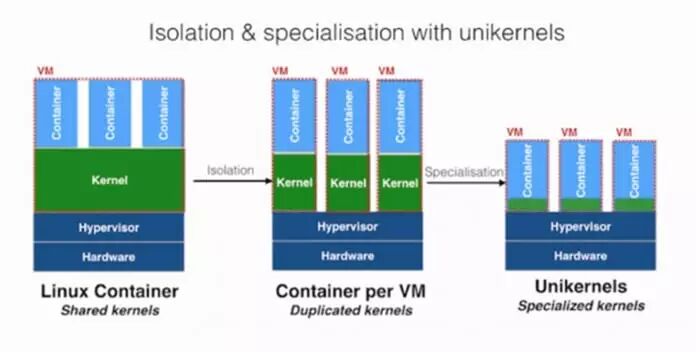
Note: About Unikernel:
Unikernel has been referred to as a technology with built-in nuclear weapons by QingCloud CEO Huang Yunsong. Huang predicts that FPEA + Unikernel will play an important role in the future, even replacing CPUs (see: Destroying Traditional IT, Leaving No Stone Unturned). In this article, Mr. Andrew Walsh did not use such radical language, only stating that it belongs to the innovation in virtualization and manageability. For the relationship between Unikernel, Containers, and Virtual Machines, see the diagram below.
Hive, China’s largest commercial and enterprise-level self-media alliance. “From IT, I” is a core member of the Hive self-media alliance.
Welcome to subscribe: