
In the ICT field, hardware markets that can maintain triple-digit growth are rare, and edge computing servers are one of them.
According to IDC consulting data, the edge computing market in China grew rapidly in 2021, with demand for edge servers increasing by as much as 266.3%; it is expected that investment growth in edge computing power will significantly outpace that in core locations, with global spending on edge servers expected to increase from 14.4% to 24.9% by 2025.
In addition to the super high year-on-year growth, the penetration rate is also noteworthy. Jeffrey Moore, in his book Crossing the Chasm, believes that there exists a “technology adoption lifecycle” in the high-tech industry—before the penetration rate exceeds 14%, it can be classified as an early market, and during the process of expanding from the early market to the mainstream market, a significant chasm must be crossed.
Many once-popular technologies have disappeared into the annals of history because they could not cross this hurdle. Edge computing, which is currently in an explosive period, will also attempt to make the “thrilling leap” to the mainstream market in the coming years. What are its chances?
Based on past experience, the best path to the other side consists of flagship product solutions, strong leading manufacturers, and solid practical cases. Currently, product solutions centered around edge servers are increasingly taking shape, with practical results based on edge scenarios across various industries demonstrating significant effectiveness, and leading companies in the first echelon are showing a forward-looking spirit.
According to IDC’s 2021 China Edge Computing Server Market Tracking Report, Inspur’s edge servers ranked first in the market with a market share of 40.9%, a year-on-year increase of 368.4%, surpassing the market average growth rate. By examining the development trajectory and path choices of Inspur’s edge servers, one might find the correct way to open the explosive period of edge computing.
The Driving Force Behind the Rapid Growth of Edge Computing
In a sense, edge computing is not a sudden emergence but a derivative of the collaborative explosion of emerging technologies such as 5G, the Internet of Things, and artificial intelligence, which, once born, also reflexively act on related technologies, jointly promoting the continuous upgrade of ICT infrastructure.
In an era where the cloud defines everything, edge computing resembles a decentralized magician, physically moving computing resources to the location where data is created, thereby significantly enhancing the efficiency of obtaining data insights and enabling intelligent business processes and decision-making instantaneously outside the core IT environment.
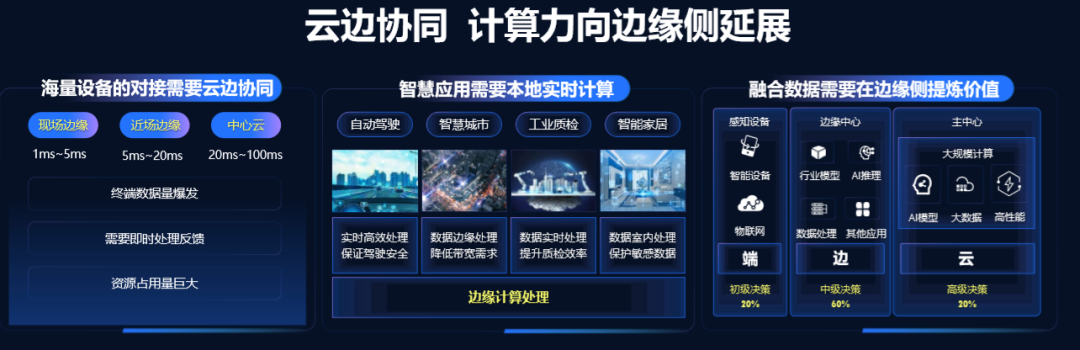
As the potential of edge computing is often closely related to the digital transformation of industries, countries around the world are increasing their policy support and investment in edge computing. The 14th Five-Year Plan for Digital Economy Development clearly proposes to promote the coordinated development of cloud and network and the integration of computing and networks, as well as to build edge computing facilities for specific scenarios and deploy edge data centers on demand.
From an industry perspective, domestic sectors such as electricity, energy, manufacturing, and transportation are accelerating the deployment of edge computing infrastructure to enhance production operations and resource utilization efficiency. For example, intelligent power grids can use edge computing and IIoT to control power distribution and optimize power supply; oil companies can use edge computing technologies for predictive maintenance of oil rigs, achieving remote operation and maintenance; non-ferrous metal companies utilize edge computing and AI to promote upgrades in metallurgical processes, achieving comprehensive business innovation.
According to Liu Xiangnan, senior product manager of Inspur’s edge computing product line, when Inspur established a team specifically targeting the edge computing market, it set seven major business directions for focused expansion—ICT integration, new generation CDN, smart connected vehicles, industrial Internet, industry + AI, urban governance, and smart IoT. These scenarios harbor significant demand for edge computing and are the core focus for mainstream manufacturers during the market explosion.
The Path to Breakthrough for Inspur’s Edge Servers
Being the first to embark on the explosive point of new technologies, which is what many manufacturers dream of achieving to “win at the starting line,” is indeed an important factor affecting the ranking. However, very few can truly accomplish this.
For server manufacturers, the evolution of new technologies over the past five to six years has been tumultuous, and a moment’s inattention could lead to missed opportunities. The year 2016 marked the explosion of AI, and Inspur seized the market opportunity to layout intelligent computing ahead of others; in 2017, as heterogeneous computing power extended to the edge, Inspur quickly integrated resources scattered across different business units and established a dedicated team to focus on edge computing.
Scattered distribution and uneven demand are pain points for edge computing, as many scenarios cannot achieve economies of scale and thus miss out on the fresh fruits of edge computing. Inspur actively promotes the standardization process, jointly developing edge server design standards OTII with the Open Compute Project, and has released the industry’s first edge server NE5260M5 based on this standard.
As a benchmark pioneer, NE5260M5 not only meets the standards of data centers and communication rooms, adapting to edge scenarios such as MEC and NFV for communication users, but also, through optimized signal transmission, structural cooling, and power supply designs, is compatible with high-power CPUs, GPUs, FPGAs, and SmartNICs, continuously winning multiple championships in MLPerfTM AI inference performance testing, providing flexible and ultimate AI computing performance for edge inference scenarios and promoting the rapid penetration of edge computing technology.
To cope with the harsher environments and more diverse computing architectures in edge scenarios such as manufacturing and transportation, Inspur has defined a new modular design architecture for edge computing, ECOM, which decouples core computing platforms, heterogeneous acceleration platforms, and IO modules, achieving standardization and modularization, allowing various functional modules to be flexibly combined like building blocks to adapt to diverse and differentiated edge scenarios, providing reference standards for upstream and downstream partners.
This is an important step in moving edge computing from the chaotic explosive period to a diffusion growth stage, and it equally requires groundbreaking product breakthroughs. The edge microserver EIS800, based on the ECOM architecture, plays this role and recently won the 2022 Red Dot Award for its outstanding industrial design and flexibility.
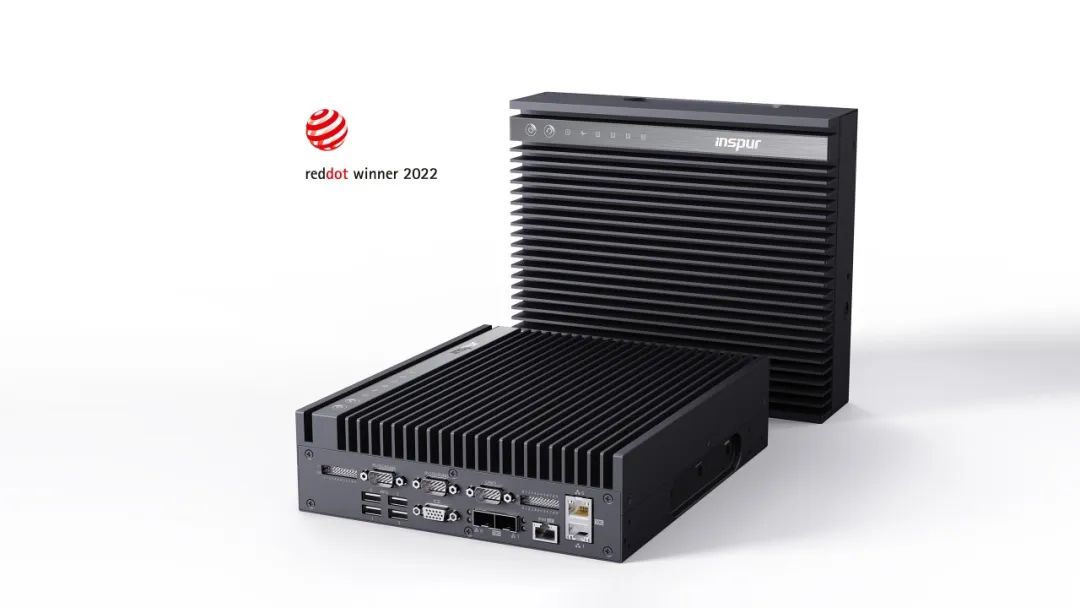
According to Fu Changzhao, senior hardware architect of Inspur’s edge computing product line, the industrial design inspiration for EIS800 comes from a romantic story: the designer, while at home on the weekend, heard his wife playing the accordion. He approached and found that the accordion’s classic vertical stripes and button layout on one side were very simple, meeting industrial design requirements and possessing a strong sense of technology. Later, EIS800’s heat sink design and the arrangement of buttons, indicator lights, and logo all drew inspiration from the accordion’s characteristics.
Modular design is another significant advantage of EIS800, which can be flexibly combined into three types of computing node forms for indoor, outdoor, and micro data center applications based on user needs, adapting to various edge scenarios. For example, in smart factories: the indoor node of the edge microserver is compact, meeting the needs for intelligent operation and maintenance of factory equipment and real-time management of production data; the outdoor node can withstand extreme environmental temperatures and has IP65-level waterproof and dustproof features; and the micro data center node can be deployed based on multi-node stacked desktop micro data centers and two-node spliced rack-level micro data centers, supporting more complex smart factory management.
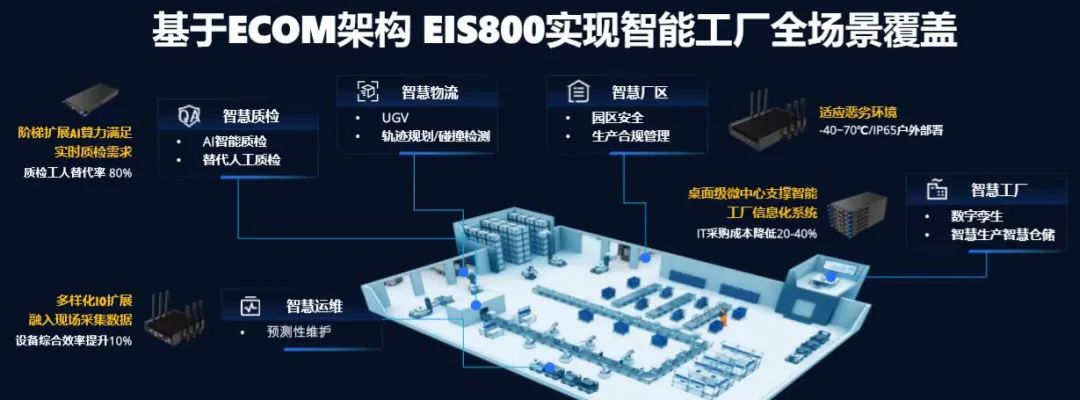
Comprehensive Expansion of Edge Computing Landing Scenarios
It is evident that establishing industry standards and creating benchmark products are powerful tools for Inspur’s edge servers to break through market ice, while expanding landing scenarios and accelerating penetration processes are good strategies for achieving healthy development.
Currently, Inspur has a complete family of edge computing products, including edge micro data centers, edge servers, portable AI servers, and edge microservers, featuring flexible architecture, extreme cooling design, inference capabilities, and seamless cloud-edge-end collaboration, achieving remarkable results in manufacturing, energy, transportation, and communication industries—from global bearing giants’ smart factories, Asia’s largest offshore wind farms, to smart intersections in the Guangdong-Hong Kong-Macao Greater Bay Area and smart parking lots at Tokyo Institute of Technology, providing abundant edge computing power for various scenarios.
To address the issue faced by Tokyo residents of “5 minutes driving, 2 hours parking,” Inspur has collaborated with the Tokyo Institute of Technology to develop an AI + edge smart parking project, which has officially launched in over a hundred parking lots. This system provides lower latency, higher computing speed, and safer edge computing power for AI inference scenarios such as vehicle recognition and road environment perception, enabling various vehicles to park and pay intelligently and quickly, while also providing real-time detection of abnormal conditions such as fires, smoke, and long-term occupation of parking spaces, ensuring the safety and smoothness of parking lots and surrounding roads.

The digitalization and intelligent upgrading of the manufacturing industry is a grand stage for edge computing to demonstrate its capabilities. Inspur, in collaboration with a leading bearing manufacturer in South Korea, has developed an intelligent manufacturing solution for bearings, playing a crucial role in improving the quality and production efficiency of bearing products. For instance, in intelligent quality inspection: industrial cameras capture the geometric parameters of bearings to create 3D images, which are then classified and inspected by Inspur’s edge microserver EIS200 on the production site, achieving an accuracy rate of 98% in extracting product faults, with a defect leakage rate of less than 330 ppm, three times the accuracy rate of manual extraction.
The transformation of traditional resource companies towards low-carbon and intelligent directions is also a new scenario for edge computing. Inspur, in collaboration with an oil company, has developed a smart monitoring solution for oil wells based on the edge microserver EIS200. The edge microserver can perform real-time diagnostic inference of oil well production conditions, intelligently predict the working state of the pump, adjust its operating frequency to save 80% of idle electricity costs, and achieve remote operation and maintenance through intelligent fault warnings, reducing on-site labor costs by 70%, realizing smart and green oil extraction.
Liu Xiangnan, senior product manager of Inspur’s edge computing product line, believes that edge servers will continue to maintain high growth in the coming years, with ICT integration, industrial Internet, and industry + AI scenarios releasing strong momentum. Of course, the road ahead is still long, and the leading Inspur will continue to make efforts in resource investment and ecosystem building, becoming the winner in the long run of edge computing.🖋
Author: Guan Jian, Partner and Chief Writer of IT Creation Record: Former Executive Vice President and Executive Editor of Computer Business News, Assistant Editor of China Computer News, with over 10 years of media experience.Guan Jian has long focused on the dynamics and trends of the technology industry, having conversed with leaders of over a hundred high-tech companies, and has also served as a guest host at numerous technology conferences and forums.
—— The More You Look, The More Wonderful It Is ——
IT Creation Record focuses on enterprise-level technology ecology, strategy, and business knowledge. You can find the same named text column and IT Creation Record · Short Video column on various mainstream media platforms. If you have relevant content to share, remember to leave us a message on our official account.