 Abstract:Gastric cancer is a refractory malignant tumor, ranking fifth in incidence and third in mortality worldwide. Despite various treatment options significantly improving the prognosis of advanced gastric cancer (AGC), survival rates remain unsatisfactory. Therefore, the development of new therapeutic drugs is crucial for enhancing long-term efficacy. Antibody-drug conjugates (ADCs) are innovative and effective anti-tumor drugs composed of specifically targeted monoclonal antibodies, chemical linkers, and small molecule cytotoxic payloads.Their notable advantages are strong efficacy and moderate toxicity. However, it is inevitable that this formulation encounters resistance. This article systematically reviews the recent research progress of ADC drugs in the treatment of advanced gastric cancer.
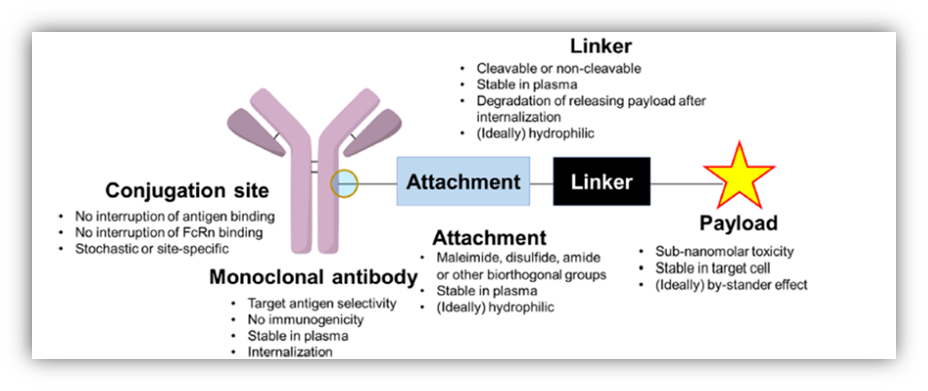 Figure 1 Basic Composition of ADC DrugsGastric cancer is a common malignant tumor that has severely threatened human health, and most gastric cancer patients are already in the advanced stage at the time of diagnosis, resulting in relatively poor prognosis. Compared to traditional medical treatments, antibody-drug conjugates (ADCs) offer better targeting, significant anti-tumor capabilities, and lower systemic toxicity, and have garnered widespread attention in recent years. ADC drugs are primarily composed of humanized monoclonal antibodies (including IgG1, IgG2, and IgG4, which effectively reduce the immunogenicity and side effects of ADC drugs), stable linkers (to ensure the structural integrity of ADC drugs, preventing early release of cytotoxic drugs, reducing off-target effects, and allowing rapid cleavage of the linker once the ADC drug is internalized), and highly effective small molecule cytotoxic drugs. The selection of corresponding targets for an ADC drug is particularly important. In recent years, ADC drugs targeting five specific targets: HER2, GCC, TROP-2, CLDN18.2, and HER3 (Table 1) have shown certain efficacy in the treatment of advanced gastric cancer; this article will review these findings.Table 1 ADC Drugs Available for Advanced Gastric Cancer Treatment
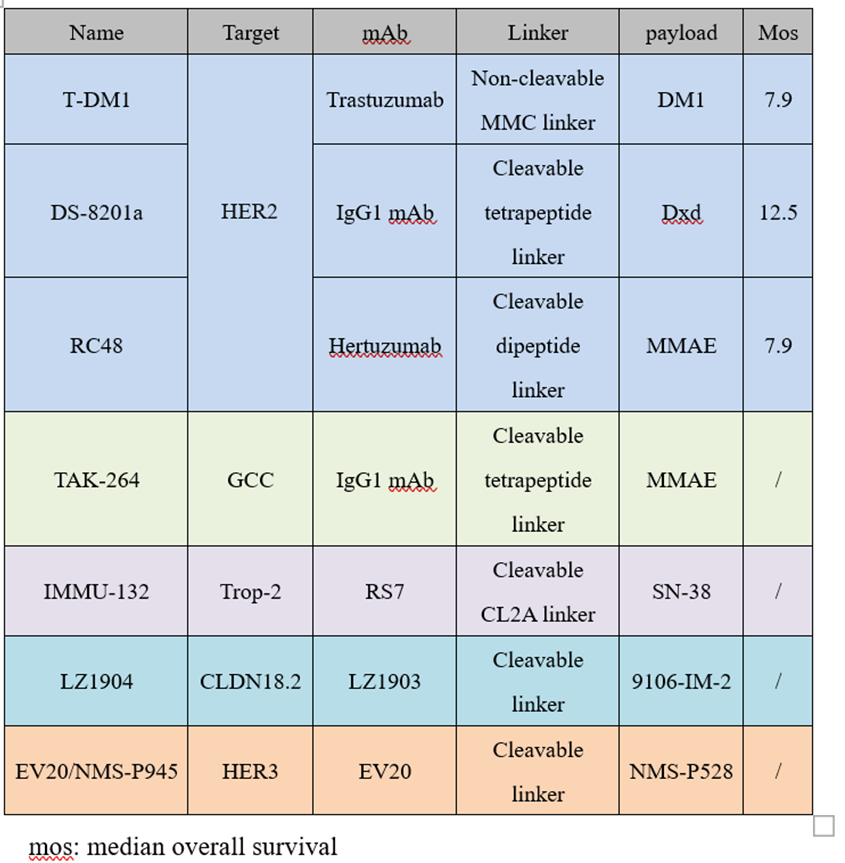 1. HER2 TargetHER2HER2is overexpressed in 15-20% of gastric and gastroesophageal junction cancers, thus many ADC drugs targeting HER2 are used for treating advanced gastric cancer, specifically including T-DM1, DS-8201a, and RC48.T-DM1 is an ADC drug targeting HER2, consisting of Trastuzumab conjugated with DM1 (a microtubule inhibitor), with a DAR value of 3.5. This drug has been approved by the FDA for the treatment of advanced breast cancer. According to II/III clinical data, T-DM1provides a median survival of 7.9 months for HER2+ advanced gastric cancer patients, with a clinical response rate of 20.6%. In terms of safety, the rate of grade 3 adverse reactions induced by T-DM1 is low (26% anemia, 11% thrombocytopenia). Overall, compared to other treatment methods, T-DM1 does not significantly benefit patients, possibly due to the heterogeneity of HER2+ expression in advanced gastric cancer.DS-8201a is another ADC drug targeting HER2, which connects the toxic drug DXd with a cleavable peptide linker, having a DAR value of 7-8. This drug has also shown good efficacy in gastric cancer patients with low HER2 expression. Results from a controlled trial against chemotherapy indicated that among the patients treated with DS-8201a (125 patients), 10 achieved CR (complete response), while the chemotherapy group (62 patients) had no CR cases. In terms of median survival, patients treated with DS-8201a had a survival of 12.5 months, significantly higher than the chemotherapy group’s 8.4 months. This indicates that DS-8201a is an effective drug for treating advanced gastric cancer patients, and it was approved by the FDA in January 2021 for treating HER2+ gastric cancer patients.RC48 is an ADC drug composed of trastuzumab linked to a cleavable dipeptide linker with a microtubule inhibitor (MMAE), with a DAR value of approximately 4. Based on a Phase II clinical trial, RC48 shows certain efficacy for low HER2+ advanced gastric cancer patients, with a median survival of 7.9 months. In terms of safety, the main adverse reactions of RC48 are neutropenia, leukopenia, and sensory neuropathy, and the rate of adverse reactions is significantly related to dosage. According to this clinical trial, a dosage of 2.5mg/kg has good safety. In June 2021, RC48 received conditional approval from the National Medical Products Administration of China for the treatment of advanced gastric cancer.2. GCC Target GCC plays an important role in regulating intestinal fluid, ion secretion, and inhibiting cell proliferation. A related study has shown that compared to normal tissues, GCC is highly expressed on the surface of malignant tumor tissues, making it a gradually emerging target for ADC drugs.TAK-264 is an ADC drug targeting GCC, obtained by conjugating an IgG monoclonal antibody through a cleavable peptide linker with MMAE. Preliminary results from animal models indicate that TAK-264 has initial cytotoxic effects on high GCC expression models. Clinical trial results show that the main side effects of TAK-264 include malignancy (41%), loss of appetite (41%), fatigue (32%), and diarrhea (27%). The occurrence rates of grade 3 adverse reactions such as neutropenia and hypokalemia are 22% and 7%, respectively, indicating that TAK-264 has good tolerability. Among the 41 enrolled patients, 1 achieved partial response, and 3 had stable disease, with the median progression-free survival (mPFS) of all patients being 44 days. This result indicates that TAK-264 shows limited efficacy for advanced gastric cancer patients; however, due to the high expression of GCC in gastric cancer, this target still shows great potential for advanced gastric cancer treatment.3. Trop-2 Target Trop-2, also known as tumor-associated calcium signal transducer 2, has oncogenic properties, promoting cancer cell proliferation and metastasis. Currently, 56% of advanced gastric cancer patients with high Trop-2 expression exhibit poor prognosis. IMMU-132 consists of RS7, the active payload SN-38, and a cleavable CL2A linker, with a DAR of 7.6. Currently, IMMU-132 is the first ADC drug approved by the FDA for treating metastatic triple-negative breast cancer. Furthermore, existing preliminary results from I/II clinical trials indicate that IMMU-132 shows certain efficacy for advanced gastric cancer patients. Another ADC drug targeting Trop-2, SKB264, has demonstrated good safety and efficacy in positive animal models of advanced gastric cancer, indicating that Trop-2 is an effective target for the treatment of advanced gastric cancer. More data is under further investigation.4. CLDN18.2 and HER3 Targets CLDN18.2 is involved in maintaining tight junctions between cells, affecting the permeability of paracellular ions. Its specific subtype characteristics make it a potential target for gastric cancer treatment. The component LZ1904 of CLDN18.2 has shown significant selective anti-tumor ability in vitro, warranting further in vivo studies. However, clinical trials for CLDN18.2 are still in the early stages.In gastric cancer patients, HER3 overexpression is associated with poor prognosis. A novel ADC targeting HER3, EV20/NMS-P945, consists of EV20; thiolindole (TEI) NMS-P528; and a cleavable linker. Preclinical studies have found that EV20/NMS-P945 exhibits good anti-cancer activity against gastric cancer cells and mouse xenograft models, indicating that this formulation may be an effective tool against HER3-expressing gastric cancer.
 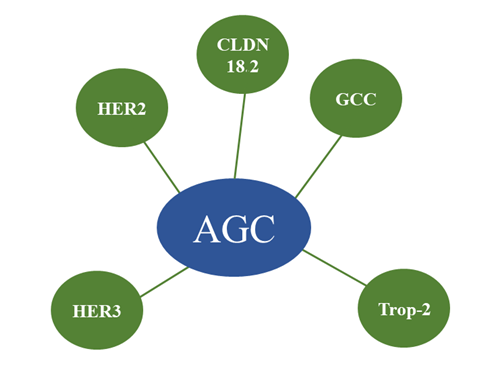 Potential Targets for Advanced Gastric Cancer Treatment Conclusion In summary, the ADC drugs targeting HER2, GCC, TROP-2, CLDN18.2, and HER3 demonstrate certain efficacy and represent significant breakthroughs in tumor treatment, being key for future advanced gastric cancer therapy. In the future, optimizing each ADC component and better understanding potential modifications can personalize and refine ADCs. The research and development of ADCs will further improve the prognosis and efficacy for advanced gastric cancer patients.
 References
[1] Wang N, Mei Q, Wang Z, Zhao L,Zhang D, Liao D, Zuo J, Xie H, Jia Y and Kong F (2022) Research Progress of Antibody–Drug Conjugate Therapy for Advanced Gastric Cancer.Front. Oncol. 12:889017.doi: 10.3389/fonc.2022.889017
[2] Shitara K , e t a l .Trastuzumab Deruxtecan (DS-8201a) in Patients With Advanced HER2- Positive Gastric Cancer: A Dose-Expansion, Phase 1 Study. Lancet Oncol (2019) 20:827–36. doi: 10.1016/S1470-2045(19)30088-9.
Scan the WeChat QR code to add the editor of the Biopharmaceutical Circle, and those who meet the criteria can join
Biopharmaceutical WeChat Group!
Please indicate: Name + Research Direction!


Copyright Statement
All articles reproduced by this public account are for the purpose of conveying more information, and the sources and authors are clearly indicated. Media or individuals who do not wish to be reproduced can contact us ([email protected]), and we will immediately process the deletion. All articles represent the author’s views and do not represent the position of this site.