Over the past few decades, electronic engineers have developed increasingly sophisticated sensors capable of reliably measuring various physiological signals, including heart rate, blood pressure, respiratory rate, and blood oxygen saturation. These sensors are widely used in the development of biomedical devices and consumer wearable technology, not only advancing related research but also enabling real-time monitoring of health-related indicators such as sleep quality and physiological stress.
Fatigue is a mental state characterized by decreased performance due to stress, lack of sleep, excessive activity, or other factors, and reliably quantifying it has always been challenging. Currently, mainstream fatigue measurement methods either rely on subjective surveys where individuals report their fatigue levels or use technologies like electroencephalography (EEG) that record brain electrical activity, or camera-based monitoring systems.These methods are mostly unreliable and only suitable for laboratory environments, as they either depend on subjective evaluations, require bulky equipment, or have strict environmental control requirements. These limitations prevent their widespread application in everyday life scenarios.Recently, researchers at the University of California, Los Angeles (UCLA) have developed a novel flexible sensor that can reliably measure human fatigue levels by monitoring eye movements. This research has been published in Nature Electronics, and the new device can track the frequency of blinks by monitoring changes in the magnetic properties of materials induced by mechanical stress.
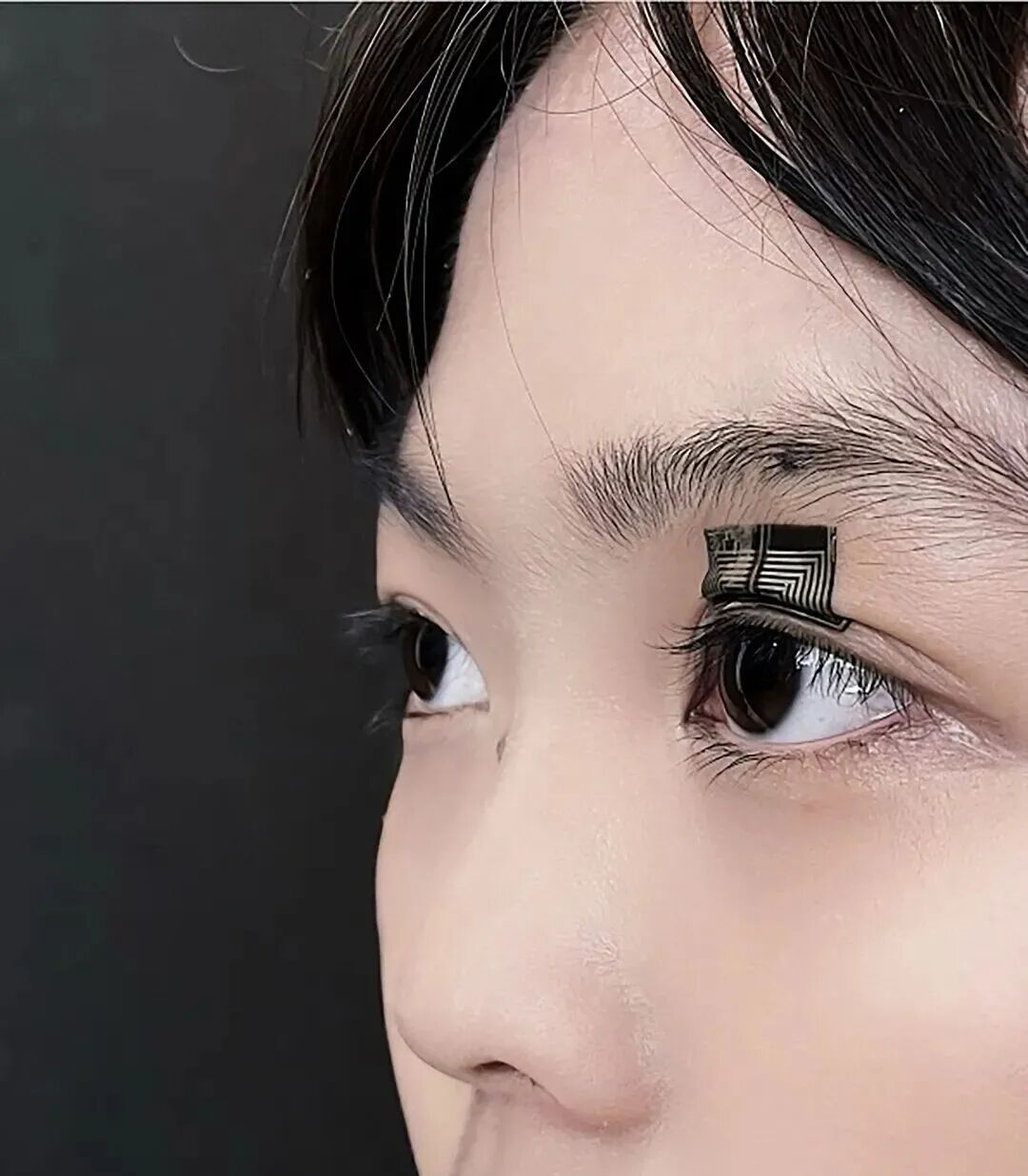
The team installed the sensor on the eyelid, and the photo shows that when the eyes are open, the sensor forms a conformal interface with the eyelid tissue. Image source: University of California, Los Angeles.
“Our research began with a simple question: how can we monitor fatigue states in real-life scenarios?” said Jing Xu, a PhD student at UCLA. “For a long time, we have known that fatigue is much more than just ‘feeling tired’ — it leads to gradual declines in bodily or brain functions, and this decline often occurs silently, affecting attention, reaction speed, and potentially impacting personal safety. However, measuring fatigue with wearable devices outside the laboratory has always been a challenge.””
The main goal of the research team was to develop a new type of sensing device that can measure fatigue levels in real-time and reliably outside the laboratory. When analyzing the effects of fatigue on the physiological state of the body, the researchers quickly realized that people’s blinking patterns might be a key indicator of fatigue levels.
“When a person is fatigued, there are subtle yet representative changes in the eyes,” Jing Xu explained. “The blink frequency changes, the speed of blinking slows down, and the overall blinking pattern shifts. But can we continuously capture these changes in a comfortable way in real-life scenarios? We believe we can, which is why we developed this new device.”
The flexible sensor developed by the researchers can gently adhere to the eyelid, feeling as comfortable as a second skin. Notably, this sensor has high extensibility, does not require battery power, and can respond quickly to each blink.
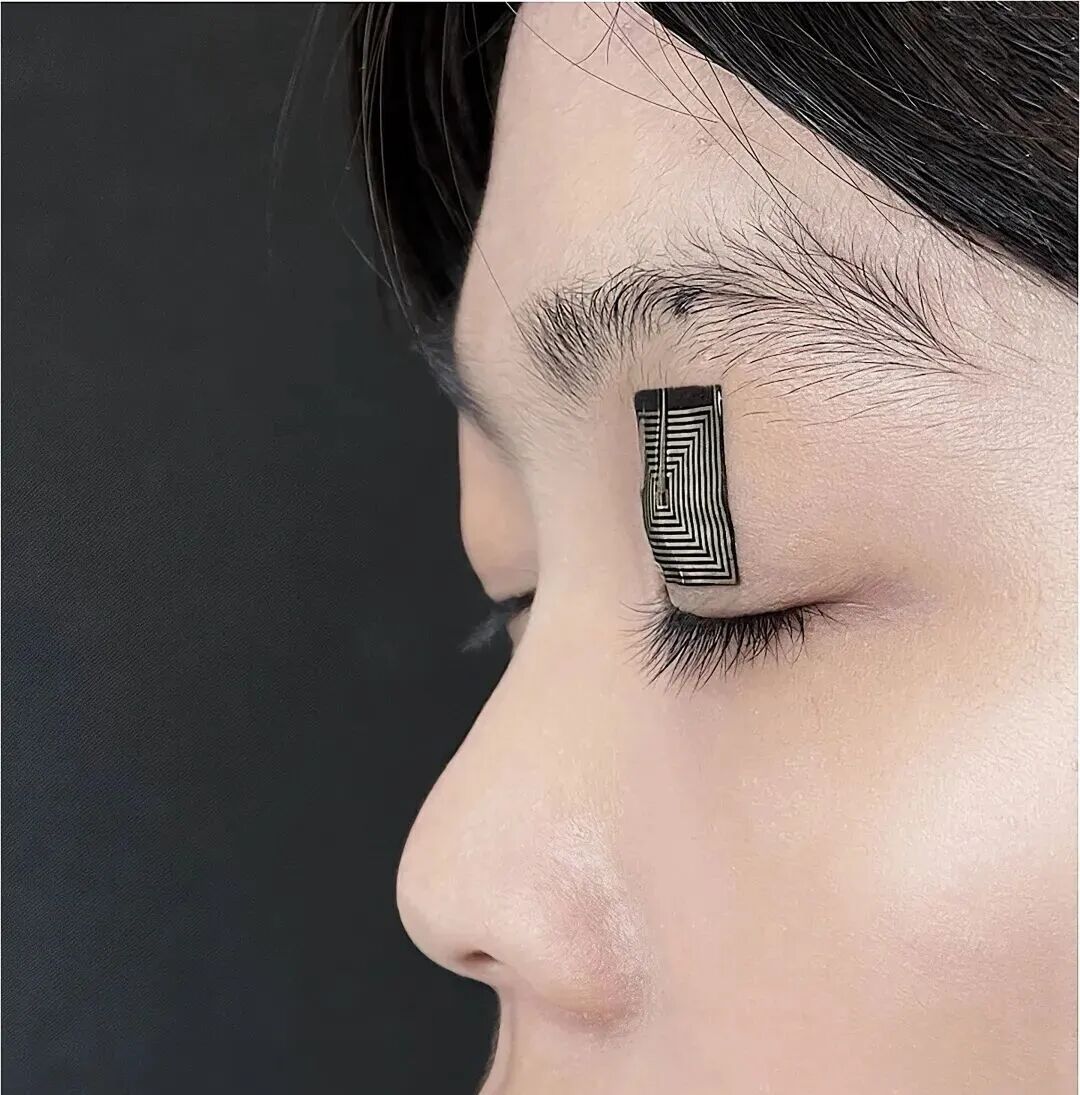
The team installed the sensor on the eyelid, and the photo shows that when the eyes are closed, the sensor forms a conformal interface with the eyelid tissue. Image source: University of California, Los Angeles.
During the preparation of the sensor, the research team first etched conductive gold coils onto a super-thin thermoplastic elastomer, then covered this elastomer with a magnetoelastic film filled with micro-magnets.
“This device can convert the movement of the eyelid into high-fidelity electrical signals — essentially turning each blink into analyzable data,” Jing Xu further explained. “Its uniqueness lies not only in the technology used but also in its application potential. This is a fully wearable, self-powered system with built-in wireless transmission capabilities, designed for everyday use — it can be used not only in clinics or research laboratories but also in real-life scenarios where monitoring fatigue is crucial, such as while driving, in classrooms, or in high-demand work environments.””
Whether wearable or implantable, bioelectronic devices must operate stably in high-humidity environments, as they inevitably come into contact with sweat or bodily fluids. However, most sensors used to monitor physiological signals do not possess waterproof capabilities.
“Typically, to enhance the waterproofing of such devices, an additional encapsulation layer must be added, but this often increases the thickness of the device and can reduce its performance, such as sensitivity,” said Dr. Jun Chen, the lead researcher of the study at UCLA.
“When I started my independent research at UCLA, I pondered a fundamental question: can we develop bioelectronic devices that are inherently waterproof? To explore this question, I studied various forms of natural energy, including electrical, magnetic, thermal, and optical energy.”
The sensor developed by the research team operates based on changes in the magnetic field — that is, the invisible forces present around magnetic materials. Since this force can penetrate water and is unaffected by humidity, Dr. Jun Chen has long been exploring its use to develop inherently waterproof devices.
“Since the discovery of the magnetoelastic effect in 1865, this phenomenon has only been observed in rigid metals and alloys, requiring mechanical pressures of up to 10 megapascals (MPa) — conditions that are not suitable for flexible electronic devices,” Dr. Jun Chen explained. “I speculated that perhaps the magnetoelastic effect could be applied to flexible polymer systems.”
In 2021, Dr. Jun Chen’s research team at UCLA first discovered the giant magnetoelastic effect in flexible polymer composites. Specifically, they observed that when these materials are subjected to mechanical pressure, the magnetic flux passing through the material undergoes significant changes.
“This groundbreaking research demonstrated that the magnetoelastic effect can be realized in flexible materials, and the pressure threshold required was reduced to about 10 kilopascals (kPa) — a pressure level easily achievable during natural biomechanical activities of the body such as heartbeat, breathing, and eye movements,” Dr. Jun Chen stated.
“Currently, our team is at the forefront of this emerging field of flexible magnetoelastic bioelectronics and is working to apply this technology to various biomedical and healthcare technologies. Over the past five years, the most innovative achievement from our lab has been the discovery of the giant magnetoelastic effect in flexible materials, which opens new directions for the application of bioelectronic devices.”
The magnetoelastic effect observed in flexible polymer composites has actually been discovered in other materials before. In 1865, Italian physicist Emilio Villari first discovered this effect, but to date, it has mainly been observed in rigid metals and alloys, requiring the influence of an external magnetic field.
“After joining UCLA, I led the research team to first discover the giant magnetoelastic effect in flexible polymer systems, and then we observed this phenomenon in liquid permanent magnetic fluids,” Dr. Jun Chen said, “We also combined the giant magnetoelastic effect with magnetic induction technology to invent a flexible magnetoelastic generator (MEG), which has become a new foundational platform for developing human-powered flexible bioelectronic devices.”
Dr. Jun Chen and his team’s inherently waterproof flexible magnetoelastic bioelectronic technology is expected to be applied in the development of various sensing devices. In addition to fatigue monitoring, it can also be used to predict other important health indicators and monitor environmental changes.
“This breakthrough provides new pathways for developing practical energy devices, sensing devices, and therapeutic devices centered around the human body,” Dr. Jun Chen said.
“With the continued efforts of the UCLA research team, the discovery of the giant magnetoelastic effect in flexible systems has been widely introduced as a new foundational mechanism in multiple research fields, including injectable and recyclable liquid bioelectronic devices, liquid acoustic sensors, pulse wave monitoring devices, voiceless speech technology, tactile sensors, implantable cardiovascular monitoring devices, respiratory monitoring devices, muscle physiotherapy devices, human-computer interaction systems, personal temperature regulation devices, and even wind energy, wave energy, and biomechanical energy harvesting technologies.”
The research team is currently planning to further optimize this fatigue monitoring sensor and push it to market. Meanwhile, they are also developing other types of bioelectronic devices based on the previously discovered giant magnetoelastic effect.
“From a broader perspective, the giant magnetoelastic effect in flexible systems is a scientifically significant discovery, but its theoretical and experimental potential has yet to be fully explored,” Dr. Jun Chen added. “Our team is committed to deeply studying this phenomenon, comprehensively understanding its principles, and using it as a foundational platform for developing new intelligent responsive technologies. By exploring its applications in bioelectronics, flexible robotics, and other fields, we hope to drive breakthroughs in related areas, redefine the interaction between materials and life, and ultimately support social development and future productivity enhancement.”For more information:Jing Xu et al, A soft magnetoelastic sensor to decode levels of fatigue, Nature Electronics (2025). DOI: 10.1038/s41928-025-01418-x.
Source: techxplore
About Us
21dB Acoustic People is a technology media under the Suzhou Electromechanical Industrialization Base of the Institute of Acoustics, Chinese Academy of Sciences, focusing on new acoustic technologies, audio testing and analysis, acoustic market research, acoustic entrepreneurship incubation, intellectual property services, etc.
Cooperation Promotion
Article Submission | Entrepreneurship Support | Intellectual Property Services | Technology TransferPlease send your requirements to the following email, and we will send a dedicated person to contact you[email protected]
Copyright Statement
All images and text in this article are copyrighted by 21dB Acoustic People
If you need to reprint or cooperate with the media, please contact us