The next generation of lithium metal batteries urgently requires electrolytes that simultaneously possess low cost, high safety, a wide operating temperature range, high electrochemical stability, and good electrode-electrolyte interface formation capability.
On November 19, 2025, researchers from the Suzhou Institute of Nano-Tech and Nano-Bionics, Chinese Academy of Sciences, including Wu Xiaodong, Xu Jingjing, and Li Hong from the Institute of Physics, Chinese Academy of Sciences, published a research paper titled “Flame-retardant electrolytes with electrochemically-inert and weakly coordinating dichloroalkane diluents for practical lithium metal batteries” in the internationally renowned journal Nature Communications. Zhicheng Wang and Haifeng Tu are co-first authors of the paper, while Wu Xiaodong, Xu Jingjing, and Li Hong are co-corresponding authors.
This study developed a flame-retardant electrolyte by introducing electrochemically inert and weakly coordinating dichloroalkane diluents into a high-concentration triethyl phosphate-based electrolyte.
It systematically investigated the effects of different carbon chain lengths of dichloroalkane diluents on the lithium ion solvation structure, redox behavior, and lithium metal interfacial chemistry.
Results showed that 1,3-dichloropropane, due to its good electrochemical inertness, weak coordination ability, and wide liquid phase temperature range (−99 to +120°C), was selected as an ideal diluent, capable of forming a stable anion-derived rich inorganic phase electrode-electrolyte interface on the electrode surface and enhancing lithium ion transport/de-solvation capabilities.
The developed electrolyte significantly improved the safety, cycling stability, rate performance, and wide temperature range operational capability of high-voltage lithium metal batteries.
In particular, the practical Li (50 μm) || LiNi0.83Co0.12M0.05O2(NCM83, 5.6 mAh cm-2) pouch battery exhibited over 100 stable cycles at 0.1 C charge/0.2 C discharge at 25°C, with a capacity retention rate of up to 94.1%, and demonstrated good application prospects over a wide temperature range of −60 to +60°C.
Lithium metal batteries (LMBs) using lithium metal anodes and high-voltage nickel-rich cathodes are considered one of the most promising directions for next-generation high energy density storage devices.
However, their practical application is hindered by limited cycle life due to the high reactivity of lithium metal and safety issues caused by lithium dendrite formation.
As a key component of batteries, electrolytes significantly affect the electrochemical performance of batteries. Unfortunately, the most advanced commercial carbonate-based electrolytes have a narrow electrochemical stability window (~4.3 V), limited operating temperature range (−20 to +50°C), and high flammability, severely restricting the electrochemical performance and safety of lithium metal batteries.
Recent studies have shown that innovative electrolyte formulations can significantly enhance the cycling stability and safety of lithium metal batteries.
For example, phosphate-based solvents with excellent flame-retardant properties (such as trimethyl phosphate and triethyl phosphate) have been widely used as the main solvents for electrolytes.
By introducing high concentrations of lithium bis(fluorosulfonyl)imide (LiFSI) salt to modulate the solvation structure of the electrolyte, the proportion of free solvent in the system is reduced, effectively suppressing interfacial side reactions between phosphate solvents and lithium metal electrodes.
This method has been successfully applied to lithium metal batteries, achieving enhanced cycling stability and safety.
However, these high-concentration electrolytes (HCEs) also have many issues, such as high viscosity, low ionic conductivity, and high cost, severely limiting the application of lithium metal batteries, especially under low-temperature and high-rate conditions.
To improve the physicochemical properties of high-concentration electrolytes, weakly polar fluorinated ether solvents (commonly referred to as non-coordinating diluents) with low viscosity and electrochemical inertness have been introduced into high-concentration electrolytes to construct local high-concentration electrolytes (LHCEs), such as bis(2,2,2-trifluoroethyl) ether (BTFE), 1,1,2,2-tetrafluoroethyl-2,2,3,3-tetrafluoropropyl ether (TTE), and 3,3,4,4,5,5-hexafluorotetrahydrofuran (HFTHP).
These highly fluorinated diluents cannot dissolve lithium salts and interact minimally with lithium ions, thus maintaining an anion-dominated lithium ion solvation structure and promoting the formation of an anion-derived rich inorganic phase electrode-electrolyte interface (EEIs) on the surfaces of both electrodes.
These local high-concentration electrolytes effectively suppress lithium dendrite growth, enhancing the cycling life and rate performance of lithium metal batteries.
However, the limitations of these highly fluorinated inert diluents, including restricted lithium ion transport kinetics, high cost, and increased density, particularly due to their potential hazards to humans and the environment, have led to their prohibition in many countries, making them less suitable for practical applications.
Therefore, there is an urgent need to develop new diluents to optimize the design of local high-concentration electrolytes and promote their application in lithium metal batteries with excellent performance over a wide temperature range.
The design concept of the electrolyte diluents in this study is shown in Figure 1a.
The primary criterion for selecting diluents should be suitable physicochemical properties, such as low freezing point, high boiling point, low viscosity, non-flammability, and low cost.
Secondly, weak coordination ability and high electrochemical inertness are secondary criteria for diluent selection, with the expectation of enhancing lithium ion transport/de-solvation kinetics by partially coordinating lithium ions, while their electrochemical inertness facilitates the preferential decomposition of anions, thereby forming a stable interface on the electrode and improving the electrochemical performance of lithium metal batteries.
Recently, weakly polar symmetric dichloroalkane (C-2Cl) solvents such as 1,2-dichloroethane (C2-2Cl) have been reported as candidate diluents for local high-concentration electrolytes to achieve highly stable lithium metal batteries, expected to meet the above two criteria, as they can modulate the electron cloud density to weakly coordinate lithium ions through the electronegative chlorine atoms and provide good flame-retardant properties due to the presence of chlorine.
However, due to the low boiling point (84°C) and high freezing point (−35°C) of the C2-2Cl diluent, it is difficult to meet the requirements for wide temperature range electrolytes.
As shown in Figure 1b, a series of symmetric C-2Cl diluents with different carbon chain lengths (dichloromethane (C1-2Cl), C2-2Cl, 1,3-dichloropropane (C3-2Cl), 1,4-dichlorobutane (C4-2Cl), and 1,5-dichloropentane (C5-2Cl)) are considered major candidates.
By comparing the melting and boiling points of different C-2Cl diluents with the commonly used TTE diluent in the literature (Figure 1c and Supplementary Table 1), it is evident that as the carbon chain length of C-2Cl increases, the liquid phase temperature range (TR) of the solvent widens.
Solvents with carbon chain lengths ≥3 exhibit potential for wide temperature range applications, with their liquid phase temperature range exceeding that of TTE diluents.
Additionally, these C-2Cl solvents also have low density and low market prices (Figure 1d), demonstrating advantages for large-scale applications.
Nevertheless, the effects of different chain length C-2Cl diluents on the physicochemical properties, solvation structure, and electrochemical performance of the electrolyte remain unclear.
Based on the above research, this work used a high-concentration phosphate-based electrolyte (LiFSI-TEP molar ratio of 1:1.5) as the base electrolyte and prepared a series of flame-retardant electrolytes using C-2Cl diluents with different carbon chain lengths.
It systematically studied the effects of different carbon chain length C-2Cl diluents on the lithium ion solvation structure, redox behavior, and lithium metal interfacial chemistry. The study found that as the carbon chain length of the diluent increased, the coordination interaction between the diluent and lithium ions strengthened.
When the carbon chain length ≤3, the diluent tends to form stable cyclic chelate structures with individual lithium ions, thus achieving good electrochemical stability of the diluent. By comprehensively evaluating the physicochemical properties and electrochemical inertness of the diluents, C3-2Cl was determined to be the ideal diluent, with a wide temperature range (−99 to +120°C).
Based on theoretical calculations and experimental results, it was confirmed that C3-2Cl has weak coordination interactions with lithium ions, which not only effectively enhances the ionic transport and de-solvation characteristics of the electrolyte over a wide temperature range but also ensures the formation of an anion-derived rich inorganic phase electrode-electrolyte interface on the surfaces of both electrodes, significantly improving the cycling stability, rate performance, and low-temperature performance of lithium metal batteries.
Using the optimized flame-retardant electrolyte (LiFSI-TEP/C3-2Cl molar ratio of 1:1.5:3), the Li (50 μm) || LiNi0.5Co0.2Mn0.3O2(NCM523, 2.0 mAh cm-2) coin battery achieved stable cycling for 200 cycles at a high cutoff voltage of 4.5 V (capacity retention rate of 81.7%).
The practical Li (50 μm) || LiNi0.83Co0.12Mn0.05O2(NCM83, 5.6 mAh cm-2) pouch battery also demonstrated over 100 stable cycles (capacity retention rate of 94.1%). This pouch battery also exhibited good cycling stability at −20°C and maintained high discharge capacity over a wide temperature range of −60 to +60°C.
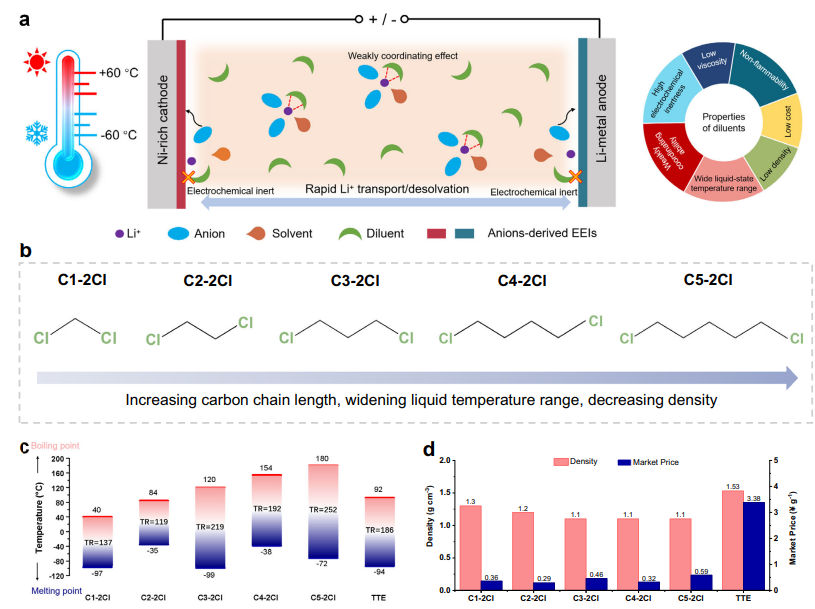
Figure 1:Design of ideal electrolyte diluents for wide temperature lithium metal batteries. a Schematic diagram of electrolyte solvation structure, rapid lithium ion transport/de-solvation, electrode interfacial chemistry, and diluent properties in flame-retardant electrolytes containing C-2Cl diluents. b Molecular structures of C-2Cl diluents with increasing carbon chain lengths. c Boiling and melting points of different diluents. d Densities and market prices of different diluents. Market prices are calculated based on the reference prices of Adamas brand products as of September 1, 2024.
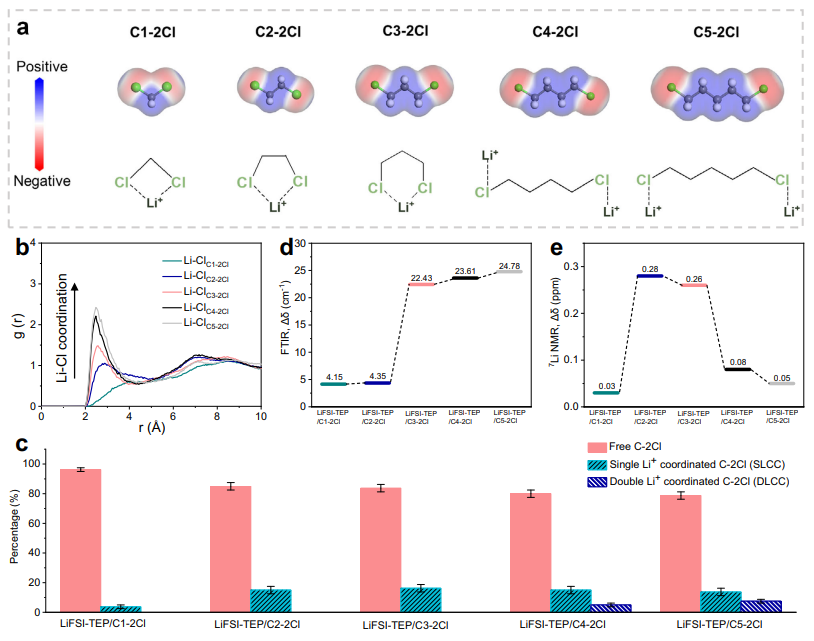
Figure 2:Analysis of electrolyte solvation structures containing different C-2Cl diluents. a Electrostatic potentials of different C-2Cl diluents and their coordination structures with Li+. Color code: C-dark gray, H-white, Cl-green. b Radial distribution function curves of Li-Cl coordination in electrolytes containing different C-2Cl diluents. c Percentages of different C-2Cl structures in different electrolytes obtained through molecular dynamics simulations. We define the error bars as the difference between the maximum and minimum values in three data statistics. d Δδ of C-Cl characteristic peaks in different electrolytes obtained through FTIR. e Δδ of characteristic peaks of Li+ in different electrolytes obtained through 7Li NMR. Source data is provided as source data files.
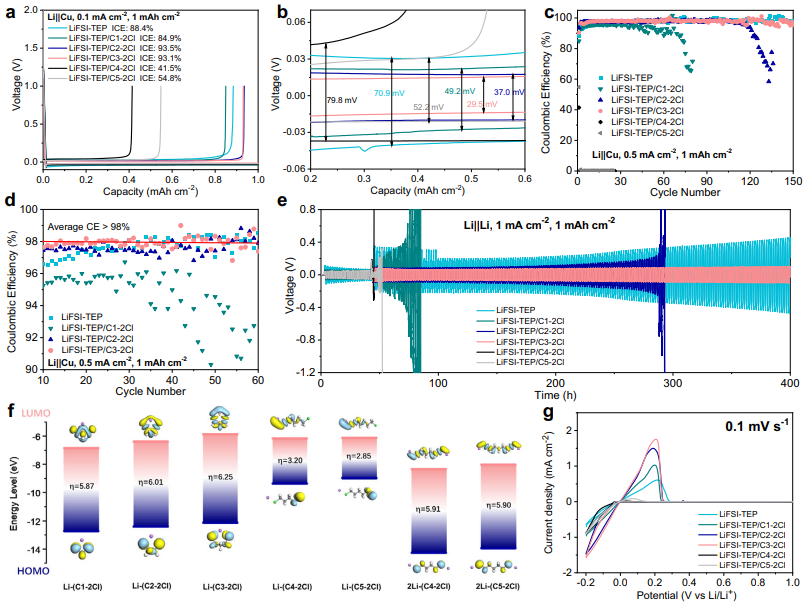
Figure 3:Compatibility of lithium metal in different C-2Cl diluent electrolytes. a Initial Coulombic efficiency of Li||Cu batteries in different electrolytes. b Initial polarization of Li||Cu batteries in different electrolytes. c Cycling performance of Li||Cu batteries in different electrolytes under 0.5 mA cm-2 and 1 mAh cm-2 conditions. d Average Coulombic efficiency of corresponding Li||Cu batteries from the 10th to the 60th cycle. e Long-term lithium deposition/stripping performance of Li||Li symmetric batteries in different electrolytes. f HOMO/LUMO energy levels of different Li-C-2Cl coordination complexes obtained through DFT calculations. Color code: Li-purple, C-dark gray, H-white, Cl-green. g CV curves of Li||Cu batteries in different electrolytes at a scan rate of 0.1 mV s-1 Source data is provided as source data files.
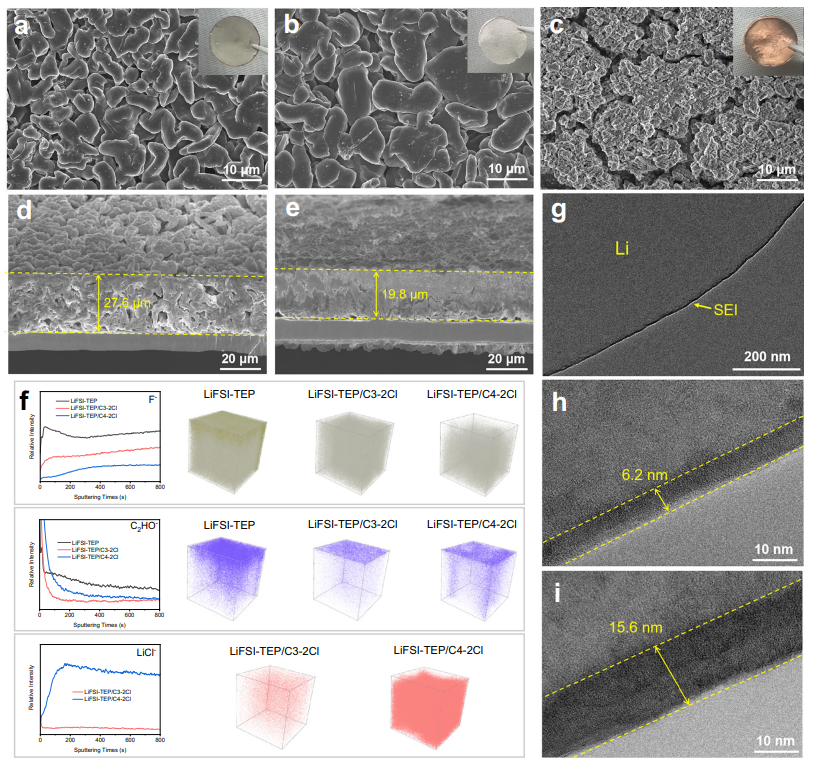
Figure 4:Lithium deposition morphology and interfacial chemistry of lithium metal electrodes in different electrolytes. a LiFSI-TEP, b LiFSI-TEP/C3-2Cl, c LiFSI-TEP/C4-2Cl electrolytes, top view SEM images of lithium deposited on Cu foil at a current density of 0.5 mA cm-2 and area capacity of 3 mAh cm-2 The insets are optical images of the corresponding lithium-plated Cu foil (diameter 1.6 cm). d LiFSI-TEP, e LiFSI-TEP/C3-2Cl electrolytes, cross-sectional SEM images of lithium deposited on Cu foil at a current density of 0.5 mA cm-2 and area capacity of 3 mAh cm-2 After cycling 50 times, TOF-SIMS depth profiling and distribution of F, C2HO–, LiCl– species on the surface of lithium metal electrodes in different electrolytes. g, h Morphology and thickness of the SEI layer formed on the lithium metal surface in LiFSI-TEP/C3-2Cl and i LiFSI-TEP electrolytes characterized by Cryo-TEM. Source data is provided as source data files.
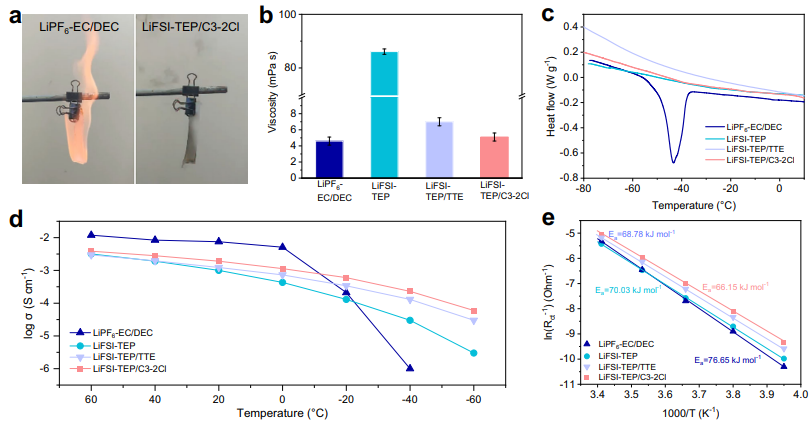
Figure 5:Physicochemical properties of different electrolytes. a Combustion tests of flammable cotton strips soaked in different electrolytes. b Viscosity of different electrolytes. We define the error bars as the difference between the maximum and minimum values in five repeated measurements. c DSC curves measured at a cooling rate of 10 °C min-1 in the range of -80 °C to 20 °C for different electrolytes. d Ionic conductivities of different electrolytes over a wide temperature range of -60 to +60 °C. e De-solvation activation energy tests of Li+ in different electrolytes. Source data is provided as source data files.
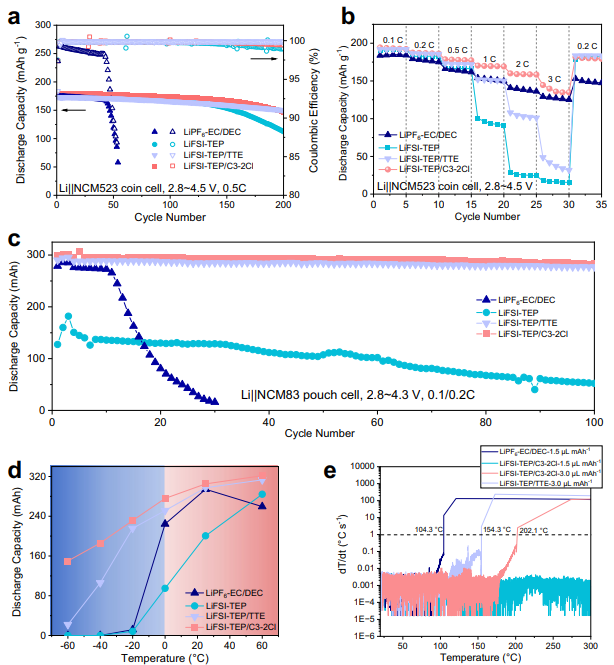
Figure 6:Electrochemical performance of high-voltage lithium metal batteries using different electrolytes. a Cycling performance of Li||NCM523 coin batteries using different electrolytes under 2.8~4.5 V, 0.5C charge/discharge, and 25 °C testing conditions. b Rate performance of Li||NCM523 coin batteries using different electrolytes. c Cycling performance of Li||NCM83 pouch batteries using different electrolytes under 2.8~4.3 V, 0.1C charge/0.2 C discharge, and 25 °C testing conditions. The inset shows an optical image of the pouch battery. d Discharge capacity of Li||NCM83 pouch batteries using different electrolytes at different temperatures. e ARC tests of Li||NCM83 pouch batteries using different electrolytes and different electrolyte amounts. Source data is provided as source data files.
In summary, this paper successfully developed a phosphate-based local high-concentration electrolyte with flame-retardant properties, wide temperature adaptability, and high voltage stability by introducing electrochemically inert and weakly coordinating dichloroalkane (C-2Cl) diluents, systematically revealing the regulatory mechanism of diluent carbon chain length on the performance of lithium metal batteries.
Research found that when the carbon chain length does not exceed 3, short-chain diluents tend to form stable cyclic chelate structures with lithium ions, with 1,3-dichloropropane (C3-2Cl) standing out due to its widest liquid phase temperature window (−99 to +120°C), low cost, and optimal electrochemical inertness.
The optimized electrolyte (LiFSI-TEP/C3-2Cl) modulates the lithium ion solvation structure through weak coordination, promoting the formation of an anion-derived rich inorganic phase electrode-electrolyte interface while significantly enhancing ionic transport and de-solvation kinetics.
In practical applications, the pouch battery composed of a 50 μm thin lithium anode and a high-loading NCM83 cathode (5.6 mAh cm-2) demonstrated excellent overall performance: a capacity retention rate of 94.1% after 100 cycles at 25°C, stable operation over a wide temperature range of −60°C to +60°C, and still able to output 50% of room temperature capacity at −60°C.
Safety tests indicated that this flame-retardant electrolyte, combined with a low electrolyte amount (1.5 μL mAh-1), can completely suppress thermal runaway, with the thermal runaway initiation temperature still reaching 202.1°C even under high amounts (3 μL mAh-1), far exceeding that of commercial electrolytes (104.3°C).
The study also pointed out the current system’s incompatibility with graphite anodes, suggesting that the solvation structure needs further precise modulation to avoid co-intercalation of lithium ions.
This strategy provides a new paradigm for developing high-safety, wide-temperature lithium metal battery electrolytes, but there is still room for deepening: theoretically, it is necessary to combine more refined molecular simulations and in situ characterization techniques to further elucidate the dynamic decomposition mechanisms of chlorinated alkane diluents on the electrode surface and the molecular trajectories of interfacial phase evolution.
Flame-retardant electrolytes with electrochemically-inert and weakly coordinating dichloroalkane diluents for practical lithium metal batteries, Nat. Commun., 2025. https://doi.org/10.1103/s41467-025-651378-8.