Have you ever had that moment? Frantically tapping the screen when your headphones won’t connect to Bluetooth, chuckling at the name “BT-520” when pairing with a speaker, yet never asking: why is it called “Bluetooth”?
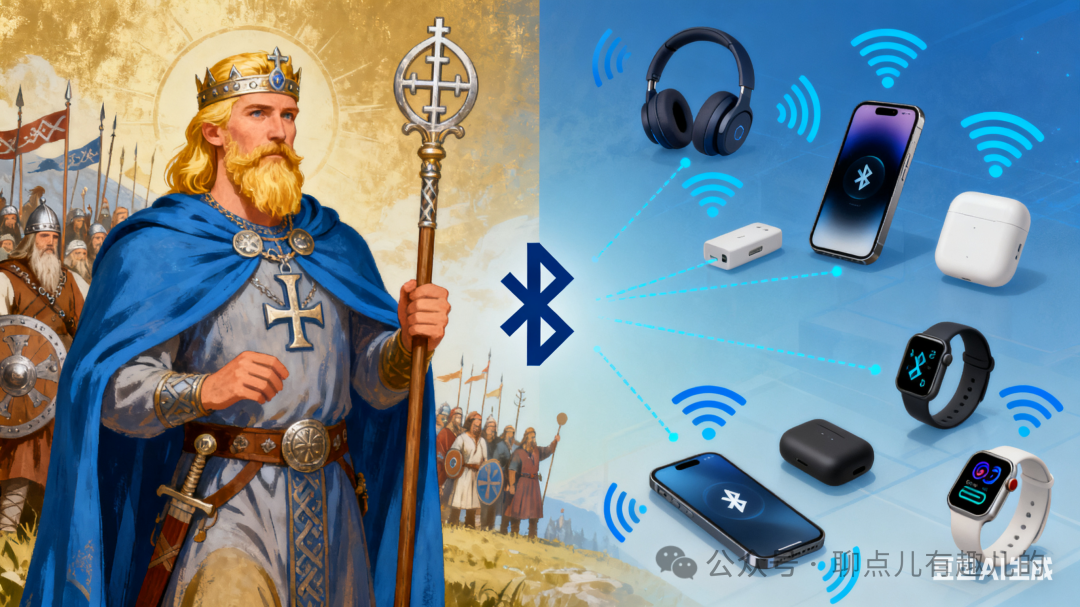
It is neither blue nor a tooth, and it has nothing to do with what we think a “tech product should be named”—shouldn’t it be called something like “Wireless Connection V3.0” or “Near Field Communication Master”? It wasn’t until I flipped through technical archives from the 1990s that I discovered this seemingly nonsensical name hides a story that spans a millennium, a “cross-border” tale that is 100 times cooler than you might imagine.
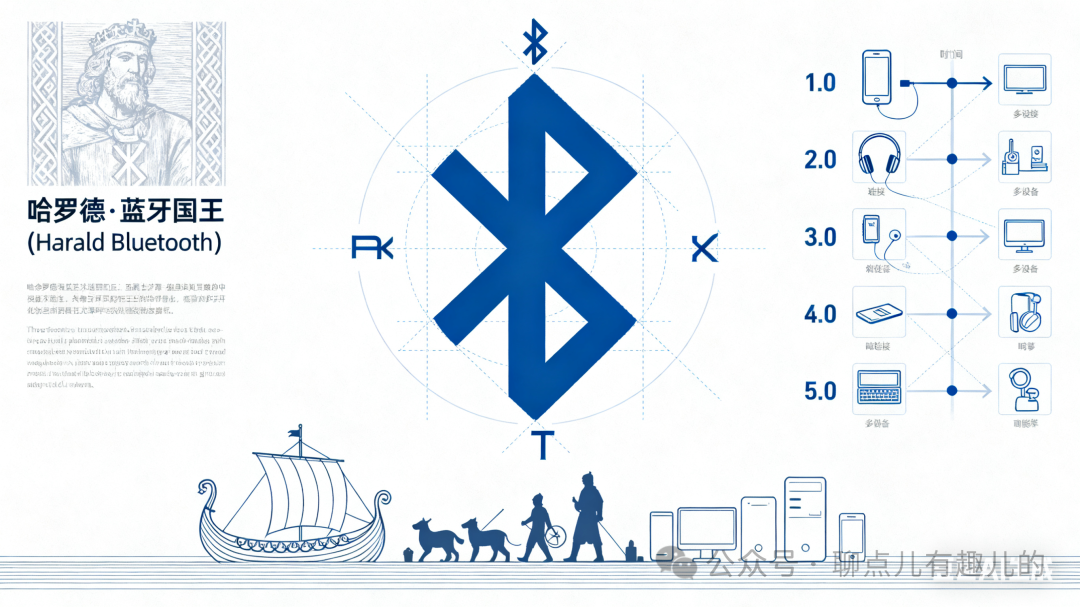
Don’t rush to guess the “tech joke”; the inspiration for Bluetooth came from a king 1000 years ago. In 1994, engineers at Ericsson in Sweden were struggling with a big problem: at that time, electronic devices were like a group of “reclusive children”; mobile phones, computers, and headphones were all doing their own thing, with tangled data cables resembling a mess, making it harder to share information than getting cats and dogs to coexist peacefully. They wanted to create a “short-range wireless connection technology” to link these devices together. The technical challenges were manageable, but when it came to naming the technology, the team was in a heated debate. Some suggested “IRDA Upgrade” (too dull), others proposed “RadioLink” (too ordinary), and one joked about calling it “Wireless Hug” (too cute, not hardcore enough). Until an engineer named Jim Kardach slammed the table: “Why not call it ‘Bluetooth’?” The room fell silent—this name sounded like “grandpa’s old glasses” or “grandma’s sewing box”; how could it be related to high technology? But Jim pulled out a book on Viking history: “Do you remember King Harald Bluetooth?” This name instantly sparked excitement among the Nordic engineers present—King Harald Bluetooth, the legendary Danish king of the 10th century, was the most famous “connector” in Viking history. At that time, Scandinavia was divided into countless small tribes, fighting each other for hundreds of years, just like the electronic devices at that time. King Harald Bluetooth did two significant things: first, he unified southern Denmark and Norway through force and negotiation, connecting the divided tribes into a whole; second, he promoted Christianity among the Norse people, breaking down cultural barriers. “Isn’t our technology about uniting isolated devices? It’s exactly like King Harald’s mission!” Once Jim said this, no one opposed it anymore. Even more interesting is the Bluetooth logo—it’s not just a random design, but a combination of the Nordic runes: the left side is the initial of Harald (ᚼ), and the right side is the initial of Bluetooth (ᛒ), together forming a mini “connector” that quietly ties the king from 1000 years ago to modern technology.
Don’t laugh at the “Bluetooth” name; it almost became “Zipper” and hides a technical secret. In fact, “Bluetooth” was initially just a “temporary nickname”; the engineers thought, “Let’s use it for now and change it when we officially launch.” But unexpectedly, the name became more and more catchy, even becoming an internal “code” for the team—saying “How’s the Bluetooth progress?” was much quicker than saying “short-range wireless communication project.” Interestingly, there was another candidate name: “Zipper”. The reason was simple: a zipper can seamlessly connect two pieces of fabric, perfectly matching the technology’s function. However, during the team vote, “Bluetooth” won by an absolute majority—not because “Zipper” was bad, but because the story behind “Bluetooth” was too compelling. You may not have noticed, but every upgrade of Bluetooth echoes King Harald’s original intention. For example, Bluetooth version 1.0 solved the “Can it connect?” problem, just like King Harald first brought the small tribes together; Bluetooth 2.0 added “high-speed transmission,” allowing images and music to be shared, equivalent to the unified tribes starting to exchange resources; now, Bluetooth 5.0 can connect multiple devices (headphones, watches, speakers all at once), with a transmission distance of up to 100 meters—this is the ultimate version of King Harald’s mission to “break barriers and connect more.” Another fun fact: the “Bluetooth icon” displayed on your phone actually contains a “low-key tribute”—the icon that looks like a “B” and a “signal” has a light blue background, not pure white! The designer said this was to subtly echo the word “blue” without being too obvious, just like King Harald unified the tribes in a gentle way rather than through violence.
From “temporary nickname” to “globally recognized,” Bluetooth teaches us that a good name tells a story. Today, Bluetooth is no longer just about “connecting phones to headphones.” The smart watch you wear in the morning syncs your heart rate via Bluetooth; the smart lock at home unlocks via Bluetooth; even the monitors in hospitals transmit data via Bluetooth; the navigation sound in your car is sent to the speakers via Bluetooth—it acts like an “invisible King Harald,” quietly connecting various devices in our lives into a “non-conflicting family.” Who would have thought that this technology, used by billions of devices worldwide, got its name from a Viking king 1000 years ago? At that time, Ericsson’s CEO was worried: “Will people in non-English speaking countries understand the story of ‘Bluetooth’?” What happened? Chinese users found “Bluetooth” to sound cute, Japanese users thought “ブルートゥース” (the Japanese pronunciation of Bluetooth) was catchy, and American users went to check “Who is Harald?” and ended up remembering this technology. Later, someone asked Jim Kardach: “If you could choose again, would you still call it Bluetooth?” He smiled and said: “Of course! Technology may become outdated, but stories do not. People remember not ‘short-range wireless connection,’ but the king who unified the divided, just like when they think of Bluetooth, they remember how it helped us solve the problem of ‘devices not communicating.'” Now, when you connect Bluetooth, do you feel a little different? That small icon flashing on the screen carries the legend of a king from 1000 years ago, the ingenuity of engineers, and the essence of “connection”—whether it’s ancient tribes or modern devices, we always need a way to break barriers and connect together.
Finally, let me ask you a question: what was the first thing you did with Bluetooth? Was it sharing a song with a classmate or connecting headphones to listen to a novel? Share your “Bluetooth first experience” in the comments!