The screw, as a key “transmission joint” in mechanical equipment, plays a core role in converting the rotational motion of motors into the linear motion required by devices. It is widely used in various mechanical devices with linear motion capabilities, such as injection molding machines, medical equipment, machine tools, robots, and new energy vehicles.
As early as the mid-19th century, screws were applied ingrape presses and other simple machines; by the 1930s, ball screws began to be used inautomotive steering systems; in the 1940s, roller screws were introduced into theCNC machine tool field; entering the 21st century, with the continuous advancement of industrial automation and robotics technology, the precision of screws has been continuously improved, especially planetary roller screws, which have seen a significant increase in demand in high-precision application scenarios such as humanoid robots and medical devices. (Image source: Dongwu Securities)
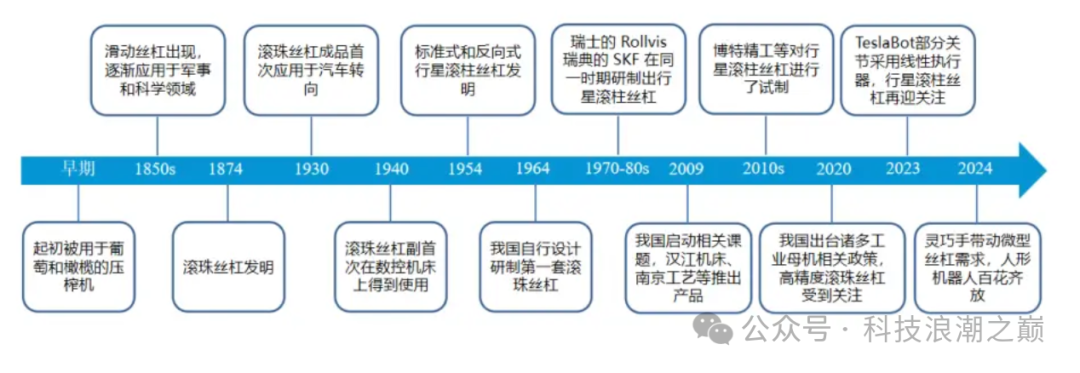
The development of the screw industry in China can be roughly divided into three stages. From the 1970s to the early 1980s, it was the initial stage, where ball screws began to be applied and promoted domestically. From the early 1980s to the early 1990s, it entered a standardization period, where the country gradually emphasized the standardization of ball screws and introduced a series of related standards. From the early 1990s to the present, the industry has entered thedomestic substitution stage, with domestic companies rapidly growing and gradually replacing imported products.
In humanoid robots, screws serve as the core component of linear drives, mainly responsible for the conversion between rotational and linear motion. They are widely used in joint drives and motion control of robots, such as arms, legs, and dexterous hands, and are an important part of achieving precise movement and stable support.
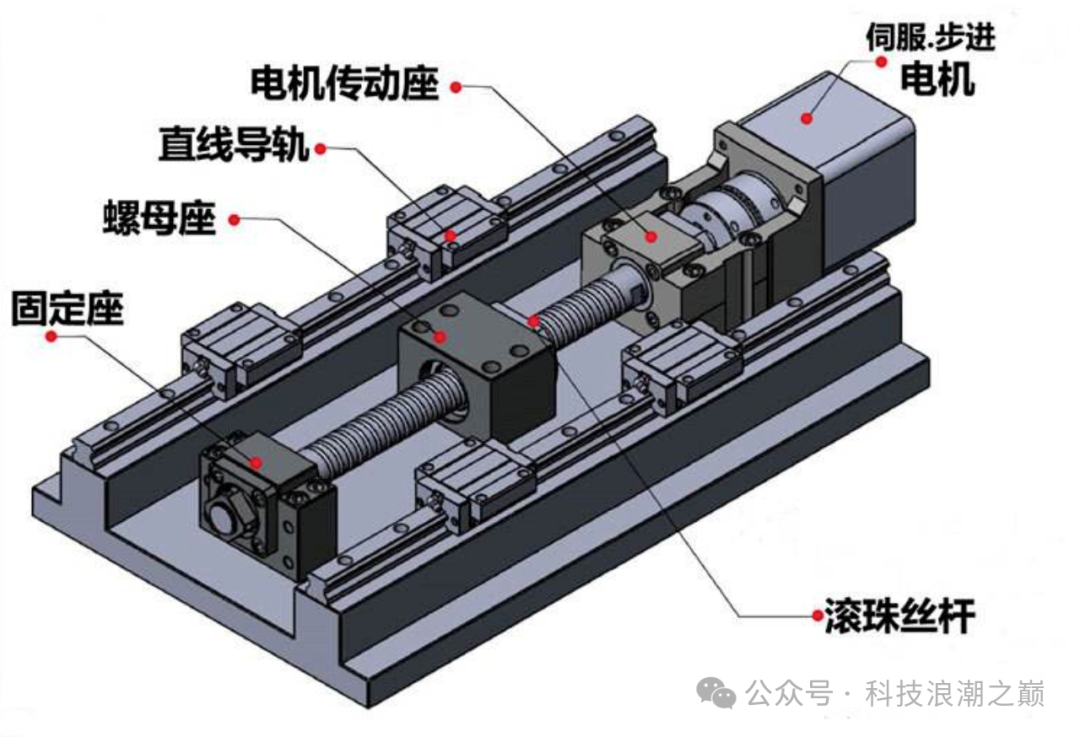
Screws can be classified in various ways according to different standards, with the most common being classified by “friction characteristics,” which is also the mainstream classification method in the industrial and robotics fields. According tofriction characteristics, they can be divided into sliding screws, rolling screws, and hydrostatic screws.
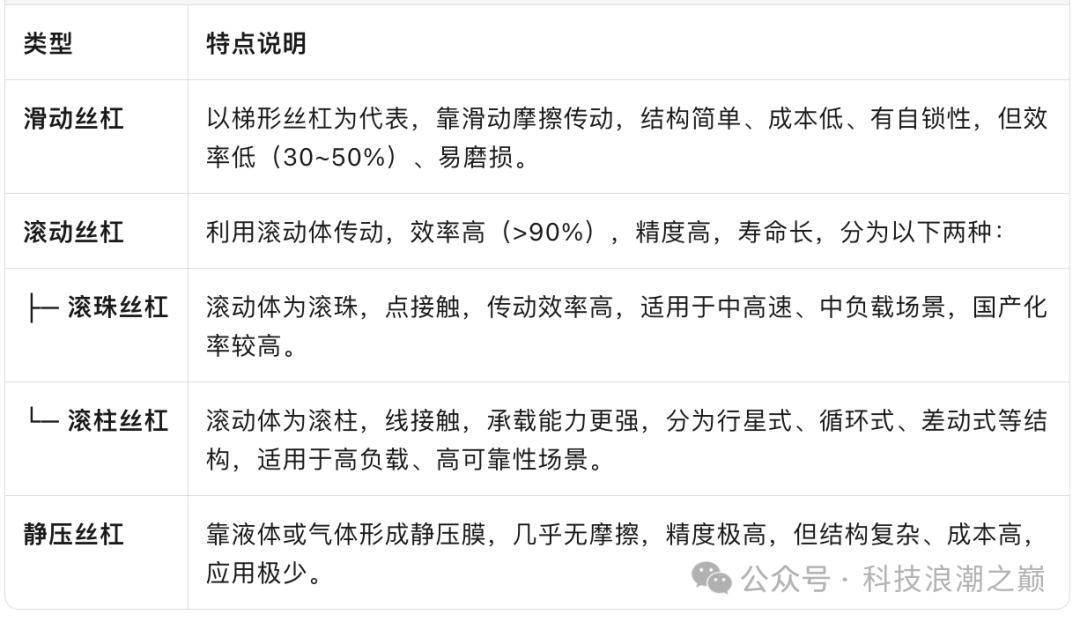
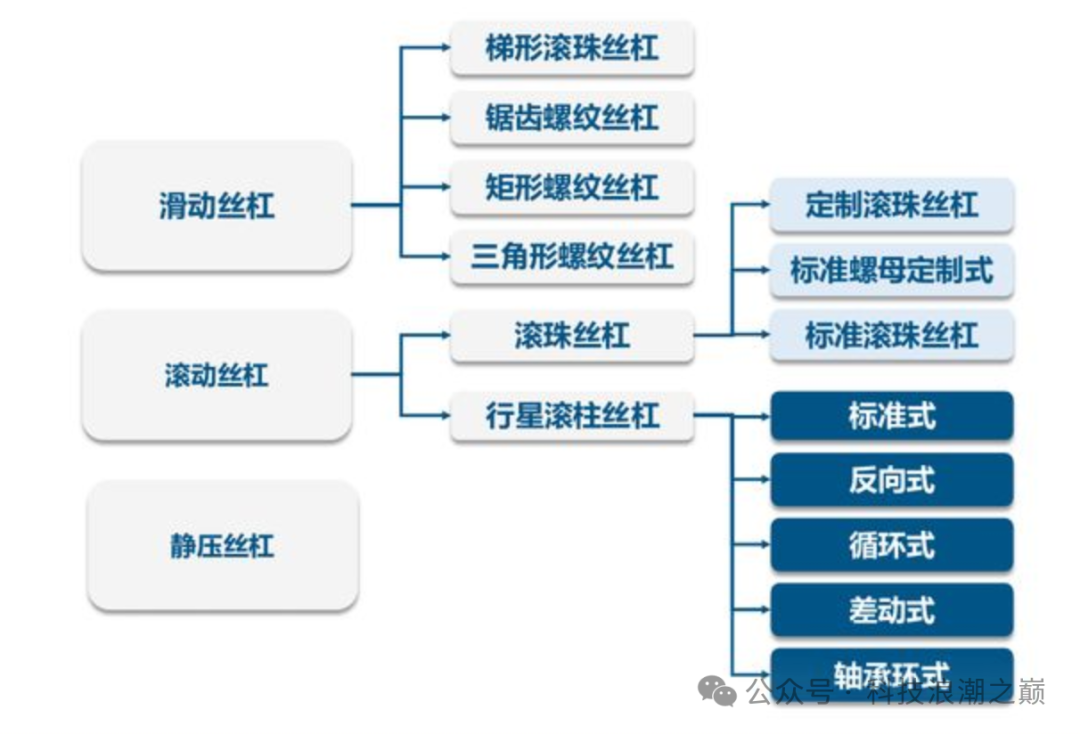
Subdivided by structure or function includes planetary roller screws: rollers perform “planetary motion,” high load, long life, used in high-demand scenarios such as robotics, military, and aerospace. reverse planetary roller screws: the nut performs rotational motion, the screw performs linear motion, compact structure, used in Tesla humanoid robots. circulating roller screws: rollers circulate within the nut, suitable for high precision, small lead scenarios. trapezoidal screws: representative of sliding screws, with a trapezoidal tooth shape, commonly used in machine tools, lifting mechanisms, etc.
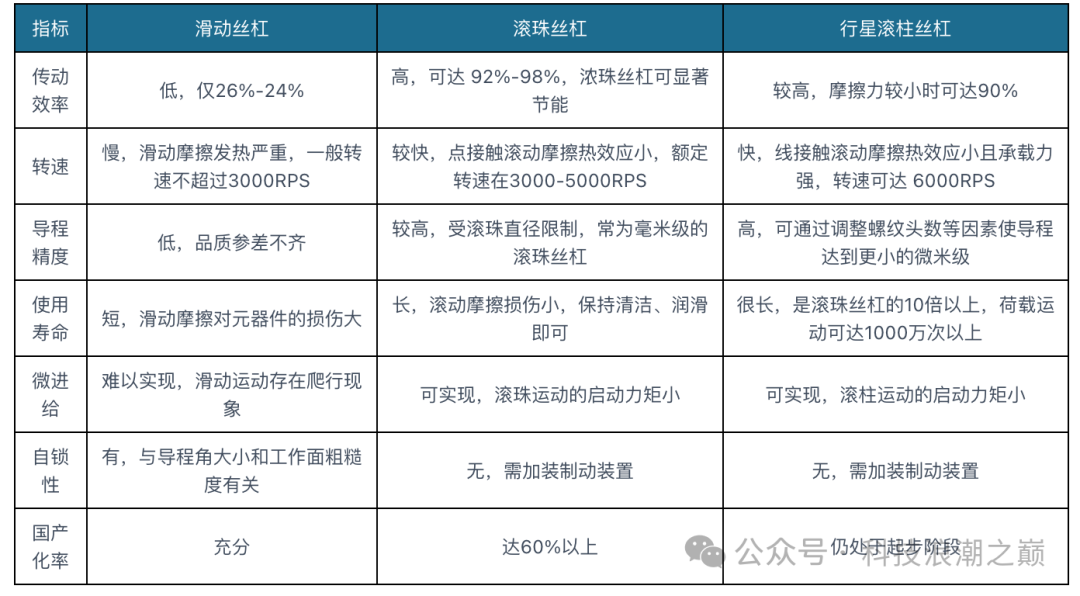
 Comparison of performance between sliding screws, ball screws, and planetary roller screws: sliding screws have low transmission efficiency, slow speed, and short lifespan; ball screws have high transmission efficiency, high speed, and relatively long lifespan; planetary roller screws have high load capacity, small size, high speed, and long lifespan. (Image source: Guanyan Tianxia, etc.)
Ball screws, also known as ball screw assemblies, are commonly used transmission components in industrial precision machinery and are core components of CNC machine tools. Their main structure includes the screw shaft, ball nut, and balls.
From the perspective of industry competition, the high-end market for ball screws in China is mainly occupied by overseas companies such as Japan’s THK, NSK, and Germany’s Rexroth; the mid-range market is dominated by Taiwanese companies such as Hiwin and Yintai; while mainland Chinese companies are currently mainly concentrated in the low-end market. Overall, domestic companies still have significant room for improvement in the localization rate in the high-end market.
The screw industry chain covers multiple links from upstream to downstream, including raw material supply, component manufacturing, screw processing, and end applications. The upstream mainly includes suppliers of raw materials such as stainless steel and alloy steel, as well as manufacturers of components such as retaining rings and caps, providing basic support for the midstream screw processing. The midstream is the core link of the industry chain, responsible for the production and processing of sliding screws, rolling screws, and hydrostatic screws. The downstream application fields are wide-ranging, covering aerospace, robotics, automotive, machine tools, etc., with CNC machine tools accounting for over 50%.
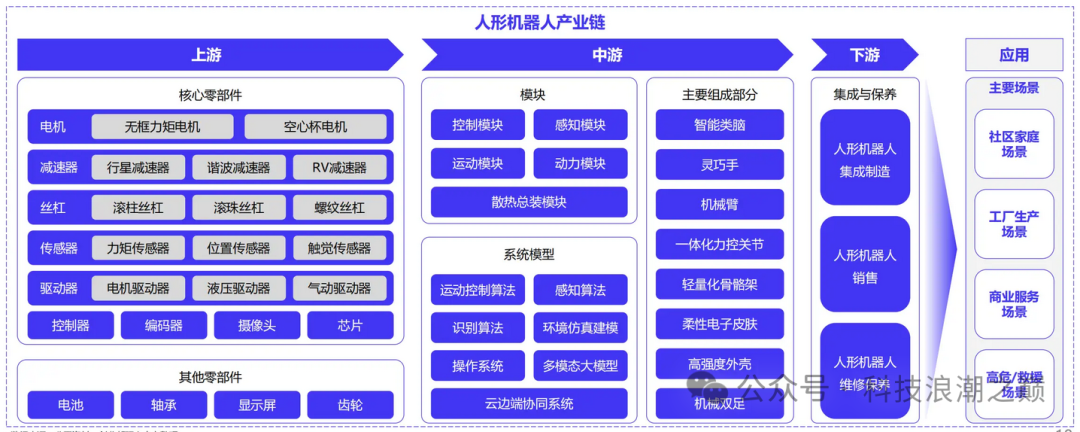
The industry chain map of humanoid robots is as follows: (Image source: Chuangyebang, CITIC Construction Investment Securities)
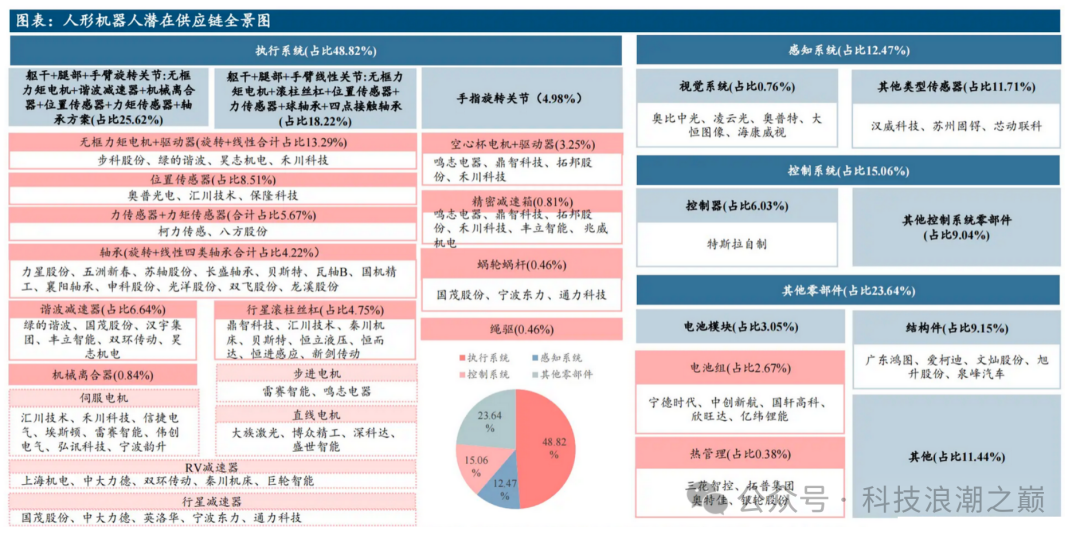
According to calculations by Huaxin Securities, from 2023 to 2030, the global market size for ball and roller screws is expected to grow from 15.95 billion yuan to 47.3 billion yuan. By 2030, the value of planetary roller screws used in humanoid robots is expected to reach 22.96 billion yuan. (Data source: network, please refer to cautiously)
Major screw manufacturers abroad include: American companies (such as Thomson, Moog, Barnes, Rockford, etc.), Japanese companies (such as NSK, Kuroda, THK, Ozak), German companies (such as Bosch Rexroth, RACO, NEFF, etc.), Swiss companies (such as GSA, Rollvis), as well as British EVART and Swedish Ewellix.
Currently, there are about 110 screw manufacturers in China (the following are some examples): Beite Technology, Shuanglin Co., Hengli Hydraulic, Hechuan Technology, Best, Qinchuan Machine Tool, Dingzhi Technology, Xinjian Transmission, Norshi Robotics, Nanjing Craft, Hanjiang Machine Tool, Bote Precision, Kate Precision, Minjia Manufacturing, Wuzhou Xinchun, Changsheng Bearings, Zhenyu Technology, Yintai Technology, Qishan Beifang, Jiangsu Leili, Qijian Screws, Kaixuan Intelligent, etc.
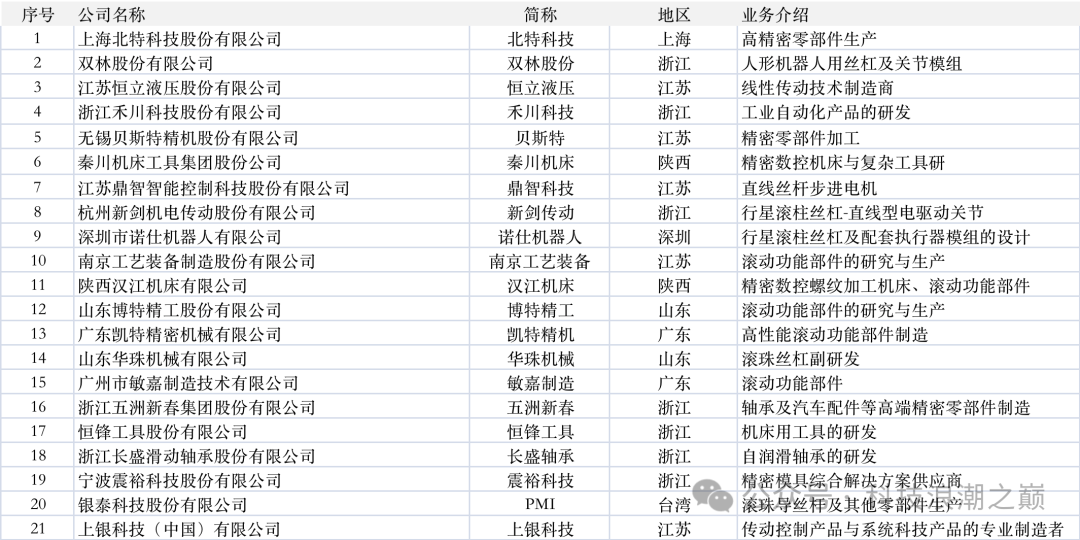
Among the registered screw manufacturers, there are 29 in Jiangsu Province, 26 in Zhejiang Province, 17 in Guangdong Province, 11 in Shanghai, 10 in Shandong, 5 in Beijing, and 4 in Shaanxi Province.
Note: The content of this article references publicly available information from the internet, and the sources of the images have been indicated. Please use the relevant statistical data cautiously. You are welcome to correct and supplement in the comments section. The cover image is AI-generated.
Complete list of 110 screw manufacturers (Excel format) includes full company names, abbreviations, business introductions, official websites, and brief descriptions. If you need to obtain it, please contact us (not free). The compilation is not easy, please do not disturb.