

Care for Life
Quality First
Huahe Medical for Your Health
Unwavering Commitment, Never Forgetting Our Original Intention

With the development of the medical industry, non-invasive blood pressure monitoring (NIBP) methods are unable to achieve the desired clinical treatment effects. Therefore, the invasive blood pressure monitoring (IBPM) method, which allows for intuitive and rapid dynamic monitoring of patient blood pressure using pressure sensors, has emerged. Invasive blood pressure monitoring effectively cooperates with clinical treatment and nursing, reduces nurses’ workload, and greatly improves the rescue success rate for critically ill patients. This technology has significant clinical value.
Principle of Invasive Blood Pressure Monitoring
A catheter is inserted through a puncture into the blood vessel at the measurement site. The outer end of the catheter is directly connected to one end of a disposable pressure sensor, while the other end of the pressure sensor is connected to a monitor via a cable. Due to the pressure transmission effect of fluids, the pressure within the blood vessel is transmitted through the liquid in the catheter to the external pressure sensor, allowing for real-time dynamic waveform changes of the internal blood vessel pressure. Through specific calculation methods, the systolic pressure, diastolic pressure, and mean arterial pressure of the measured blood vessel can be obtained, achieving real-time continuous pressure monitoring. Common arterial puncture pathways for invasive blood pressure monitoring include the radial artery and dorsalis pedis artery.
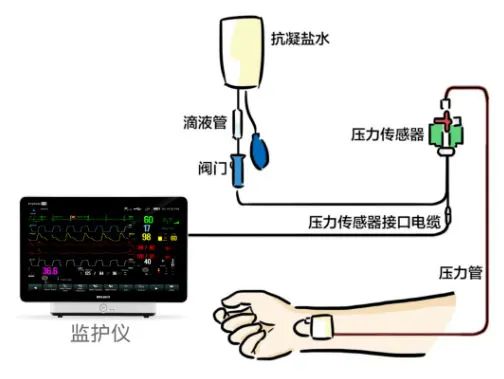
Advantages and Disadvantages of Invasive Arterial Blood Pressure Monitoring
1. Advantages: It can quickly respond to changes in the patient’s arterial blood pressure and provide dynamic continuous measurements. For critically ill patients such as those in shock, severe myocardial infarction, heart failure, undergoing complex major surgeries, or requiring controlled hypotension and hypothermic anesthesia, it allows for timely and accurate monitoring of blood pressure changes, providing a reliable basis for treatment and improving the success rate of rescue.
2. Disadvantages: This measurement method is invasive and can cause a certain degree of damage to the body. Improper operation can lead to complications such as infection, thrombosis, and bleeding.
Indications for Invasive Blood Pressure Monitoring
1. Various critically ill patients and complex major surgeries with significant blood loss;
2. Shock circulatory surgery;
3. Surgeries requiring hypothermia treatment or controlled hypotension;
4. Patients with severe hypotension or shock who require repeated blood pressure measurements;
5. Patients needing repeated arterial blood samples for blood gas analysis;
6. Patients requiring vasopressor drugs;
7. Patients after cardiopulmonary resuscitation;
8. During selective angiography and arterial catheter chemotherapy.
Contraindications for Invasive Blood Pressure Monitoring
1. Various critically ill patients, circulatory failure, open-heart surgery under extracorporeal circulation, major vascular surgeries, organ transplantation, etc., which may lead to significant intraoperative blood loss;
2. Severe hypotension, shock, and other hemodynamic instability diseases, or cases where non-invasive blood pressure monitoring is difficult;
3. Severe hypertension, trauma, myocardial infarction, heart failure, MODS;
4. Procedures requiring controlled hypotension, hypothermic anesthesia, blood dilution, and surgeries for hemangiopericytoma;
5. When repeated arterial blood gas analysis is needed;
6. During selective angiography and arterial catheter chemotherapy.
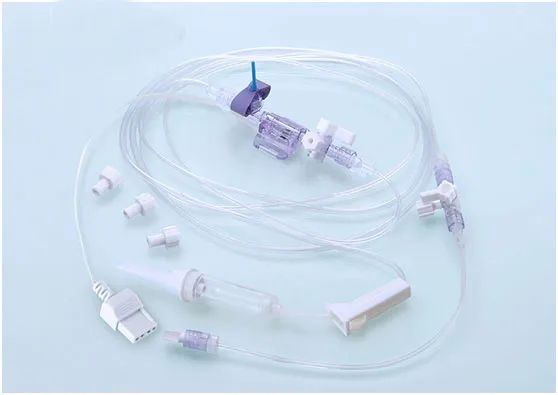
Huahe Medical – Pressure Sensors
The nursing care for invasive blood pressure monitoring directly relates to the accuracy of the feedback data from the pressure sensors, which is especially important for patient treatment. Huahe Medical’s pressure sensors use precision imported chips for accurate measurements, adhering to the principle of “product quality first” to provide high-quality products for patients.
Advantages of the Product
1. Uses imported chips with extremely high sensitivity, precision, and safety; the overall structure is exquisite and compact, safe and reliable;
2. The core structure of the pressure sensor is assembled using an automated production line, minimizing human operation impacts and giving the product unique highlights: very high clinical use consistency, making the product more reliable and stable, with accurate and efficient monitoring results;
3. The product’s cable connector models are complete and can be matched with 100% of market monitors.
Long Press the QR Code to Follow