Recently, Professor Yang Liang’s team from the Intelligent Medical Devices Research Center at the University of Science and Technology of China Suzhou Institute collaborated with Professor Wang Cheng from Xiamen University to publish a research paper titled “3D Printing of Conductive Polymer via Photo-Oxidation Polymerization inside Metal-Organic Framework” in the international journal Small. This work uses microporous metal-organic framework (MOF) crystals as the substrate for laser printing, leveraging the support of its micropores to provide a new method for the 3D printing of conductive polymers and corresponding microelectronic devices with high spatial resolution and controllable morphology.
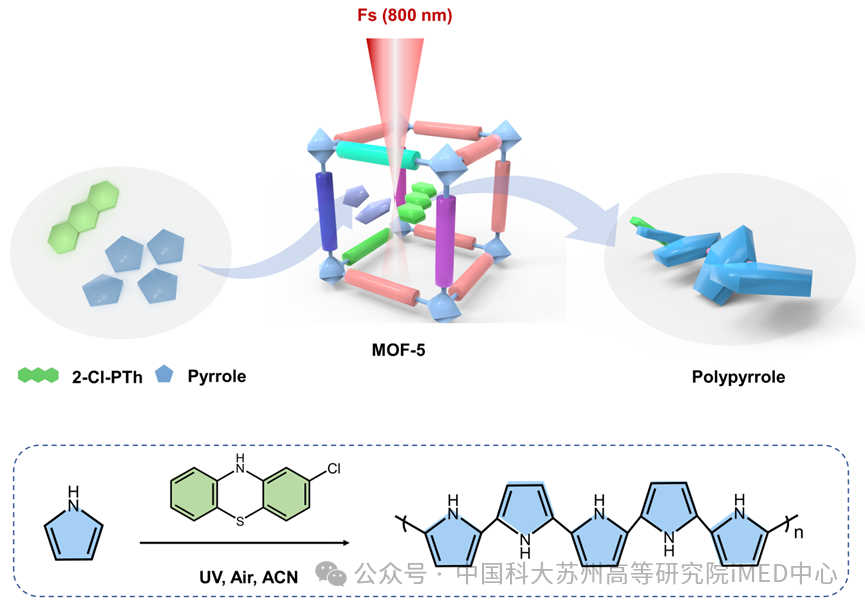
Figure: Schematic diagram of 3D printing conductive polymers inside microporous MOF single crystals

Although conductive polymers play a key role in flexible microelectronics, the current 3D manufacturing of conductive polymers still faces challenges such as poor material dispersion and low precision. Femtosecond laser direct writing technology offers a potential solution. However, fabricating complex 3D structures of conductive polymers using this technology remains challenging. This work proposes an innovative method: using inorganic microporous MOF single crystals as supporting materials, the preparation of polypyrrole is achieved through laser 3D printing. Under femtosecond laser excitation, the novel photosensitizer 2-chlorothiazine molecules generate singlet oxygen, triggering the polymerization of pyrrole monomers. Utilizing femtosecond laser direct writing technology, multilayer patterns and complex 3D structures of polypyrrole can be directly printed inside MOF single crystals, successfully imparting conductivity to the originally insulating MOF materials. Furthermore, the fluorescent properties of the photosensitizer molecules support in-situ characterization, providing real-time guidance for the 3D printing of functional conductive polymers. This technology shows great application potential in areas such as 3D sensing and microelectronic devices.
Postdoctoral Zhang Yusheng from the University of Science and Technology of China Suzhou Institute is the first author of the paper, with corresponding authors being Professor Yang Liang and Dr. Zhang Yusheng from the University of Science and Technology of China, and Professor Wang Cheng from Xiamen University. The University of Science and Technology of China Suzhou Institute is the first institution of the paper. This work was supported by the National Natural Science Foundation, the Suzhou Youth Innovation Leading Talent Project, and the China Postdoctoral Fund. Paper link: https://doi.org/10.1002/smll.202508454