The globalization of the chip industry is like a rope that cannot be tightened; the more one tries to break it, the more the close dependencies of each link become apparent.
No matter how some countries stir things up, the “global village” nature of this supply chain cannot be changed—after all, no place can confidently say, “We can produce all chips by ourselves without relying on others!”

Data speaks volumes. Recently, statistics on the global distribution of chip production capacity and demand have laid bare the cards of various players.
First, let’s look at the United States: demand accounts for 53% of the global market, but production capacity is only 8%, leaving a gap of 45%. What does this mean? Chips like Apple’s A-series, Qualcomm’s Snapdragon, and NVIDIA’s GPUs—all these “American chips” rely on non-American companies like TSMC, Samsung, and SMIC for manufacturing. The local production capacity is insufficient even to meet the needs of its own mobile phones.
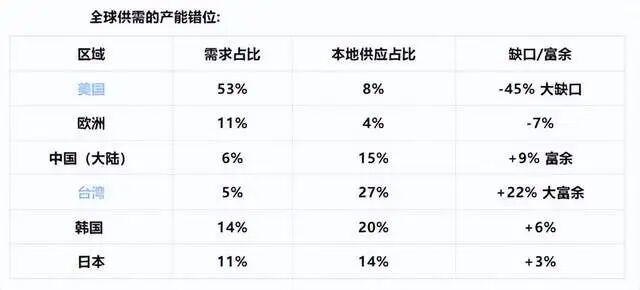
Now, looking at Taiwan: production capacity accounts for 27% of the global market, while demand is only 5%, resulting in a surplus of 22%. This is like running a large restaurant but only having one table of customers every day—if TSMC does not take global orders, its production capacity will go to waste.
Therefore, they have to search for customers worldwide, from Apple to AMD, from automotive chips to AI accelerators; as long as they can digest the production capacity, they will take any order.
The situation in mainland China is similar: production capacity accounts for 15%, demand is 6%, resulting in a surplus of 9%. Foundries like SMIC and Hua Hong cannot satisfy their production lines with local orders alone and must seek orders overseas.
In Europe, local production capacity is insufficient, so they directly hand over chip designs to Chinese factories for manufacturing; Japan and South Korea also have surplus capacity but must focus on overseas orders to survive.

In this landscape, the future trajectory is already scripted. The U.S. will certainly need to increase its domestic production capacity, as the 45% gap is like a thorn in its side; meanwhile, regions with surplus capacity like Taiwan, mainland China, and South Korea will have to engage in a more intense “order-snatching war”—relying solely on domestic demand cannot digest so many production lines.
Ultimately, the globalization of the chip industry is not a matter of choice but a matter of survival. TSMC cannot do without global orders, SMIC must rely on overseas customers for sustenance, and even American chip giants must bow down to find foundries. In this chain, no one can do without the other; breaking the chain and cutting off supplies will only harm oneself while trying to harm others.
Some may ask: Since globalization is so important, why do some still think about “decoupling”? The answer is simple: ideals are rich, but reality is stark. Chip manufacturing involves hundreds of processes and thousands of materials, from photolithography machines to chemical reagents, from design software to packaging and testing equipment; no country can close its doors and handle everything alone. Does the U.S. want to rebuild a complete industrial chain? First, ask if ASML’s photolithography machines are willing to move over, then calculate how much it will cost and how many years it will take.
Therefore, rather than resisting the trend, it is better to follow the rules. The Chinese chip industry should not be about building cars behind closed doors, but finding its position within globalization—able to digest surplus capacity while enhancing technology through cooperation. After all, in this era where you are in me and I am in you, cooperation is the hard truth; dismantling the platform will only leave everyone without a stage to perform.