Using trim-galore to remove low-quality reads and adaptersAdapters: An adapter is a known short nucleotide sequence used to link unknown target sequencing fragments.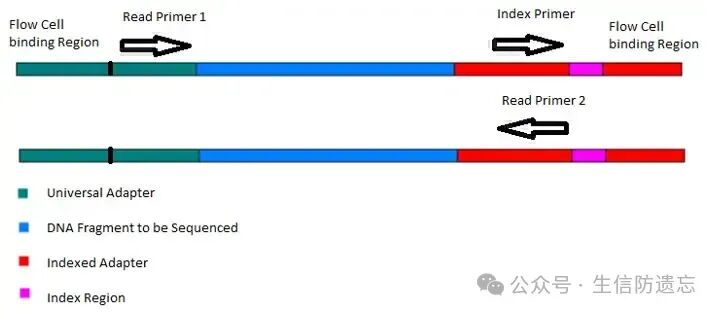 Create a new directory “trim-galore” to store the output results of trim-galore.1. If running a single sample (A-1_1, A-1_2):
trim_galore -q 25 --phred33 --stringency 3 --length 36 --paired A-1_1.fq.gz A-1_2.fq.gz --gzip -o ./cleandata/trim_galoredata/-q: Set the Phred quality score threshold, default is 20. For stricter results, change it to 25.–phred33: Generally 33 or 64, indicating the Phred quality score used by the sequencing platform.–stringency: Set the number of overlapping bases that can be tolerated between adapters, default is 1 (very strict). It can be relaxed somewhat, as the second adapter is unlikely to be read by the sequencer.–length: Set the output reads length threshold; reads shorter than this value will be discarded.–paired: For paired-end sequencing results, if one read in a pair is discarded, the other will also be discarded regardless of whether it meets the criteria.2. For multiple samples, write a for loop:Open the file with the vim command to write the for loop
vim trim_galore_batch.sh
for i in A-1 A-2 A-3 A-4
do
        trim_galore -q 25 --phred33 --length 36 --stringency 3 --paired /data/RNAseq/${i}_1.fq.gz /data/RNAseq/${i}_2.fq.gz --gzip -o /mnt/d/Users/RNAseq/cleandata/trim_galoredatadone##--paired /mnt/d/Users/RNAseq/${i}_1.fq.gz /mnt/d/Users/RNAseq/${i}_2.fq.gz is the storage location for the results obtained from fastqc, i.e., the qc1 folder##-o /mnt/d/Users/RNAseq/cleandata/trim_galoredata is the output path for trim-galore results
Run, one file takes about 1 hour
bash trim_galore_batch.shThe resulting files are as follows; the files generated by trim_galore have the suffix _val_1.fq.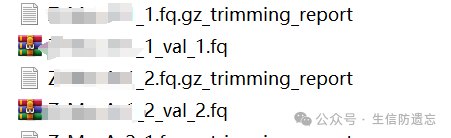 Then run fastqc again on these fq.gz files (see previous text) to generate .html reports, checking the base quality and adapter removal status after cleaning.Adapters before running trim-galore:
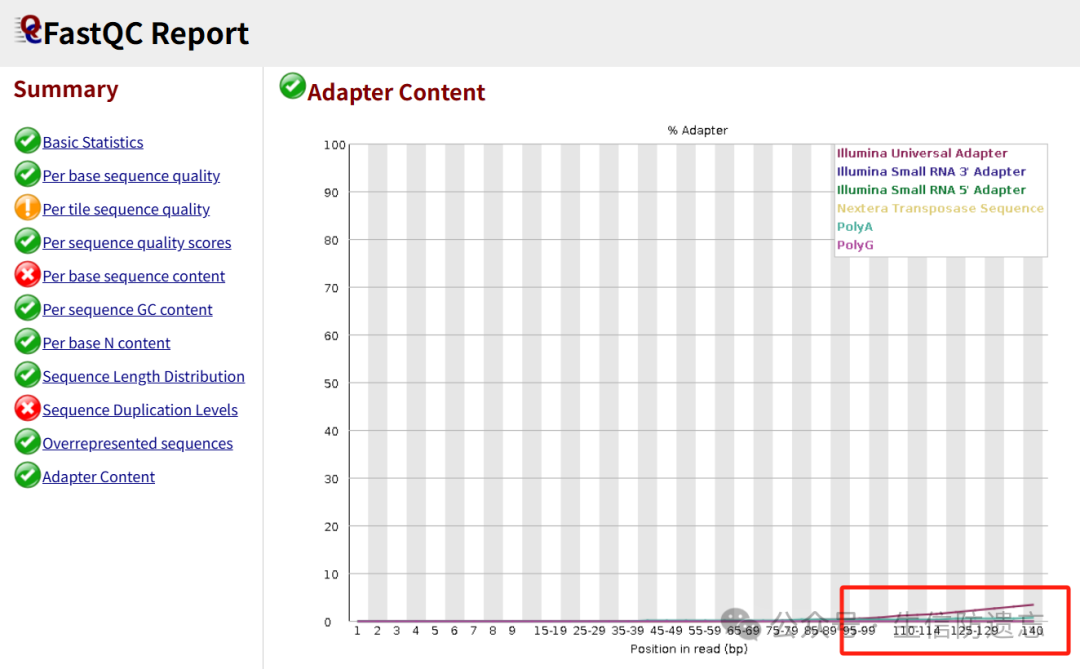 After cleaning:
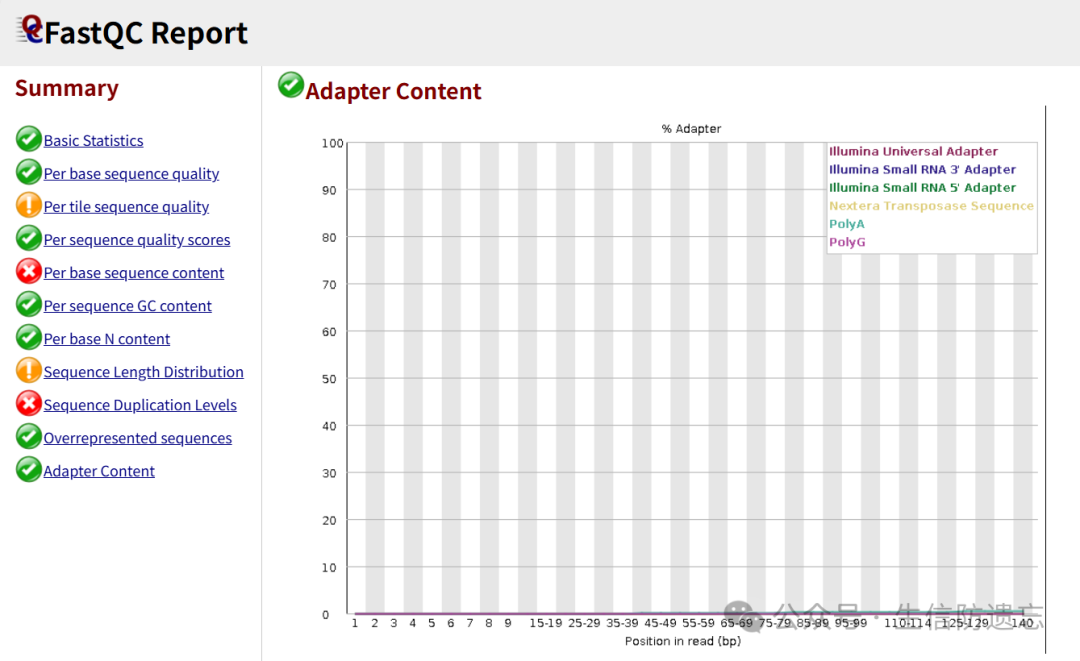 And the base quality is also very high
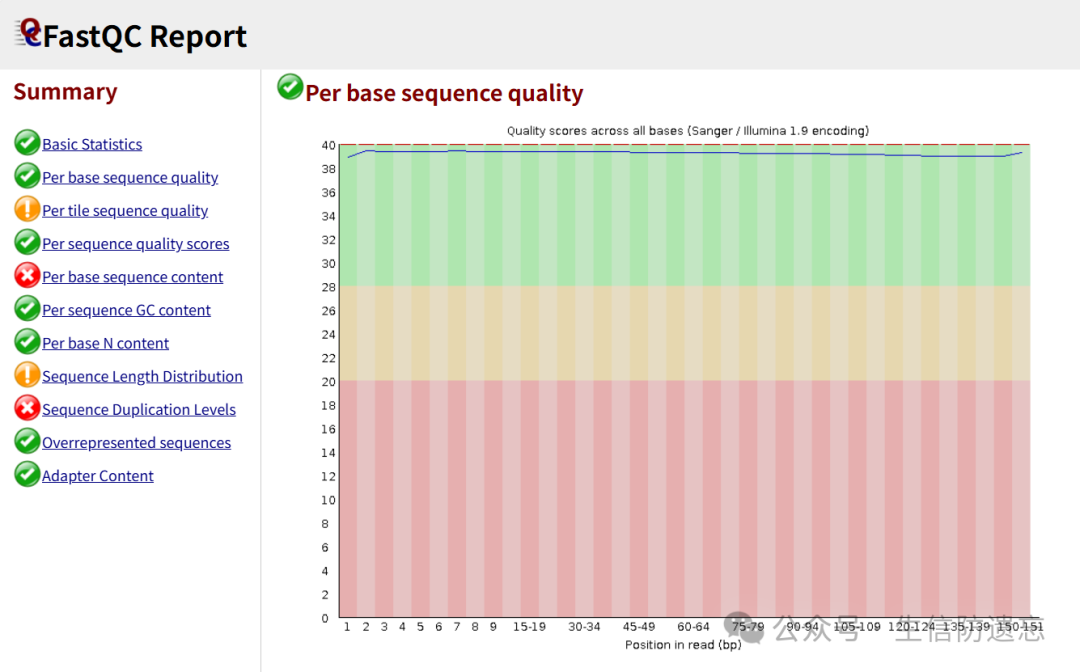 Thus, the data cleaning is complete. Next, use hisat2 to align the sequences to the reference genome.References:1. Jingxuan | What are adapters in high-throughput sequencing? (https://www.jianshu.com/p/3164dca8bd61)2. DoubleHelix | Transcriptome Analysis | Using trim-galore to remove low-quality reads and adapters (https://cloud.tencent.com/developer/article/1703054)