
Compared to large drones, small drones are much easier to operate. A skilled operator can make them fly in any direction to better meet shooting needs. So, what are the flight principles of drones?
Drone Takeoff
Each drone is equipped with rotors, and the basic theory of rotors is something that friends who have played with bamboo helicopters should know: when the hand’s rotation gives the bamboo helicopter a spinning speed, it generates lift, allowing the bamboo helicopter to take off.
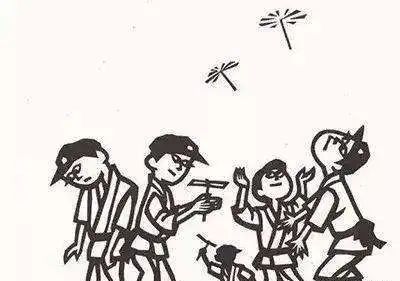
Similarly, multi-rotor drones also generate lift through the rotation of the motors, allowing the propellers to fly.
Drone Hovering
Taking a quadcopter as an example, when the sum of the lift from the four propellers equals the total weight of the aircraft, the lift and gravity balance, allowing the aircraft to hover in the air.
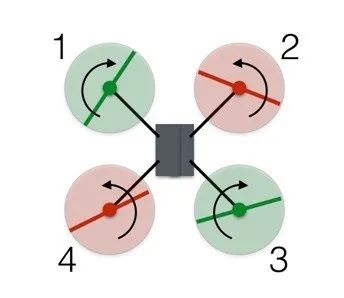
According to Newton’s laws, as the rotors spin, they also exert a reaction force on the motors, causing the motors to rotate in the opposite direction. To prevent the drone from spinning uncontrollably, the two adjacent propellers among the four of a quadcopter rotate in opposite directions.
Vertical Movement
Drones utilize rotors to achieve forward and stopping movements. The relativity of force means that when the rotors push air, the air also pushes back against the rotors. This is the basic principle that allows the drone to move up and down. Furthermore, the faster the rotors spin, the greater the lift, and vice versa.
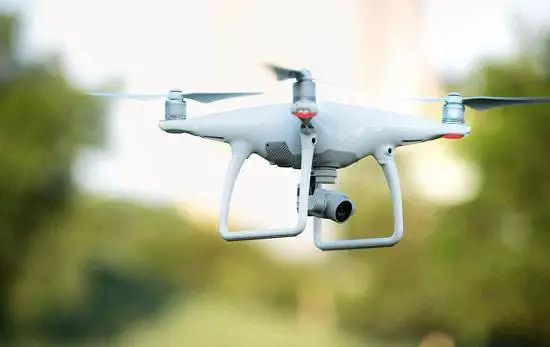
By increasing the thrust of the four rotors to generate an upward force greater than gravity. After this action is completed, the drone’s thrust can be relatively reduced, but to continue flying upward, the upward force must still be greater than the downward force. The requirement for lowering the drone is the opposite: it requires reducing the rotor thrust speed, at which point the net force is downward.
Rotational Movement
How does a drone flying north turn to fly south? What is the principle of rotor movement in this case?
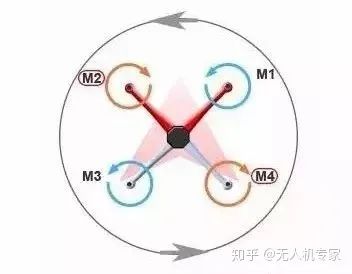
As shown in the figure, the red rotor rotates counterclockwise, while the green rotor rotates clockwise. When these two sets of rotors rotate in opposite directions, the total thrust of the drone is zero.
To make the drone turn right, the angular speed of rotor M1 needs to be reduced. However, while the loss of thrust from rotor M1 can change the direction of movement, the upward force does not equal the downward gravity, so the drone will descend.
So, how can the drone maintain its altitude while changing direction?
By reducing the rotational speed of rotors M1 and M3 while increasing the rotational speed of rotors M2 and M4. At this time, the angular momentum of the rotors is still not zero, so the drone can rotate. The total force still equals the gravity, allowing the drone to maintain the same altitude. Since the rotors rotating in the same direction are diagonal, the drone can still remain balanced.
Horizontal Flight
What is the difference between the principles of a drone moving forward and backward? Actually, there is none, because drones are symmetrical. This also applies to lateral movement. A four-rotor drone is like a vehicle that can treat any side as the front, so how to move forward also explains how to move backward or sideways.
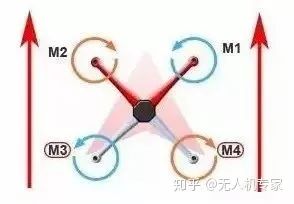
When it is necessary to move forward in the direction of the arrow, the motors M3 and M4 will increase their speed, while the motors M1 and M2 will decrease their speed. Since the lift at the rear of the aircraft is greater than that at the front, the aircraft will tilt forward.
The side view when tilted is shown in the following figure. At this time, the lift generated by the propellers not only offsets the weight of the aircraft in the vertical direction but also has a horizontal component, which gives the aircraft horizontal acceleration, allowing it to fly forward.
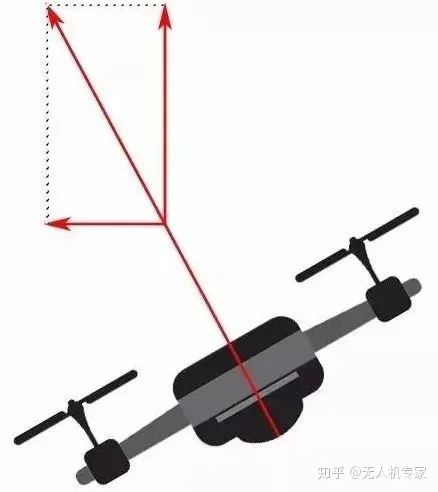
Conversely, when motors M1 and M2 accelerate while motors M3 and M4 decelerate, the aircraft will tilt backward, thus flying backward.
Similarly, when motors M1 and M4 accelerate while motors M2 and M3 decelerate, the aircraft tilts left, thus flying left;
When motors M2 and M3 accelerate while motors M1 and M4 decelerate, the aircraft tilts right, thus flying right.
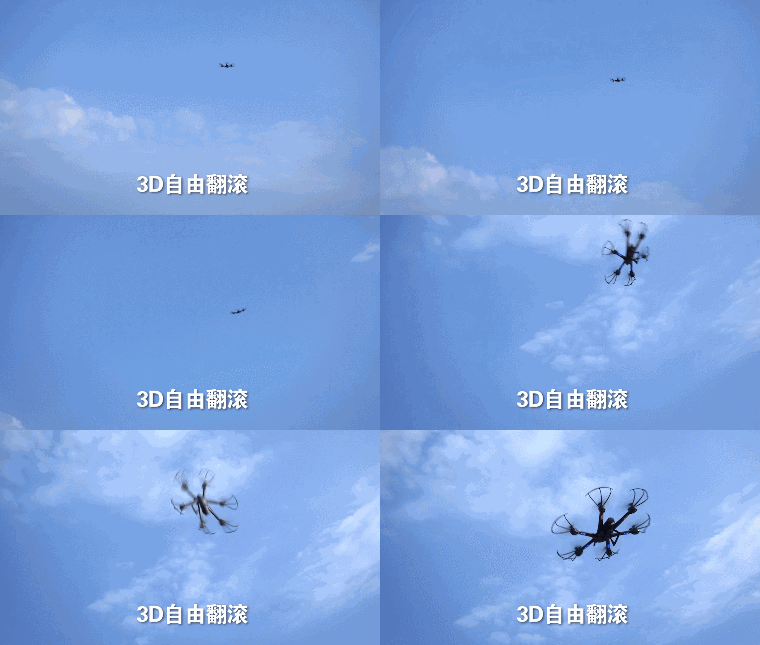
Of course, drones can perform many more complex maneuvers that will amaze us:
Learn to Use Computer Systems
Every action of operating a drone is accomplished by changing the speed of one or more rotors. To control all rotors with a single controller, one must make good use of a certain computer control system. In addition, the drone’s accelerometer and gyroscope can fine-tune each rotor, further enhancing the ease and stability of flight. So if the computer system does all the work, operating the drone becomes quite easy.
Isn’t it interesting to understand the flight principles of drones?

Jiangdong Vocational Technical College
Scan to | Follow us
Source | 36Kr, Zhihu
Editor | Party Office
Review | Sun Libing