Limited Time Offer, Military Science and Technology 2024 Annual Package Original Price 720 Yuan, Limited Time Discount Price 699 Yuan!
For a long time, China has had a significant gap in maritime patrol aircraft. Generally speaking, maritime patrol aircraft need to have long endurance, wide patrol range, and the ability to monitor both surface and underwater. When necessary, they should also be able to participate in anti-submarine and anti-ship operations.
In recent years, as maritime conflicts in the vicinity have intensified, the Chinese Navy has invested more resources into the development of this type of aircraft. However, to date, the number of patrol aircraft equipped by our Navy is still very limited. At the same time, large manned maritime patrol aircraft are relatively expensive in terms of operational costs, while unmanned reconnaissance and surveillance aircraft are lower in cost, have longer mission execution times, do not require crew shifts like manned aircraft, and are not restricted by the physiological conditions of personnel. At the 2021 Zhuhai Airshow, the new generation WJ-700 “Falcon” high-altitude high-speed reconnaissance-strike integrated UAV developed by the China Aerospace Science and Industry Corporation (CASC) made a stunning appearance, providing a new solution for long-term maritime patrol and surveillance in China.

WJ-700 High-Speed UAV
Outstanding reconnaissance capability with wide-area maritime surveillance
In terms of appearance, the WJ-700 UAV continues the typical long-endurance UAV design, featuring design elements such as a bulbous nose similar to the “Global Hawk”, a high aspect ratio main wing, V-shaped tail, and dorsal air intake. It is reported that the maximum flight speed of the WJ-700 may reach around 700 kilometers per hour, with a maximum cruising speed of 600 kilometers per hour, placing it at a prominent position among domestic long-endurance UAVs. Its practical ceiling is expected to easily exceed 9,000 meters, with a cruising time exceeding 20 hours.
According to the promotional claims of the Sea Eagle Company, the WJ-700 UAV achieves domestic leading and internationally advanced levels in key performance indicators such as endurance, range, and payload capacity for UAVs of equivalent tonnage. This model focuses on the domestic and international market demands for the next 5 to 10 years, integrating high altitude, high speed, long endurance, and large payload capabilities.
Due to the long-endurance capabilities similar to the “Global Hawk” high-altitude high-speed UAV and strong payload, the WJ-700 also possesses wide-area reconnaissance and surveillance capabilities at sea like the RQ-4C, and it can even replace maritime patrol aircraft in most mission scenarios, executing various long-duration reconnaissance and surveillance tasks.
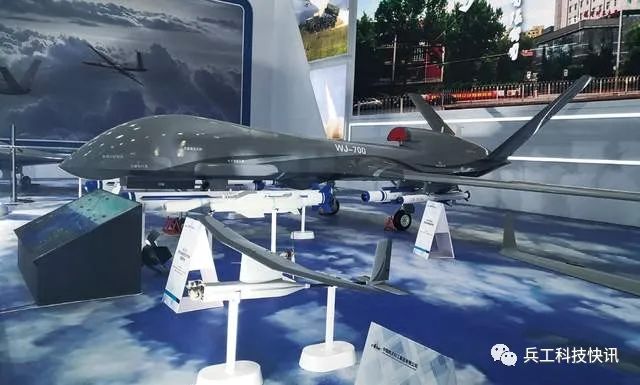
WJ-700 Outstanding reconnaissance capability with wide-area maritime surveillance
From the high bulbous structure at the nose, it can be seen that the WJ-700 is designed with a satellite antenna, which can fully perform remote reconnaissance and even communication relay tasks over thousands of kilometers at sea. Below the UAV’s nose, there is a complete equipment compartment that houses a Synthetic Aperture Radar (SAR) for observing, monitoring, and imaging land and maritime targets. This equipment has high measurement and imaging accuracy and is a high-performance reconnaissance payload. Below the head of the WJ-700 UAV, there is a multi-window electro-optical turret, which is an electro-optical reconnaissance payload that can likely perform white-light photography, video recording, and low-light and infrared imaging, providing 24-hour all-weather reconnaissance capabilities, embodying the most basic and conventional reconnaissance capabilities for UAVs.
Interestingly, on both sides of the rear of the WJ-700’s nose, there are elongated fairing structures, which are the locations for electronic reconnaissance antennas. This indicates that the WJ-700 UAV also possesses certain electronic reconnaissance capabilities, able to direction-find, locate, and track radiation targets such as enemy radar stations emitting electromagnetic waves. This means the WJ-700 also has the capabilities of an electronic reconnaissance UAV. In addition, it is noteworthy that there is a streamlined protrusion on the belly of the WJ-700 UAV. Although the third academy has not specified its function and equipment type, it is expected to be an important ground/sea detection system.
In summary, the outstanding reconnaissance capabilities of the WJ-700 enable it to easily undertake wide-area maritime reconnaissance tasks.
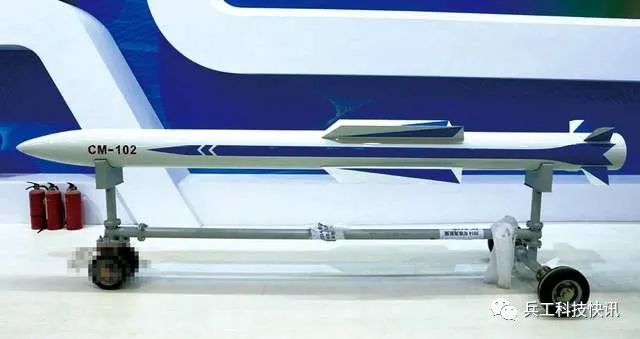
CM-102 Anti-Radiation Missile
Core of the Maritime Unmanned Combat System
The WJ-700 UAV is a reconnaissance-strike integrated UAV. In addition to reconnaissance and patrol, the Sea Eagle Company also describes it as the “Maritime Unmanned Combat Center”, indicating its strong strike capabilities. According to the official introduction from Sea Eagle Company: The WJ-700 UAV has capabilities for precise strikes against ground targets beyond the defense perimeter, anti-ship, anti-radiation, and wide-area reconnaissance and surveillance operations, capable of performing diverse combat missions in high-threat battlefield environments.
First, anti-radiation missions. The WJ-700 UAV can be equipped with the CM-102 anti-radiation missile, which can effectively attack various air defense, guidance, and fire control radars of the opponent, carrying out air defense suppression with advantages such as long range, wide launch envelope, and high hit accuracy. The CM-102 anti-radiation missile uses a wing design, and the center of gravity and lift center do not change significantly with distance, speed, and altitude, which helps improve the missile’s static stability, thereby enhancing its maneuverability. The small aspect ratio of the missile wings results in lower wave drag, facilitating rapid acceleration after launch, and the small span size of the missile makes it suitable for installation under the UAV’s wings.
Second, beyond defense perimeter ground attack missions. The WJ-700 can carry various advanced and diverse air-to-ground missiles, such as the CM-501GAK, CM-502KG, and C-705KD air-to-ground missiles.
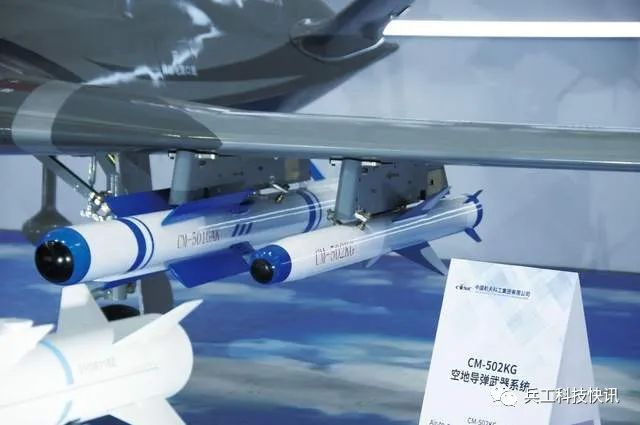
CM-501GAK Air-to-Ground Missile and CM-502KG Missile
Third, anti-ship combat missions. At the Zhuhai Airshow, the WJ-700 UAV model directly carried two C-701 anti-ship missiles. The C-701 anti-ship missile weighs 100 kilograms and has a range of 30 kilometers. This missile was developed by the Third Academy of Aerospace Science and Industry and is sold by China Precision Import and Export Corporation. It is a lightweight short-range anti-ship missile primarily used to attack small surface targets such as missile boats due to its limited range and warhead weight. In promotional materials from the Chinese side, it is claimed that this missile can also be used as a small air-to-ground missile. The missile can be launched from attack boats or heavy trucks, and can also be launched from helicopters or UAVs. It has become one of the commonly used anti-ship missile models for UAVs.
Broad Application Prospects
As a flagship product of advanced UAV equipment from the China Aerospace Science and Industry Corporation, the WJ-700 UAV is currently one of the few high-altitude high-speed long-endurance reconnaissance-strike integrated UAVs in the world and will pioneer a new style of UAV combat use; following the completion of various system-level tests and validations, it will be officially put into combat application.
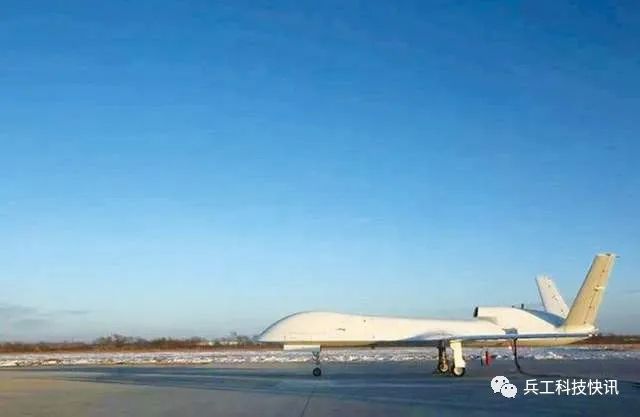
On January 11, 2021, the WJ-700 successfully completed its maiden flight.
From the perspective of reconnaissance-strike integrated UAVs, although the WJ-700 still has obvious gaps in platform quality, size, and payload compared to the “Global Hawk” UAV, its diverse reconnaissance payload and strike capabilities allow it to serve not only as a wide-area maritime surveillance system but also as a core for maritime strikes. This versatility is currently unmatched by any other high-altitude high-speed UAV model in China. This is also the core competitiveness of the WJ-700 UAV.
Currently, the WJ-700 UAV system has achieved its maiden flight in January 2021, successfully verifying the correctness, rationality, and coordination of the WJ-700 UAV system design, taking a solid step towards UAV productization, significantly enhancing the influence of the academy in the UAV industry, and providing important support for breakthroughs in the development of domestic unmanned equipment.

Interested readers, hurry up and click the link below to purchase, limited print quantity, while supplies last!
Purchase Link:
2024 Issue 1 “Official Announcement! Domestic Intelligent Tank Production Line” Military Science and Technology Magazine302023 Issue 24 “075 Amphibious Assault Ship No. 4 Launched”Military Science and Technology Magazine302023 Issue 23 “Detailed Analysis of J-15 Carrier-Based Aircraft”Military Science and Technology Magazine30

Welcome to follow the public account below:↓↓↓
Important Notice: Due to WeChat’s revision, it is recommended to star the account and like it; the system will mark you as a long-read user, otherwise you may not receive the next article.
End