The emergence of drones has significantly lowered the “high-end” threshold for aerial reconnaissance. With just a few drones, a continuous stream of real-time intelligence can be obtained, making this temptation clear to commanders at all levels in the field. Consequently, the military demand for drones from various countries has shown “explosive” growth.
Due to the enormous market potential and the relative ease of development compared to larger manned combat aircraft, a situation has arisen where both large and small aviation enterprises are clustering around drone development. In this wave, Italy’s aerospace industry certainly will not be “absent” and quickly developed the impressive “Falco” medium-altitude unmanned reconnaissance aircraft.
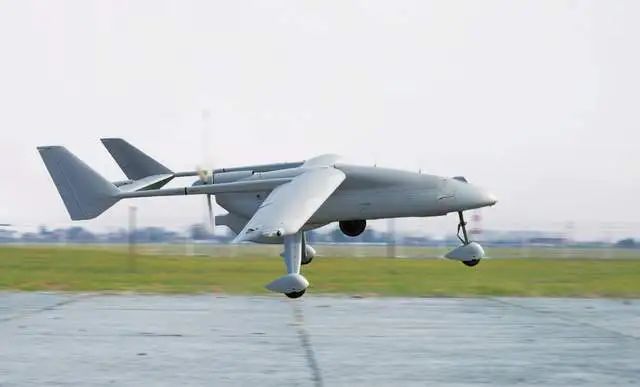
Italy’s “Falco” medium-altitude unmanned reconnaissance aircraft
The Eyes of Frontline Commanders
Although the name Galileo Avionics does not stand out among the elite of Italy’s aerospace industry, the company has considerable expertise in aerospace electronics, which has become their “capital” for self-developing unmanned reconnaissance aircraft. After comprehensively considering the company’s technological strength and market prospects, the technical team at Galileo Avionics proposed a design for a medium-altitude long-endurance unmanned reconnaissance aircraft named “Falco” (Italian for “falcon”).
The development process was relatively smooth, with the drone’s airframe (without a full set of avionics and mission equipment) successfully completing its maiden flight in December 2003. It then underwent nearly 40 hours of testing in the airspace near Sardinia. Subsequently, Galileo Avionics conducted flight tests to refine its flight control system while also installing various mission equipment, with the electro-optical turret being installed in July 2005, and radar installation and integration testing beginning in 2006. By January 2007, Galileo Avionics officially announced that the “Falco” had completed all tests and was ready for production delivery, marking the completion of the entire aircraft’s development.
After a series of mergers and integrations, Galileo Avionics is now part of the Italian aerospace giant Leonardo Company, which is responsible for the subsequent production and improvement of the “Falco”. Leonardo promotes it as a key product worldwide.
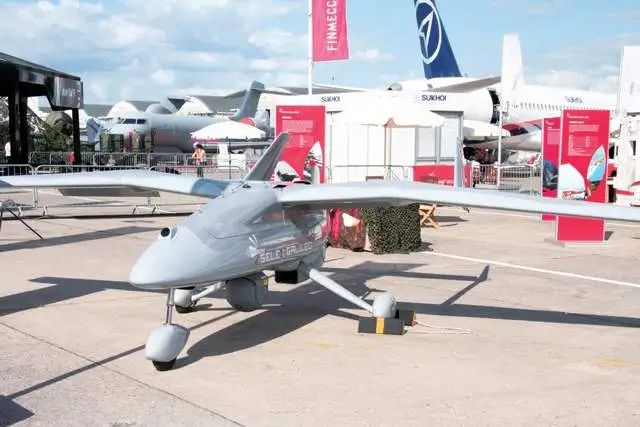
The “Falco” at the 2009 Paris Air Show, with the name Galileo on its fuselage
A Design of Radical and Conservative Elements
As one of the representative works of Italian drones, the “Falco” incorporates many “old” elements that are hard to find in manned combat aircraft, as well as “new” technologies that represent the cutting edge of aviation technology.
The “Falco” features a high-wing and twin-tail configuration, with a total length of 5.25 meters, a wingspan of 7.2 meters, and a maximum take-off weight of up to 420 kilograms. A 65-horsepower piston engine is installed at the tail, propelling the aircraft to a maximum speed of 216 km/h and a service ceiling of 6,500 meters, with a flight endurance of 8-14 hours, which is considered average for unmanned reconnaissance aircraft of this class.
Due to its push-propeller design, there is ample space at the nose and front of the aircraft for various avionics equipment. One of the highlights of the entire aircraft is that the “Falco” not only employs the most advanced reconnaissance equipment available but also encompasses various reconnaissance methods, enabling all-weather battlefield surveillance. The nose houses a “Gabianno”-20 multimode synthetic aperture radar, while an EOST 46 electro-optical turret is installed under the belly. With the rapid development of microelectronics technology, phased array radar, once a hallmark of “high-end” combat aircraft, has become miniaturized and affordable, making it an optional feature for the new generation of unmanned reconnaissance aircraft. To enhance competitiveness, the “Falco” was upgraded in September 2009 with a synthetic aperture radar utilizing an active electronically scanned array. This radar, named PicoSAR, not only features radar imaging and ground moving target indication capabilities but can also be utilized for counter-IED operations when paired with specialized detection software.
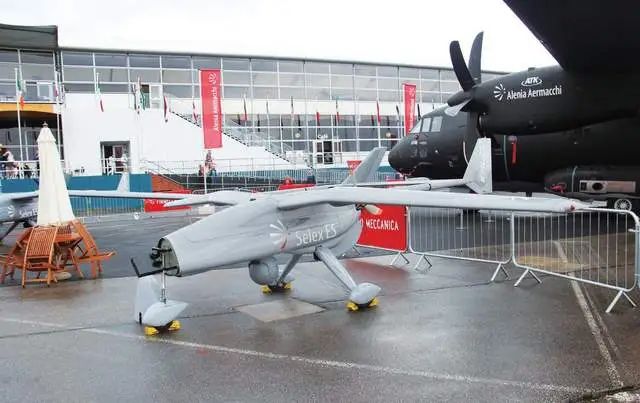
The “Falco” exhibited at the 2014 Farnborough Airshow, with the nose already upgraded to the PicoSAR synthetic aperture radar
Additionally, the aircraft has a maximum payload capacity of 70 kilograms, allowing it to carry other sensors for special missions, such as nuclear and chemical weapon detection. It is noteworthy that various portable surface-to-air missiles have become “widespread” among military forces and armed organizations, and to counter this new threat, the “Falco” is also equipped with infrared decoys and chaff dispensers.
Considering the need for emergency landings, the “Falco” features a fixed tricycle landing gear, with the front and rear landing gear fixed within a fuselage frame. The front landing gear weighs 7 kilograms, while the rear landing gear weighs 23.2 kilograms, with the wheels having fairings to reduce aerodynamic drag.
Moreover, the “Falco” is equipped with a comprehensive ground control and maintenance system. A complete “Falco” unmanned aircraft system includes a ground control station (GCS), a ground data terminal (GDT), ground support equipment (GSE), and four unmanned aircraft. In addition to conventional takeoff and landing methods, the “Falco” can also be launched from ground-based catapults.
Promising Export Prospects
Although it has not been long since its inception, the “Falco” has already spawned an improved model, the EVO, to adapt to the fierce market competition in the ever-evolving aviation technology landscape. The “EVO” variant, based on the basic model, has a total length of 6.2 meters, a wingspan of 12.5 meters, and a maximum take-off weight of 650 kilograms. To accommodate the significantly increased “size”, the engine of the “Falco” EVO has been replaced with a new 80-horsepower engine, achieving a service ceiling of 7,000 meters and a maximum endurance of over 20 hours, while also providing more powerful electrical capabilities for newer avionics equipment.
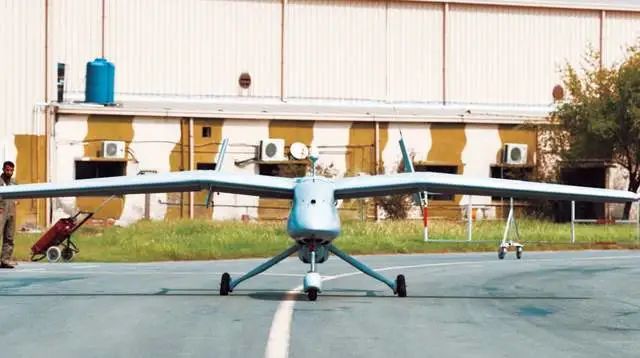
A “Falco” equipped by the Pakistan Air Force
Despite various reasons leading to the “Falco” not being widely adopted by the Italian military after its successful development, it has successfully opened overseas markets, becoming one of the most successful unmanned aircraft models sold abroad by Italy. Currently, countries such as Pakistan, Jordan, Saudi Arabia, and Turkmenistan have procured this unmanned aircraft. Improvements for this aircraft continue in Italy, with efforts to upgrade or replace various new avionics equipment to ensure competitiveness against emerging drones from other countries, as well as developing new markets and expanding its new uses through the introduction of new variants (the basic and EVO models do not necessarily replace each other but represent market behavior targeting different user needs).
Due to the continuous influx of refugees from the Middle East and North Africa in recent years, the overwhelmed European Union is determined to enhance surveillance of land and coastal border areas using new methods such as drones. To this end, Leonardo Company has developed a “Remotely Piloted Air System” (RPAS) based on the “Falco” EVO, which has already entered test flights, showing that its performance is very promising, adequately meeting the needs of EU member states.
Weng Weili / Text

Follow the backup account below:↓↓↓
Important Notice: Due to the WeChat update, it is recommended to star and like the account; the system will mark you as a long-read user. Otherwise, you may not receive the next article.
End