(Report Producer/Authors: Guolian Securities, Huang Kai, Chen Anyu, Yu Hu)
1. V2X On-Board Terminals Are Key Devices in Integrated Vehicle-Road-Cloud
1.1 V2X Terminals Are Core to Vehicle Communication with Other Devices
The on-board unit (OBU) refers to devices installed in intelligent connected vehicles, equipped with certain application systems and functional modules, capable of connectivity through EUHT, C-V2X (direct communication PC5), 4G/5G cellular networks, high-precision positioning, data collection, data storage, data transmission, and security protection. The product can be in a standalone or integrated form; the standalone OBU is designed as an independent device or system, while the integrated OBU is designed to be integrated into other vehicle devices or systems. With the development of the intelligent connected vehicle industry, the integration of V2X (Vehicle to Everything) functionality with T-BOX, domain controllers, etc., has become a trend. Therefore, in this article, we collectively refer to OBUs that realize V2X functionality as V2X on-board terminals.
V2X on-board terminals mainly include wireless communication modules, processing units, positioning modules, encryption modules, etc., with the wireless communication module being the core of the product, accounting for over 60% of the overall cost. As part of the vehicle system, V2X on-board terminals support communication between the vehicle system and cloud control platforms, roadside systems, other vehicles, and other traffic participants. They send dynamic driving information to roadside and/or cloud control platforms and receive traffic situation awareness, decision-making, and control information services from roadside and/or cloud control platforms.
According to the “Reference Guide for the Scale Construction and Application of Integrated Vehicle-Road-Cloud (Version 1.0),” OBUs should meet the requirements for 5G, C-V2X direct communication; data exchange with roadside infrastructure, cloud control platforms, data communication with on-board computing units, satellite positioning, data security, and identity authentication.
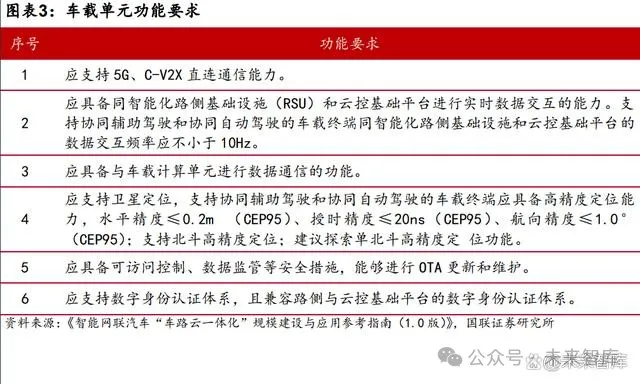
According to the Ministry of Transport’s “Performance Requirements and Testing Methods for V2X Communication Terminals for Operational Vehicles,” V2X on-board terminals should support warnings for prohibited vehicle access segments, speed limits and speeding alerts, real-time warnings for abnormal weather, warnings for crossing lines in dangerous road sections, and other safety applications.
The application scenarios for V2X are further enriched. In 2020, the China Society of Automotive Engineers released the “Application Layer and Application Data Interaction Standards for Cooperative Intelligent Transportation Systems (Phase I)” and “Application Layer and Application Data Interaction Standards for Cooperative Intelligent Transportation Systems (Phase II),” selecting 17 typical applications covering safety, efficiency, and information services as Phase I applications, and selecting 12 typical applications focused on safety, efficiency, information services, traffic management, and advanced intelligent driving as Phase II applications.
1.2 V2X Terminals Are Developing Towards 5G and High Integration
V2X terminals originated from the ETC application scenario, referred to as ETC OBU. ETC connects roadside and vehicle ends and can be seen as the primary application form of V2X, with its on-board terminal called ETC OBU. The development of the ETC system (Electronic Toll Collection) began in the 1990s, with Europe, the US, and Japan exploring automatic road charging systems based on electronic technology. In China, the first high-speed trial was conducted in 1998, and the nationwide ETC networking work officially started in 2014, with comprehensive promotion of ETC in 2019. In the scenario of electronic toll collection on highways, vehicles equipped with ETC pass through ETC lanes, and the OBU module on board communicates bidirectionally with roadside units (RSUs) using radio frequency identification (RFID) or wireless communication (such as DSRC). The OBU sends stored vehicle identification information to the RSU, which receives it and automatically identifies the vehicle through data processing, billing, deducting fees, and releasing it.
With the development of vehicle networking, V2X OBU has replaced ETC OBU. Compared to the DSRC technology primarily used by ETC, the C-V2X technology, which completed standardization work in March 2017 at 3GPP, has advantages such as better coverage, more reliable communication, lower deployment costs, and compatibility with 5G. In 2020, the US Federal Communications Commission (FCC) officially announced the abandonment of DSRC in favor of C-V2X, signifying that C-V2X, promoted by China, has become the only international standard for vehicle networking. Traditional ETC OBU cannot meet the broader V2X application demands, thus OBU devices have evolved to V2X OBU adopting C-V2X technology standards, with manufacturers launching new products.
V2X terminals will develop towards 5G NR V2X to meet higher-level autonomous driving requirements. C-V2X is a V2X technology based on cellular mobile communication, divided into LTE V2X and 5G NR V2X. Due to latency and reliability shortcomings, LTE V2X-based vehicle networking solutions can only be used for assisted driving and basic autonomous driving scenarios, necessitating the adoption of newer V2X technologies to meet future high-level autonomous driving demands, leading to the emergence of 5G New Radio (NR) V2X. V2X on-board terminals will evolve from LTE V2X OBU to 5G V2X OBU.
V2X on-board terminals are integrating with T-BOX, increasing integration levels. In recent years, different forms and paths of vehicle electronic and electrical architecture have emerged. The pre-installation of C-V2X in vehicles needs to match the evolution direction of vehicle electronic and electrical architecture, the implementation of ADAS/autonomous driving, and the requirements for vehicle safety enhancement. Manufacturers are actively exploring the integration of V2X on-board terminals with T-BOX, positioning modules, domain controllers, etc., resulting in a diverse product form.
V2X+T-BOX integration: Integrating C-V2X with 4G/5G communication functions, T-BOX is responsible for the vehicle’s communication functions, including cellular communication and vehicle networking communication. For example, Shanghai Botai, based on Huawei’s MH5000 module and self-developed vehicle-grade front-mounted terminal, possesses 5G and C-V2X communication functions, capable of providing typical V2X applications. This product can perform all functions of traditional vehicle-mounted T-BOX while also providing full-chain V2X services, supporting custom software system integration for vehicle manufacturers, and offering services such as information collection, intelligent vehicle control, assisted driving, Bluetooth keys, mobile vehicle interconnectivity, AR navigation, and high-precision map navigation.
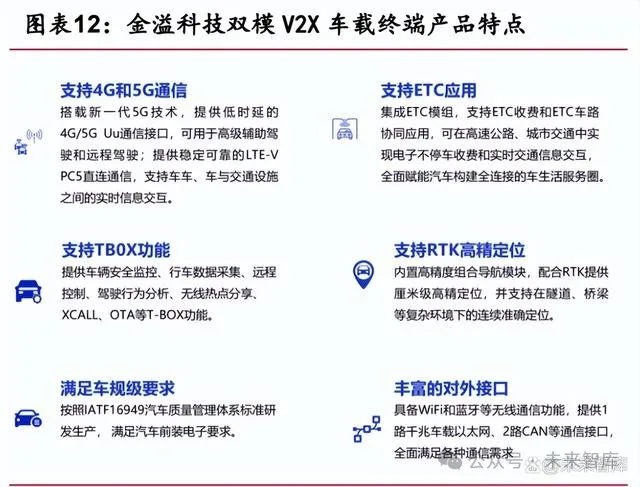
V2X+ETC+T-BOX integration: Jinyi Technology has released a dual-mode V2X on-board terminal (ETC+V2X) CBLY15 (front-mounted version), integrating ETC and 5G communication technologies, and equipped with T-BOX functions, fully serving multiple application scenarios such as autonomous driving assistance, vehicle-road collaboration, remote monitoring, and ETC charging.
5G+V2X Intelligent Antenna: Desay SV’s “5G V2X Intelligent Antenna” integrates multiple antenna technologies including 5G MIMO, C-V2X, Wi-Fi, BLE, dual-band GNSS, AM/FM, as well as high-precision IMU and GNSS modules, possessing low-latency, high-bandwidth communication capabilities, supporting centimeter-level high-precision positioning, vehicle-road collaboration, and V2X services. It features various product forms such as T-BOX, “shark fin” intelligent antennas, and flat intelligent antennas to meet diverse terminal vehicle demands.
V2X+Domain Controller Integration: V2X direct communication mainly focuses on vehicle safety and belongs to the ADAS domain or autonomous driving domain, so V2X can be integrated with domain controllers. For instance, Zhongxin Kezhilun has released a C-V2X integrated intelligent driving domain controller solution, based on DMD3A & Horizon J3 integrated vehicle-road collaboration domain control solution, supporting C-V2X direct communication, enabling vehicle-to-vehicle (V2V) and vehicle-to-infrastructure (V2I) collaboration, and integrating forward visual processing functions to achieve connected adaptive cruise control (CACC) functionality.
V2X+Gateway Integration: Given the increasingly massive information exchange data in vehicle electronic and electrical architecture, along with the rising demands for reliability and real-time performance, manufacturers are exploring the integration of C-V2X into information exchange domains. For example, Yunqi Future has released China’s first vehicle-grade 5G autonomous driving vehicle safety gateway L3000, supporting 5G, gigabit vehicle-grade Ethernet, and integrating C-V2X functions, further broadening connectivity capabilities for heterogeneous networks in the entire vehicle.
2. The Large-Scale Implementation of Vehicle-Road-Cloud Is Expected to Drive Rapid Growth of the V2X On-Board Terminal Market
2.1 Favorable Policies Are Expected to Drive Rapid Increase in V2X Terminal Penetration Rate
The penetration rate of V2X terminals is relatively low, but small-scale pre-installation has begun. Currently, the construction of intelligent connected vehicle-road-cloud integration mainly focuses on demonstration zones and pilot areas, so the vehicles equipped with V2X OBU are primarily test vehicles operating in demonstration zones and pilot areas. Overall vehicle manufacturers and ordinary users have low willingness to retrofit, as users are unwilling to pay for this under the current imperfect roadside infrastructure. Taking the Beijing Yizhuang demonstration zone as an example, by March 2024, only over 800 vehicles are conducting testing and commercial pilot explorations. Other pilot areas have also retrofitted relatively few vehicles, such as in Changsha, Hunan, where only over 2,000 buses were retrofitted by early 2023, and in Chongqing, where only 1,095 ride-hailing vehicles were retrofitted by August 2023. However, with the evolution and upgrading of intelligent connected technology, the installation rate of V2X terminals is also rapidly increasing. According to data from Zos Research, the pre-installation rate of C-V2X in passenger cars in 2023 is about 1.2%, with a pre-installation scale exceeding 270,000 vehicles, and it is expected to enter a large-scale installation period in 2026-2027, with an optimistic forecast that the pre-installation rate could exceed 9%.
Multiple favorable policies are driving rapid growth of V2X terminals. Recently, a series of favorable policies related to intelligent connected vehicle-road-cloud integration have been intensively issued, accelerating the pace of industrialization, and intelligent connected construction is entering a fast track. In January 2024, five departments, including the Ministry of Industry and Information Technology and the Ministry of Public Security, jointly issued a “Notice on Carrying Out Pilot Work for Intelligent Connected Vehicles’ Vehicle-Road-Cloud Integration Applications” (hereinafter referred to as the “Notice”), which clearly stipulates classified measures to enhance vehicle connectivity rates, requiring 100% installation of C-V2X on-board terminals and digital identity certificates for trial operation vehicles; encouraging the retrofitting of C-V2X on-board terminals in existing vehicles in public sectors such as city buses, official vehicles, and taxis, with a target installation rate of 50% for new vehicles; and encouraging the installation of C-V2X on-board terminals in mass-produced vehicles with L2 level or higher autonomous driving functions sold in pilot cities. Meanwhile, the 2024 version of the China New Car Assessment Program (C-NCAP) officially includes V2X in the assessment scope, and equipping C-V2X can ensure that manufacturers achieve better results in the field of active safety for new vehicles, with this rule coming into effect from July 2024. Under the push of policies, various regions are gradually starting project planning and implementation. Cities such as Beijing, Wuhan, Hangzhou, and Fuzhou are actively promoting the construction of vehicle-road-cloud integration. On July 3, 2024, the first batch of “vehicle-road-cloud integration” pilot cities was announced, with Beijing, Shanghai, Chongqing, Ordos, and 20 other cities and alliances included, covering 16 provinces and municipalities nationwide. The announcement of this first batch of pilot cities signifies that the large-scale construction of intelligent connected vehicle-road-cloud in China is expected to officially start, marking the entry of “vehicle-road-cloud integration” into a new phase of large-scale implementation and development. In the future, vehicle-road-cloud integration projects may be included in the scope of “supporting national major strategies and key areas of safety capacity building” (referred to as “two major constructions”) and are expected to receive long-term special support from government bonds. Therefore, we believe that under government leadership, the construction of intelligent connected infrastructure is expected to accelerate, driving the rapid increase in the installation rate of V2X on-board terminals.
2.2 The Implementation of Vehicle-Road-Cloud Integration Will Drive the V2X On-Board Terminal Market
By 2030, the market size of V2X on-board terminals is expected to approach 10 billion, with short-term retrofitting of existing vehicles combined with continuous improvement in new vehicle penetration rates. The retrofitting of existing vehicles and the promotion of V2X terminals by vehicle manufacturers will rapidly increase the penetration rate of V2X terminals. On one hand, with the announcement of the first batch of intelligent vehicle access and road traffic pilot lists, companies like BYD, NIO, Changan Automobile, and Yutong are expected to promote new vehicles equipped with V2X on-board terminals; on the other hand, the “Notice” encourages new vehicles in the public sector and mass-produced vehicles sold in pilot cities to be equipped with V2X terminals. At the same time, V2X terminals will further integrate with T-Box, ETC, and other modules, which is also expected to promote the increase in the penetration rate of V2X terminals. According to data from Zos Research, the installation volume of T-Box in passenger cars in China grew by 25.8% year-on-year to reach 16.43 million units in 2023, with the installation rate increasing by 12.5 percentage points to 78.1%. Therefore, we believe that with the development of the intelligent connected vehicle industry and the evolutionary integration of V2X, the penetration rate of V2X terminals is expected to increase rapidly.
The market size of V2X on-board terminals is expected to far exceed that of ETC. The ETC market size continues to grow, with the total market size of ETC-OBU and ETC-RSU in China being 2.65 billion yuan in 2022, according to the Head Leopard Research Institute. Due to the high penetration rate of ETC users in China, according to Shangpu Consulting data, as of the end of 2022, ETC users accounted for 86%. It is expected that future penetration rate growth will be limited, and the growth of ETC-OBU will mainly come from OBU device updates, second-hand vehicle sales, and automotive pre-installation OBU. In 2022, the sales volume of ETC-OBU grew by 10.4% year-on-year, approximately 35 million sets. Since the typical service life of ETC-OBU devices is generally 5 years, it is expected that 2024 will see a peak in device replacements for ETC-OBU. In comparison to the market size of ETC-OBU, the market size of V2X on-board terminals is larger. This is because, in terms of configuration, V2X on-board terminals have more complex configurations, and in terms of functionality, V2X on-board terminals offer richer features compared to ETC-OBU, not only with longer communication distances but also with more abundant information transmission. According to the Forward Industry Research Institute, the price of ETC-OBU is about 70 yuan, while the price of V2X on-board terminals (not considering integration with T-BOX) ranges from hundreds to thousands of yuan, with the value of V2X on-board terminals expected to be more than ten times that of ETC-OBU, especially in the current early development stage. With the integration of V2X terminals with T-BOX, ETC, and satellite communication modules S-Box, the value of V2X terminals is expected to further increase, with the value of a single unit potentially exceeding 10,000 yuan. In 2023, the installation volume of V2X T-Box grew by 78.3% year-on-year, with most manufacturers such as Neusoft Technology, Lianyou Technology, Huihan, and Jingwei Hengrun already achieving integration of this function.
2025: The Market Size of V2X Terminals Is Expected to Reach Hundreds of Millions
(1) Intelligent Connected Vehicles Access and Road Traffic Pilot Vehicles
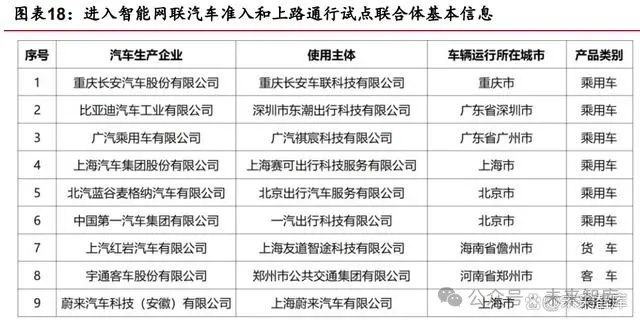
The value of on-board terminals for intelligent connected pilot vehicles may reach tens of millions in the short term. We believe that although V2X terminals are integrated with T-BOX, ETC, and other devices, in the short term, V2X terminals will still be mainly deployed independently. According to the requirements of the notice, trial operation vehicles need to be 100% equipped with C-V2X on-board terminals. With the announcement of the first batch of intelligent vehicle access and road traffic pilot lists, companies like BYD, NIO, Changan Automobile, and Yutong have entered the pilot list, and more new vehicles will be equipped with V2X on-board terminals. However, due to the current stage of large-scale pilot construction of intelligent connected roadside infrastructure being in its early stages, the scale of trial vehicles from various manufacturers is relatively small. Therefore, we assume that the number of intelligent connected vehicles under trial by each manufacturer only accounts for 0.2% of their annual sales. Based on the sales data of each manufacturer in 2023, we predict that by 2025, approximately 18,000 intelligent connected vehicles will be installed with V2X terminals and put into trial operation. Considering the small installation scale of V2X and the high unit price, assuming a unit price of 800 yuan for V2X terminals, the market size of V2X terminals for the trial vehicles of nine manufacturers is expected to be approximately 15 million yuan by 2025.
(2) New Sales of L2 Level and Above Autonomous Driving Vehicles in Pilot Cities
New sales of L2 level and above autonomous driving vehicles are beginning to see small-scale batch pre-installation of V2X terminals. The government encourages new sales of mass-produced vehicles with L2 level and above autonomous driving functions in pilot cities to be equipped with C-V2X on-board terminals. Currently, the penetration rate of L2 level and above autonomous driving is continuously increasing. According to data from Gao Gong Intelligent Vehicles and Zhongbaoxin, the retail sales of passenger cars equipped with L2 level and above autonomous driving in China in 2023 are approximately 8.18 million vehicles, with a penetration rate of about 38.7%. It is expected that by 2025, the penetration rate of passenger cars equipped with L2 level and above autonomous driving will reach 64%. According to the China Automotive Engineering Society’s forecast, the sales volume of passenger cars in China is expected to reach 26.8 million in 2024, with a year-on-year growth of about 3%. We expect that by 2025, the sales volume of passenger cars in China will maintain a growth rate of 3%, reaching 27.6 million vehicles. Based on the estimated penetration rate of 64% for passenger cars equipped with L2 level and above autonomous driving in 2025, it is expected that approximately 17.67 million passenger cars will be equipped with L2 level and above autonomous driving. We estimate that the pre-installation rate of V2X terminals will be about 5% by 2025, so it is expected that approximately 880,000 passenger cars will be equipped with V2X terminals in pre-installation. If this scale is achieved for batch pre-installation, assuming a unit value of about 450 yuan for V2X terminals, it is expected that the market size for V2X terminals equipped in new sales of L2 level and above autonomous driving vehicles will be approximately 400 million yuan by 2025.
Long-Term: The Market Size of V2X Terminals Is Expected to Reach Nearly 10 Billion by 2030, with Integrated V2X Terminal Market Size Reaching Hundreds of Billions
The widespread adoption of intelligent connected vehicles will lead to a high installation rate of V2X terminals in new vehicles. By 2030, the technical and industrial system for intelligent connected vehicles in China is expected to be initially established, with the industrial ecosystem gradually improving, and collaborative perception, decision-making, and control being continuously applied. It is expected that by 2030, the installation rate of V2X terminals in new vehicles will increase to 70%. According to predictions by Wang Qing, deputy director of the Market Economy Research Institute of the Development Research Center of the State Council, at the China Electric Vehicle 100 Forum (2023), the overall sales volume of the automobile market in China is expected to reach 33 million vehicles by 2030. Based on a 70% penetration rate of V2X terminals, it is estimated that approximately 24.75 million new vehicles will be equipped with V2X terminals by 2030. If the value of V2X terminals is estimated at 350 yuan (not integrated), then the market size of V2X terminals by 2030 is expected to be approximately 8.1 billion yuan. However, with the integration of vehicle-mounted V2X with T-BOX, ETC-OBU, and other devices, we predict that by 2030, V2X on-board terminals are expected to be highly integrated with T-BOX and other devices. At this time, the value of V2X terminal devices will be high, and the single unit value will relate to the final integrated functions. Assuming that by 2030, the price of integrated V2X terminals is 5,000 yuan, the market size of integrated V2X terminals is expected to reach approximately 115.5 billion yuan.
3. The Changing Competitive Landscape of On-Board Terminals Will Benefit Related Companies
3.1 The Competitive Landscape in the On-Board Terminal Field May Change Due to Integration Trends
Short-Term: V2X-OBU Will Mainly Be Aftermarket, ETC-OBU Manufacturers Have First-Mover Advantages
V2X-OBU will primarily be aftermarket in the short term. On-board terminals are devices installed in vehicles to receive information from roads and other vehicles, assisting drivers and enhancing driving safety. With the development of C-V2X technology, manufacturers have focused their R&D efforts on superior communication performance, neglecting the market demand for on-board terminals as consumer-grade terminals in the aftermarket. Currently, V2X-OBU products are primarily in aftermarket form, but as some vehicle manufacturers begin mass production of models equipped with C-V2X technology, the pre-installation market is gradually expanding. Before the widespread sales of V2X on-board terminals, most of the OBU devices sold were ETC, and manufacturers producing ETC devices have the capability to produce other OBU devices and sales channels for OBU. We can observe the market competition pattern from the supply of ETC devices. According to data from the Forward Industry Research Institute, the first tier of the Chinese ETC industry includes Jinyi Technology, Wanjie Technology, and Juli Technology (Huaming Intelligent). The second tier includes Chenggu Technology, Data Technology, Qianfang Technology, Woqi Data, Aites, Jinshengan, Changjiang Intelligent, and others, while the third tier includes other enterprises. We believe that companies that previously sold ETC devices may benefit from the accumulation of ETC OBU technology, and thus, from the market transformation brought about by vehicle-road-cloud collaboration, ETC equipment suppliers are expected to benefit first.
The ETC-OBU category has a high market concentration. According to data from the Head Leopard Research Institute, the ETC-OBU market is highly concentrated, with Jinyi Technology, Wanjie Technology, and Huaming Intelligent occupying over 85% of the market share in 2022. The downstream customers include ETC issuing and electronic toll collection entities, banks, government agencies, etc., with a wide customer base.
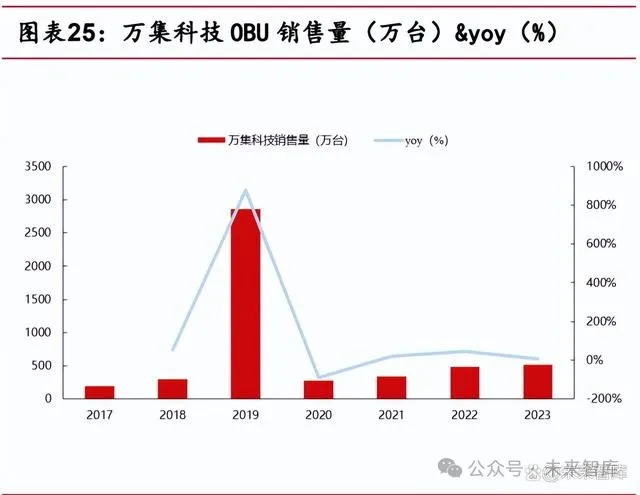
From sales volume, Jinyi Technology occupies a leading position in the market. Comparing the sales volumes of the OBU from the three listed companies, we can see that during the rapid increase in ETC penetration from 2019 to 2020, ETC as an OBU product drove the sales volume of the company’s main OBU. Except for 2021, Jinyi Technology’s sales volume has consistently led among the three listed companies. In 2022, the production and sales volume of the company’s V2X products were 589 sets and 323 sets, respectively, while in 2023, the numbers were 5,146 sets and 5,049 sets, representing a rapid year-on-year increase of +773.68%/1463.16%.
The V2X market has many participants, and the products are highly homogeneous. On-board terminal products are communication devices used to facilitate real-time information exchange between vehicles (V2V), roads (V2I), people (V2P), and clouds (V2N). Manufacturers producing V2X on-board terminals include those transitioning from ETC to V2X: Jinyi Technology, Wanjie Technology, Juli Technology (Huaming Intelligent); emerging enterprises producing V2X: Xidi Intelligent Driving, Mushroom Vehicle Networking, Vehicle Road Communication, Nebula Networking, Huali Intelligent Travel, Zhongxin Kezhilun; computer and IoT companies: Qianfang Technology, Gaoxinxing, Neusoft Group; and automotive electronics companies: Jingwei Hengrun, Desay SV, and many others. Many manufacturers have similar application scenarios and product positioning, resulting in a high degree of product homogeneity.
3.2 The Large-Scale Construction of Vehicle-Road-Cloud Integration Is Expected to Drive Revenue Growth for Companies
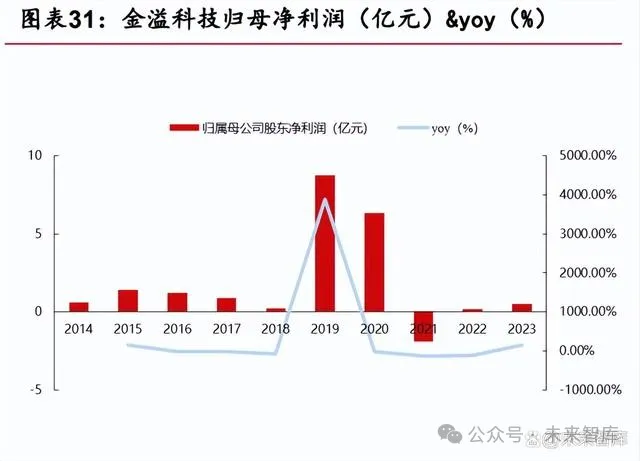
With the announcement of the first batch of pilot cities for “vehicle-road-cloud integration,” the scale of related projects in these cities is expected to reach nearly 100 billion yuan. As a key component linking the overall system, V2X on-board terminals currently have a low penetration rate, and companies selling related products are expected to encounter opportunities for large-scale development. Jinyi Technology: The company’s main business segments include highways, automotive electronics, and smart cities. From the company’s business proportion, the highway business is dominant, with the highest proportion, followed by automotive electronics and smart cities. The highway sector benefits from national policies supporting vehicle-road-cloud integration, and business revenue is expected to show rapid growth. Since the main products sold by the company are OBU products mainly consisting of ETC, the rapid increase in ETC penetration in 2019 led to a significant increase in the company’s ETC sales volume, resulting in high growth in revenue and profit in 2019. The OBU products sold by the company include traditional ETC products as well as V2X on-board terminals.
Wanjie Technology: The company’s business is divided into dedicated short-range communication series, dynamic weighing series, laser detection series, intelligent connected electronic products, and system integration equipment. Among them, the dedicated short-range communication series has the highest proportion, while dynamic weighing and laser detection are the second and third largest businesses. The dedicated short-range communication and intelligent connected business includes OBU sales. At the same time, the company’s intelligent connected business has a low base, leaving significant growth potential for the future. The company’s revenue and profit reached peaks during the rapid expansion of ETC in 2019, but later declined due to the saturation of ETC devices. The company’s OBU product sales include traditional ETC and V2X on-board terminals, with the company’s website listing on-board terminal products including W-980A and WV2X-L923.
Qianfang Technology: The company’s main business segments are smart security and intelligent transportation industries. From the industry structure, before 2018, the company’s main business was in the intelligent transportation sector, but since 2018, the proportion of the smart security business has gradually increased, surpassing the scale and proportion of the intelligent transportation business. Currently, the company is developing both smart security and intelligent transportation businesses simultaneously. The company’s operating income decreased in 2022 but is recovering in 2023. The company’s smart security and intelligent transportation businesses are gradually entering a recovery phase, with the intelligent transportation business showing rapid growth. The QF-VX2000 produced by the company is an on-board terminal device that supports rich V2X application scenarios, enabling speed guidance, road hazard warnings, and other rich safety, efficiency, and information V2X applications, contributing to the company’s smart transportation business revenue.
Gaoxinxing: The company’s main business segments include the transportation industry, public security industry, telecommunications industry, and software and information technology services. Since 2015, the company has begun to disclose its business in detail by industry. From the company’s industry distribution, the early business mainly focused on the public security industry, while the transportation sector quickly increased its share later. The transportation sector has grown to become the company’s main revenue business. The GoOBU intelligent connected vehicle communication terminal (5G+C-V2X) produced by the company is installed in the vehicle, enabling low-latency, high-reliability, and high-density data exchange between the vehicle and the external environment. The company has established sales channels with automakers based on its previous sales of vehicle networking products, showing significant channel advantages.
Jingwei Hengrun: The company’s main business segments include electronic products, R&D services and solutions, high-level intelligent driving overall solutions, and other businesses, with respective proportions of 73.09%/26.36%/0.26%/0.30% in 2023. The company’s performance in 2023 showed losses due to a significant increase in R&D expenses, impacting profits. The 5G V2X T-Box product sold by the company is part of its intelligent connected electronic products and contributes to the company’s electronic product revenue.
Desay SV: The company is an internationally leading automotive electronics enterprise and an active promoter of intelligent connected technology. The products sold by the company are divided into intelligent cockpits, intelligent driving, in-vehicle infotainment systems, driver information display systems, in-vehicle air conditioning controllers, EMS, and other businesses, with intelligent cockpits and intelligent driving being the company’s core businesses. The company’s 5G+V2X T-BOX+intelligent antenna solution has successfully achieved large-scale mass production with customers such as SAIC General and Hongqi, and the company has significant sales channel advantages for its V2X on-board terminals.