 Click the blue text above to subscribe.
In the field of smart healthcare, real-time monitoring of dynamic pressure changes in the human body has always been a research hotspot. Recently, Prof. Wu Yuxiang from Jianghan University, Prof. Li Yusheng from Xiangya Hospital, and Researcher Li Zhou from the Beijing Institute of Nanoenergy and Nanosystems, Chinese Academy of Sciences successfully developed a self-powered, flexible, and long-term stable sensor array, bringing a new breakthrough to the field of dynamic pressure monitoring. This study reports a self-powered, flexible, and long-term stable sensor array based on piezoelectric polymers designed for dynamic pressure monitoring. Through hot pressing and DC sputtering techniques, the researchers successfully fabricated pressure sensors with micro-cavity structures. The sensor exhibits high sensitivity, fast response, and long-term stability, capable of real-time monitoring of sound vibrations, arterial pulses, finger movements, and dynamic pressure changes within pig knee joints. This achievement provides new technical solutions for medical monitoring, human motion tracking, and robotics.
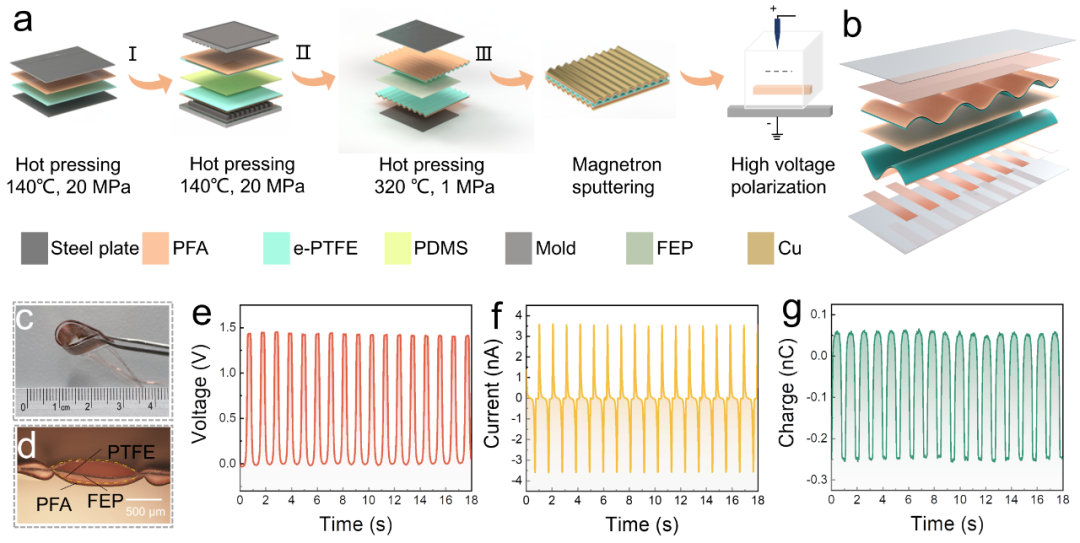
Figure 1 Manufacturing Process and Characterization of Pressure Sensors.a) Flowchart of the manufacturing process of the pressure sensor.b) Structural diagram of the pressure sensor.c) Size of the pressure sensor.d) Micro-cavity structure of the pressure sensor.e) Output characteristics of sensor voltage at 1 Hz frequency. f) Output characteristics of sensor current at 1 Hz frequency. g) Output characteristics of sensor charge at 1 Hz frequency.
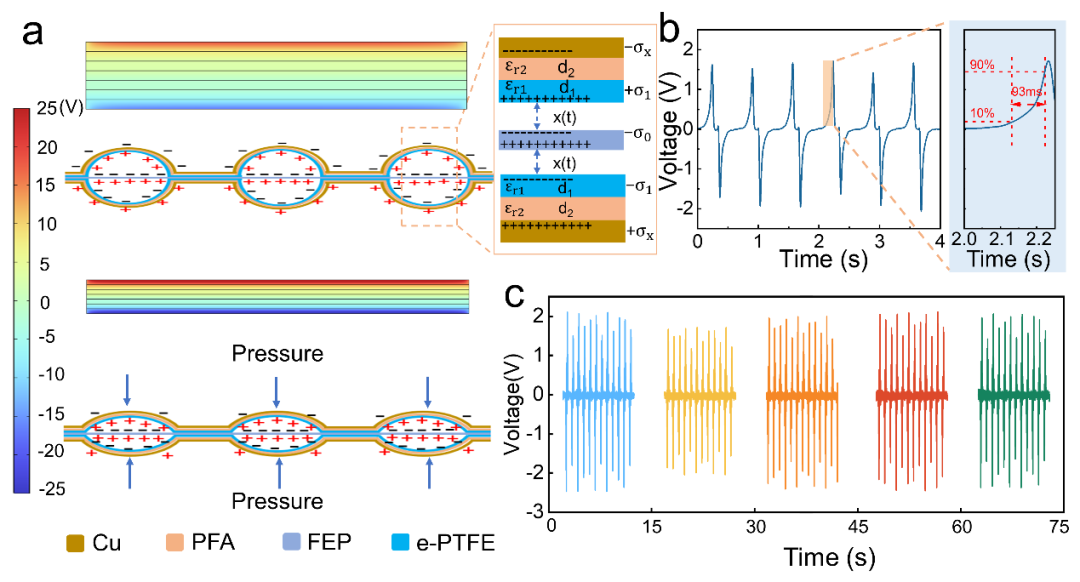
Figure 2 Simulation and Response of Pressure Sensors.a) Potential distribution of the sensor in its original state and pressed state using finite element simulation.b) Response time of the sensor.c) Output from different channels under the same contact area and force.
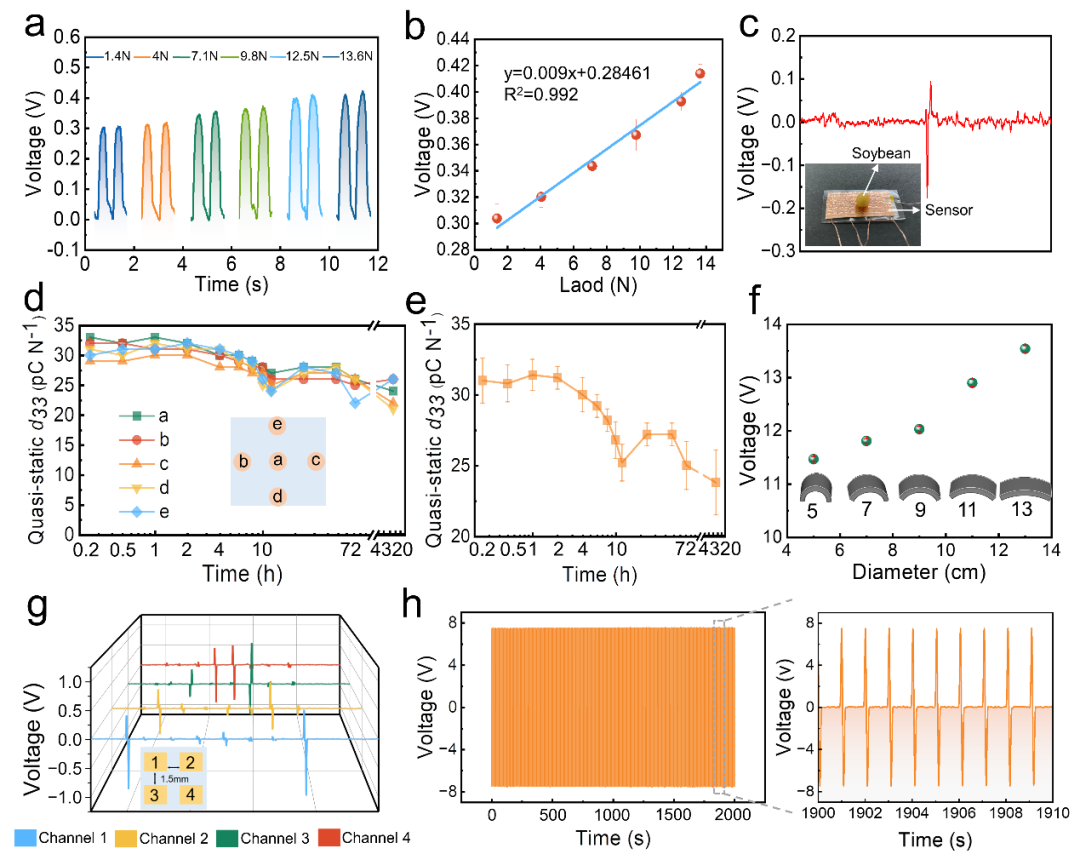
Figure 3 Performance Characterization of Flexible Pressure Sensors.a) Voltage output of the sensor under different loads.b) Relationship between pressure and voltage of the sensor under different loads.c) Minimum detection limit of the flexible pressure sensor.d) Piezoelectric coefficients of the sensor at different positions.e) Average piezoelectric coefficients of the sensor over different times.f) Changes in output of flexible pressure sensor under different curvatures of arch structure.g) Ability of flexible pressure sensor to resist serial interference.h) Variation in voltage output of the flexible pressure sensor after 4000 cycles. Data is presented as mean ± SEM.
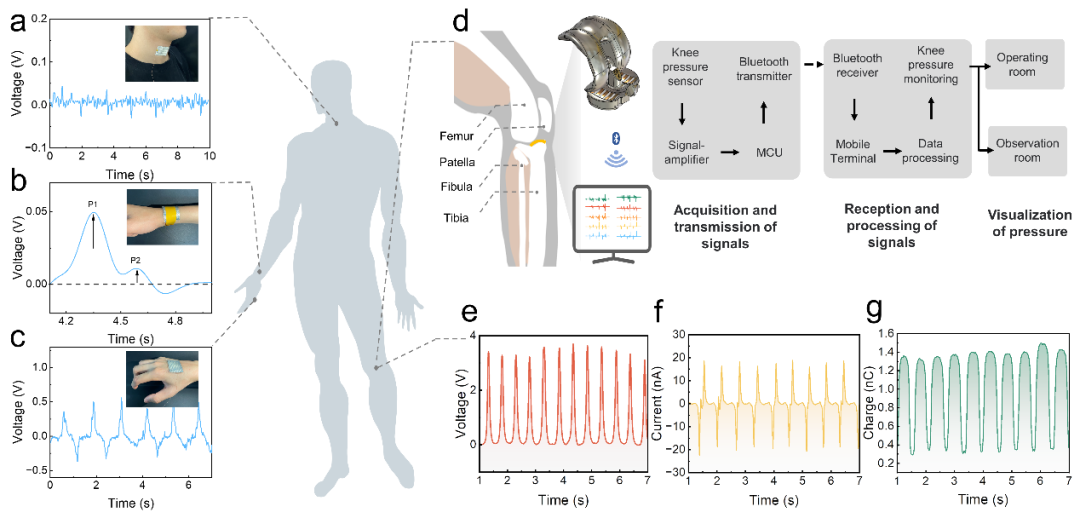
Figure 4 Applications of Flexible Pressure Sensors in the Human Body.a) Monitoring sound vibrations.b) Monitoring radial artery pulse.c) Monitoring finger flexion and extension.d) Wireless transmission of conceptual diagram of knee joint pressure.e) Voltage output characterization during the rolling process of the sensor on the knee joint mold.f) Current output characteristics of the sensor during the rolling process on the knee joint mold.g) Charge output characterization of the sensor during the rolling process on the knee joint mold.
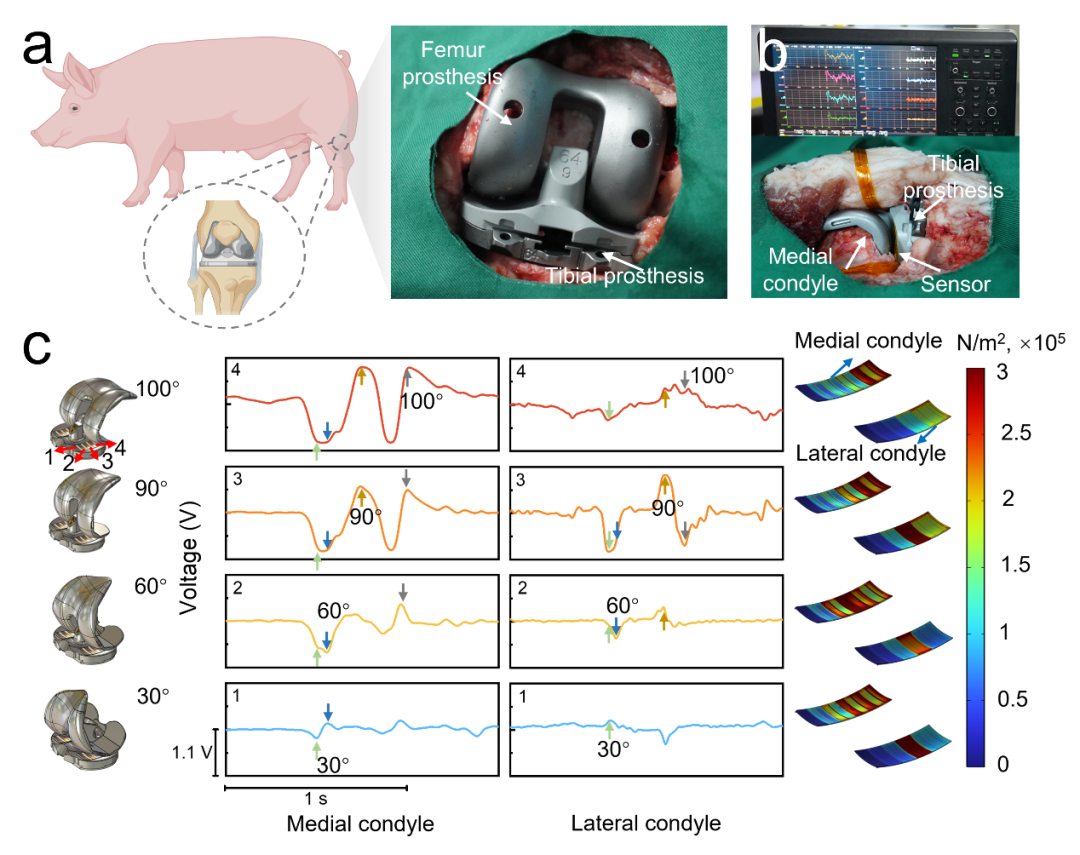
Figure 5 Dynamic Pressure Monitoring During Pig Knee Joint Replacement Surgery.a) Schematic diagram of pig total knee joint replacement surgery.b) Dynamic knee joint pressure monitoring system in animal experiments.c) Pressure distribution of the knee joint at different joint angles in pigs.Breaking Tradition: Innovative Application of Self-Powered TechnologyWith the rapid development of the Internet of Things(IoT) and artificial intelligence(AI), the demand for high-performance sensors is growing, especially in fields requiring precise pressure change monitoring, such as electronic skin, smart robots, prosthetics, and wearable electronics. Traditional pressure sensors often rely on external power sources, limiting their applications in mobile and remote monitoring. Therefore, developing a self-powered, flexible, and stable sensor array is crucial for achieving wireless, real-time pressure monitoring. The core of this technology lies in self-powering. Traditional sensors require an external power source to operate, while this new type of sensor array utilizes the properties of piezoelectric polymers to generate electrical energy from mechanical pressure changes, thus achieving self-powering. This innovation not only enhances the flexibility and portability of the sensors but also makes long-term continuous monitoring possible. Additionally, considering the adaptability of sensors in various application scenarios, the research team also focused on the flexibility and long-term stability of the sensors.Related research results were published under the title “Self-Powered Flexible Sensor Array for Dynamic Pressure Monitoring” in the journal Advanced Functional Materials.
Paper link:
https://doi.org/10.1002/adfm.202316712
Related progress
Researcher Li Zhou/Luo Dang from the Institute of Nanoenergy, Chinese Academy of Sciences, “Nat. Commun.”: Stress-induced adaptive phase change preparation of self-packaged ionic fibers for non-contact depth sensing.
Li Zhou/Hua Wei/Liu Zhuo/Wang Ningning Nat. Commun.: Progress in research on self-powered intracardiac pacemakers.
Li Zhou’s research group at the Institute of Nanoenergy, Nano Energy: Interface-induced high-pressure electric γ-glycine biodegradable flexible films.
Li Zhou’s team at the Institute of Nanoenergy, Matter: Triboelectric properties of biodegradable polymers.
Qingdao University Ma Qingming, Wang Xiaoxiong/Li Zhou’s Nano Energy, “ACS Nano”: Therapeutic electrical stimulation based on triboelectric nanogenerators applied to the skin.
Li Zhou/Ruo Dang, Zhang Jiaping from Southwest Hospital Nat. Commun.: Electric-assisted agents – a microneedle drug delivery system based on triboelectric nanogenerators to improve epidermal growth factor efficacy.
Prof. Deng Yulin from Beihang University and Researcher Li Zhou from the Institute of Nanoenergy collaborated on “Fundamental Research”: Stretchable self-driven hierarchical respiratory sensors inspired by shark gills.
Li Zhou’s research team at the Institute of Nanoenergy “Adv. Mater.”: Super-stretchable, rapid self-healing ionic hydrogels for artificial nerve fibers at -80°C.
Li Zhou’s team at the Institute of Nanoenergy ACS AM: Improved rechargeable electrode materials for ultra-thin stretchable triboelectric nanogenerators.
Li Zhou’s team latest Small review: Self-healing functional electronic devices.
Li Zhou’s team at the Institute of Nanoenergy and Li Yusheng from Central South University collaborated on “ACS Nano”: Stretchable, self-healing, and skin adhesive active sensors for muscle function assessment.
Li Zhou’s research group and Chen Xiangyu’s group “AFM”: Writable Braille display system based on triboelectric nanogenerators and dielectric elastomers.
Li Zhou’s research team at the Institute of Nanoenergy: A flexible self-arch bio-sensor based on piezoelectric and triboelectric composite effects.
Li Zhou’s research team at the Institute of Nanoenergy has made new progress in the field of conductive hydrogel sensors.
Researcher Li Zhou from the Institute of Nanoenergy, Academician Wang Zhonglin’s team, and Prof. Fan Yubo’s team from Beihang University collaborated: Progress in research on battery-free self-driven cardiac pacemakers.
Li Zhou’s research team at the Institute of Nanoenergy, Associate Professor Zhou Xuechang’s team from Shenzhen University collaborated: Polypyrrole-copper metal sponge for integrated devices for energy conversion and storage.
Researcher Li Zhou from the Institute of Nanoenergy and Researcher Wei Wei from the Institute of Process Engineering collaborated: A drug precision delivery system controlled by nanogenerators achieves efficient tumor therapy.
Researcher Li Zhou from the Institute of Nanoenergy, Academician Wang Zhonglin’s team, and Prof. Fan Yubo’s team from Beihang University collaborated: Energy source for biodegradable implantable electronic medical devices – fully absorbable capacitors.
Researcher Li Zhou’s team at the Institute of Nanoenergy, Researcher Li Linlin and Academician Wang Zhonglin’s team: Photothermal controllable degradable nanogenerators for tissue repair.
Researcher Li Zhou from the Beijing Institute of Nanoenergy and Academician Wang Zhonglin’s team AM: Biodegradable triboelectric nanogenerators based on natural materials.

This is an original article from Polymer Technology. Personal sharing and forwarding are welcome. If publications or media need to reprint, please contact: [email protected]


Call for Submissions
Experts and scholars are welcome to provide manuscripts (papers, project introductions, new technologies, academic exchanges, institutional news, conference information, recruitment, and enrollment, etc.) to [email protected], and please indicate detailed contact information. Polymer Technology® will promptly push and publish on China Polymer Network.
Welcome to Join WeChat Group To meet the needs of colleagues in the polymer industry, dozens of specialized discussion groups have been opened, including a group for polymer experts and scholars, covering polymer industry technology, entrepreneurs, PhDs, graduate students, media journals, and exhibition associations. Currently, it gathers over ten thousand top experts, scholars, technical personnel, and entrepreneurs from domestic and foreign universities, research institutes, and corporate R&D centers.
To apply for joining the group, please first add the WeChat account PolymerChina (or long press the QR code below), and please make sure to indicate: Polymer + Name + Institution + Title (or Degree) + Field (or Industry), otherwise it will not be processed. Qualification will be reviewed before joining the relevant professional group.

Click here to read the original text and see more.