On June 24, market research firm Counterpoint Research released its report titled “Global Mobile Processor (AP-SoC) Node Long-Term Forecast,” stating that by 2026, one-third of flagship smartphones globally will adopt advanced process technologies of 3nm or 2nm.
The report indicates that Apple will be the first to introduce TSMC’s 3nm A17 Pro chip in the iPhone 15 Pro series in 2023, followed by Qualcomm and MediaTek launching their 3nm flagship SoCs in 2024. Starting in 2025, all new generation flagship SoCs will fully transition to 3nm, with shipment proportions expected to increase by 79% year-on-year. By 2026, Apple, Qualcomm, and MediaTek are expected to upgrade to TSMC’s 2nm process. This is primarily due to the fact that 3nm and 2nm processes not only provide higher transistor density and clock speeds but also support the demands of generative AI, immersive gaming, and high-quality image processing, becoming key to enhancing smartphone performance and efficiency.
As the leading foundry, TSMC is projected to achieve an 87% market share in mobile system-on-chip (SoC) manufacturing below 5nm (including 2/3nm) this year, increasing to 89% by 2028.
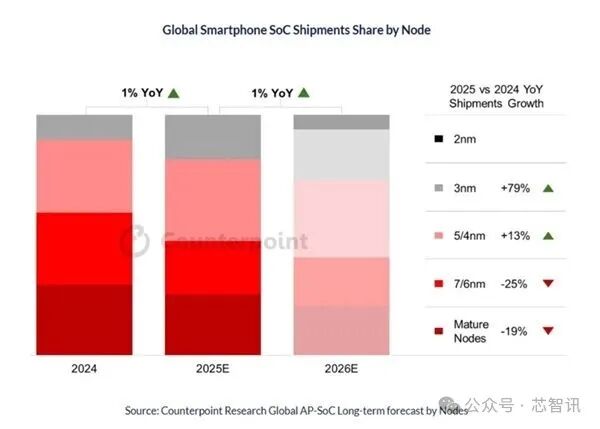
Parv Sharma, a senior analyst at Counterpoint Research, stated that as performance and energy efficiency demands continue to rise, the evolution of chips towards smaller, more powerful, and efficient processes is being driven. TSMC’s 3nm and 2nm advanced processes are expected to reach a critical milestone by 2026, at which point approximately one-third of smartphone system-on-chips globally will adopt these two process technologies, with Apple leading the way in adopting the 3nm process, expected to exceed 80% of its products using this node.
Counterpoint Research anticipates that by 2026, flagship processors from Apple, Qualcomm, and MediaTek will successively adopt TSMC’s 2nm process, increasing the share of advanced processes in the mobile sector. The 5/4nm process nodes are expected to account for over one-third of global smartphone system-on-chip shipments in 2026, becoming the most widely used process technology for smartphone system-on-chips that year, with TSMC’s market share in mobile system-on-chips being higher than its overall foundry market share.
Parv Sharma further pointed out that TSMC is expected to conduct the tape-out of its 2nm process in the second half of this year and enter mass production by 2026. Apple, Qualcomm, and MediaTek are set to launch their first wave of 2nm flagship SoCs by the end of 2026. The initial adoption of 2nm chips will focus on flagship and high-end smartphones. Mid-range devices will gradually transition from 7/6nm to 5/4nm processes, with subsequent years moving to the 3nm node; entry-level 5G system-on-chips will upgrade from 7/6nm to 5/4nm, while LTE system-on-chips will migrate from mature nodes to 7/6nm.
Brady Wang, Deputy Research Director at Counterpoint Research, expects that by 2025, TSMC’s market share in smartphone SoCs at 5nm and below (including 3nm and 2nm) will reach 87%, increasing to 89% by 2028. Currently, aside from TSMC, there are limited foundry options available for mobile chip manufacturers. SMIC’s 7nm process mainly supports HiSilicon SoCs for Huawei, but due to geopolitical tensions between the US and China and EUV equipment export bans, it is difficult to expand to more advanced processes (such as 5nm) in the short term.
Editor: Lin Zi, Xinzhi News
Previous Exciting ArticlesMu Xi Completes IPO Guidance, Competing for the Title of “First Domestic GPU Stock”!Li Suan Technology’s 6nm GPU Test Results Exposed? Official Response: Data is Inaccurate!Breaking! The US Plans to Withdraw Exemptions for Samsung/SK Hynix/TSMC’s Wafer Plants in ChinaNIO Establishes Chip Design Subsidiary, Preparing for External Orders?“Mining Machine” Supply Chain Changes, Three Major Chinese Giants Set Up Factories in the USThe First Domestic GPU Stock is Coming! Moore Threads Completes Listing GuidanceMass Production Expected by Year-End, More Technical Details of Intel 18A Exposed!Anker Recalls Over 1 Million Power Banks in the USTaiji Information and Unisoc Listed in the Military Procurement Dishonesty List for Bid RiggingThe US Forces Vietnam to Manufacture “Decoupling from China,” 46% Tariff Becomes Negotiation ChipTP-Link Shanghai WiFi Chip Department Layoffs, Compensation N+3!How Far Can ASML’s EUV Lithography Path Go?Synopsys Resumes Some Services in China, but Core EDA Sales Remain BlockedAMD MI350 Series Analysis: Inference Performance Increased by 35 Times, Surpassing B200! MI400 Computing Power Will Double!Datang Mobile Sues Xiaomi in Germany for Infringing 4G Patents
For industry communication and cooperation, please add WeChat: icsmart01
Xinzhi News Official Communication Group: 221807116