Click the blue text to follow us

Battery SOC (State of Charge) and SOH (State of Health) are important parameters in battery management, and their calculation methods differ significantly. Below is an overview of the mainstream solutions:
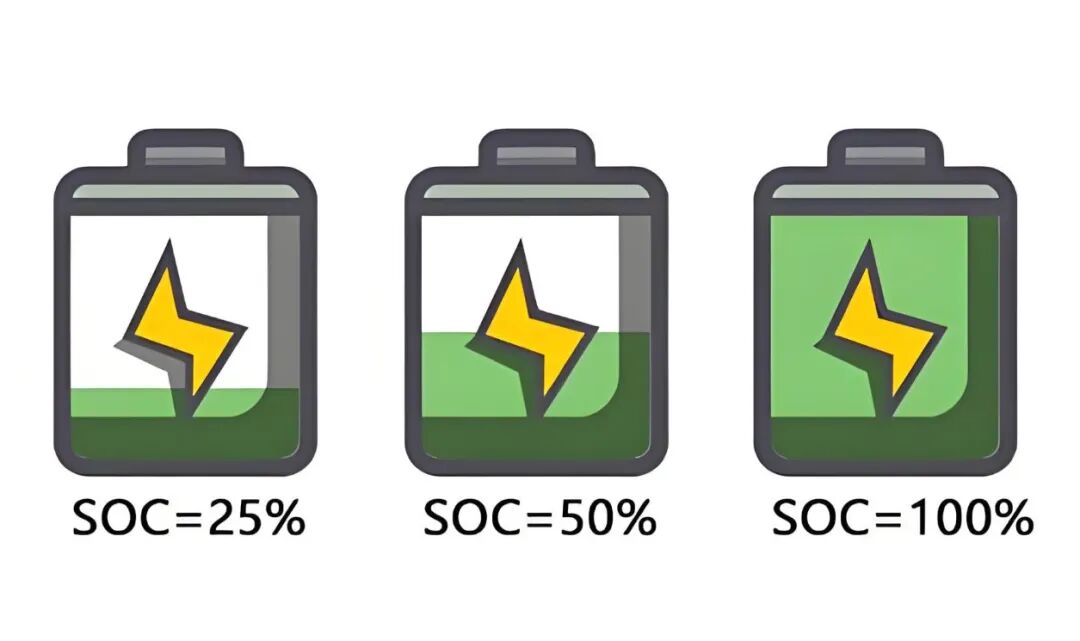
1. The mainstream calculation methods for battery SOC (State of Charge) are as follows:
Ah Integration Method
-
Principle: By measuring the integral of the battery’s charge and discharge current over time, the change in charge is calculated, combined with the initial SOC to derive the current value.
-
Characteristics: Good real-time performance, but susceptible to current measurement errors, self-discharge, etc., requiring periodic calibration.
Open Circuit Voltage Method (OCV)
-
Principle: Utilizing the relationship between the open circuit voltage of the battery and SOC (calibrated through experimental curves), the voltage after resting is measured to estimate SOC.
-
Characteristics: Simple and direct, but requires the battery to be at rest, with limited applicability in dynamic scenarios.
Equivalent Circuit Model Method (ECM)
-
Principle: The battery is modeled as a circuit composed of resistors, capacitors, etc., and SOC is calculated using circuit equations combined with real-time voltage and current data.
-
Characteristics: Can simulate the dynamic characteristics of the battery well, often combined with algorithms like Kalman filtering to improve accuracy.
Neural Network Method
-
Principle: Uses neural networks to learn the complex mapping relationship between battery inputs (current, voltage, temperature, etc.) and SOC.
-
Characteristics: Strong adaptability, does not require an accurate physical model, but needs a large amount of training data, and the model’s interpretability is poor.
Kalman Filtering and its Variants (e.g., Extended Kalman Filter EKF, Unscented Kalman Filter UKF)
-
Principle: Based on the battery model, it uses a recursive algorithm to fuse measurement data with model predictions, iteratively optimizing SOC estimates.
-
Characteristics: Effectively handles noise and uncertainty, widely used in power battery management systems.
Hybrid Pulse Power Characteristic Method (HPPC)
-
Principle: By applying short pulse currents and measuring voltage responses, parameters such as internal resistance of the battery are calculated, combined with models to estimate SOC.
-
Characteristics: Commonly used for battery performance testing and SOC calibration, requires offline or semi-offline operation.
In practical applications, multiple methods are often combined (e.g., Ah integration + OCV calibration, ECM + Kalman filtering) to balance accuracy, real-time performance, and robustness, adapting to different operating conditions for SOC estimation needs.

2. SOH (State of Health) Calculation Methods
SOH is used to characterize the degree of battery aging, and mainstream methods are divided into direct measurement and model-based:
1. Direct Measurement Methods
Capacity Degradation Method (most commonly used)
-
Principle: By performing full charge and discharge tests to obtain the current actual capacity (C₀), the ratio to the nominal capacity (Cₙ) gives SOH, formula: SOH=(C₀/Cₙ)×100%.
-
Characteristics: High accuracy, but requires offline testing and cannot monitor in real-time.
Internal Resistance Growth Method
-
Principle: The internal resistance of the battery increases with aging, measured through Electrochemical Impedance Spectroscopy (EIS) or Direct Current Internal Resistance (DCIR), calculating SOH using the ratio to the initial internal resistance (Rₙ): SOH=(Rₙ/R₀)×100% (R₀ is the current internal resistance).
-
Characteristics: Can be measured online, but is greatly affected by temperature and requires calibration.
2. Model-Based and Data-Driven Methods
Equivalent Circuit Model (ECM) Parameter Correlation Method
-
Principle: Estimates SOH by mapping ECM parameters (such as polarization resistance, open circuit voltage offset) to aging, requiring historical data to establish a model.
Kalman Filtering and State Estimation Integration
-
Characteristics: Embeds SOH as a state variable in the SOC estimation model, simultaneously estimating SOC and SOH using recursive algorithms, such as Extended Kalman Filter (EKF).
Machine Learning Methods (e.g., Neural Networks, Support Vector Machines)
-
Principle: Trains models using data from charge and discharge curves, voltage, and current fluctuations to directly predict SOH.
-
Characteristics: Does not require a physical model, suitable for complex conditions, but needs a large amount of aging data.
3. Hybrid Methods
-
Capacity – Internal Resistance Joint Assessment: Monitors changes in both capacity and internal resistance, taking the minimum SOH of the two as the final result to enhance reliability.
-
Online – Offline Combination: Regularly estimates SOH through internal resistance or models, periodically calibrating with capacity tests to balance accuracy and practicality.

3. The Relationship and Differences between SOC and SOH
-
Relationship: A decrease in SOH will affect the accuracy of SOC estimation (e.g., aging leads to capacity degradation, increasing errors in the Ah integration method), thus high-precision SOC algorithms often need to couple SOH parameters.
-
Core Difference: SOC reflects the “current charge percentage” (dynamic variable), while SOH reflects the “battery health level” (slowly changing aging indicator).
In practical applications, SOH calculations rely more on long-term data accumulation and aging feature extraction, while SOC focuses on real-time dynamic estimation. Battery Management Systems (BMS) typically adopt a “model + data” hybrid approach, combining hardware sensors with algorithm optimization to achieve precise monitoring of both.
-END-
The Battery Home platform officially launched in early 2021, being the first comprehensive online evaluation and trading service platform for batteries in the country, dedicated to providing full-chain solutions for the circulation of new energy batteries and assisting in the construction of a recycling system for new energy batteries.
Beijing Bait House Technology Co., Ltd. was established on January 21, 2025, jointly invested by the Beijing Institute of Technology’s discipline company Beili New Source and the China National Machinery Group’s subsidiary Zhongjin Automobile Trade. Leveraging the advantages of its shareholders, based on the Battery Home platform, it provides a series of services around battery evaluation and testing, real-time monitoring, bidding auctions, transaction matchmaking, warehousing and capacity division, and supply chain finance.