Continuing to share a series of notes on automotive electronic and electrical architecture.This is the12th article. Before introducing automotive operating systems, let’s first share the concept of “virtualization”.
01 Why should automotive software architecture use virtualization?
Virtualization isolates different resources to avoid mutual interference, thus achievingindependence between different virtual environments; it also allows for resource sharing, thereby improving resourceutilization.
Virtualization allows for the deployment, reconstruction, and redeployment of different applications (real-time/non-real-time, functional safety/non-safety), thus enhancing the system’sflexibility.
Virtualization supports different operating systems (Safety Linux, Android, RTOS, etc.), thereby improving softwareportability.
Naturally, we assume: virtualization can provide a convenient deployment method for AI large models and avoid interference with other applications.
02 What is virtualization?
Virtualization, orHypervisor, also known as a virtual machine monitor(Virtual Machine Monitor, VMM), is actually a type of software that abstracts hardware resources into logical resources for allocation and loading of different operating systems among multiple virtual machines.
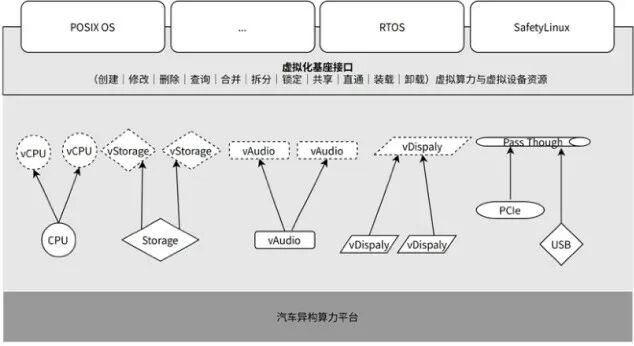
Figure: Virtualization Base Interface
2.1 Types of Hypervisors
The virtualization architecture is mainly divided into two types:
1) Bare-metal Hypervisor (also known as Type 1)
The Hypervisor runs on physical resources, acting as a direct operator of the underlying hardware, possessing hardware drivers to directly manage and call hardware resources. Guest OS access to hardware must go through the Hypervisor.
2) Hosted Hypervisor (also known as Type 2)
There is an additional layer ofHost OS beneath the Hypervisor, which can fully utilizeHost OS to provide device drivers and underlying services to manage and call hardware resources. Guest OS access to hardware must go through multiple layers (Guest OS kernel → Hypervisor →Host OS kernel).
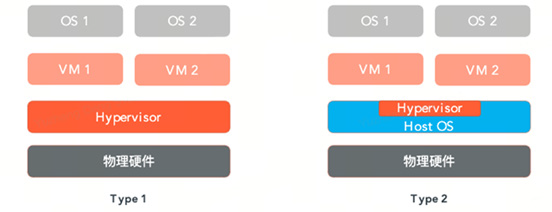
Figure: Virtualization Architecture
Due to the lower performance and ecosystem issues of Type 2 Hypervisors, the vehicle-side scenarios mainly adopt Type1 Hypervisors.
2.2 Composition of Hypervisors
Based on the virtualization of physical resources, it can be divided into CPU virtualization,RAM virtualization, and I/O virtualization.
1)CPU Virtualization
The way to achieve CPU virtualization is through “privilege removal and trap simulation”, where the Hypervisor runs at the highest privilege level, and the GuestOS runs at a non-privileged level.
Even if the Guest OS’s privilege level is removed, most instructions can still run directly on the hardware. Only when executing privileged instructions will it enter the Hypervisor for simulated execution.
Implementation methods include: full CPU virtualization, half CPU virtualization, and hardware-assisted CPU virtualization. Currently, mainstream architectures (ARM architecture, X86 architecture, etc.) SoC chips all support hardware-assisted CPU virtualization, which is also a more efficient method of virtualization.
2)RAM Virtualization
RAM virtualization abstracts physical memory to provide applications with contiguous virtual memory addresses.
It divides the virtual address space and physical address space into pages of the same size and records the mapping relationship between addresses through a page table. The memory management unit(MMU) completes the conversion from virtual address to physical address based on the page table.
There are three layers of mapping relationships: client virtual address(VA), client physical address(PA), and host machine address(MA). RAM virtualization needs to complete the conversion from VA to MA.
Implementation methods include: full memory virtualization, half memory virtualization, and hardware-assisted memory virtualization (which is more efficient).
3)I/O Virtualization
From the CPU’s perspective, peripherals are devices accessed through a set of I/O resources, so device-related virtualization is called I/O virtualization. The Hypervisor reuses limited device resources through I/O virtualization, including graphics cards, network cards, and hard drives.
I/O virtualization includes full virtualization, half virtualization, and hardware-assisted virtualization. Among them, half virtualization is one of the mainstream technologies for peripheral virtualization on the vehicle side.
03 Performance Overhead of Virtualization
Virtualization incurs performance overhead due to the abstraction and management of physical resources, leading to a performance decline of virtual machines when running applications compared to bare-metal environments.
1) For CPU
Hardware-assisted CPU virtualization can effectively reduce the performance overhead caused by virtualization, typically controlling it to around 1%.
Of course, the performance overhead of CPU virtualization is also related to the system’s operational load. Frequent context switching and scheduling can exacerbate the overhead to some extent.
2) For RAM
Hardware-assisted RAM virtualization can achieve lower memory virtualization performance overhead, typically controlling it to below 2%.
3) For I/O
There are various types of peripherals, including high-speed and low-speed devices. The corresponding virtualization technologies that can be adopted include: time-slicing multiplexing, Passthrough, VirtIO half-virtualization, and hardware-assisted virtualization (such as based on IOMMU technology).
The time-slicing multiplexing method requires close cooperation between hardware drivers andHypervisor, resulting in high complexity but can achieve high virtualization performance.
The Passthrough method is a pass-through mode that can achieve virtualization performance close to hardware, but is not conducive to device sharing between multiple VMs, typically used for exclusive access of peripherals to a specific VM.
The VirtIO half-virtualization method, based on the standardized VirtIO framework, is beneficial for decoupling the front and back ends of peripheral virtualization, but the overhead is usually higher (e.g., over 10%), typically used for I/O virtualization of low-speed devices.
The hardware-assisted virtualization method requires dedicated hardware support and can achieve high virtualization performance.
Source: AUTOSEMO;“Detailed Explanation of Smart Automotive Electronic and Electrical Architecture”
– Based on industry research, interpreting industry trends and sharing research notes
– For research reports and consulting needs in the new energy vehicle industry, please leave a message to contact