








Let’s Learn Together
Grateful for You
In the wonderful world of coding and research, we can gain many unique insights. From the perspective of algorithm optimization, it is like carefully polishing a piece of art; each simplification of code and improvement of algorithms is akin to removing impurities, making it more efficient. This inspires us to continuously examine our ways of working in life and at work, seeking optimization opportunities to enhance efficiency. For instance, when dealing with complex data, skillfully utilizing data structures and algorithms can transform originally chaotic information into an orderly format, reminding us to be adept at finding patterns and summarizing methods when faced with complex problems.

Overview

The “Instant Truth” Hidden in Signals: How Important is Transient Extraction and Transformation?
When you record with a microphone, a sudden cough distorts the singing; during radar monitoring, the electromagnetic pulse from lightning interferes with the target signal; in industrial equipment operation, an unusual noise from a bearing is drowned out by the machine’s roar—these “sudden and fleeting” signals are known as “transient signals.” They often contain key information but are easily “drowned” by environmental interference. The transient extraction and transformation technology acts as a “signal detective” that extracts these key transients from complex signals.
First, Understand: What is a Transient Signal? Why Extract and Transform?
Before explaining the technology, we first clarify the core characteristics of “transient signals”—they are sudden, short-lived, and energy-concentrated. For example:
In medical scenarios, an abnormal spike suddenly appearing on an electrocardiogram (which may indicate arrhythmia);
In mechanical scenarios, the “clunk” sound when an engine starts (which may reflect installation issues with parts);
In communication scenarios, a sudden interruption and recovery of mobile signal (which may be related to base station switching).
These signals may last only a few milliseconds but carry more “information” than stable conventional signals. The problem is that they are often mixed with a lot of “background noise”: baseline fluctuations in electrocardiograms, environmental noise in factories, and electromagnetic interference in communication networks can all make transient signals “invisible.”
The significance of “extraction and transformation” lies in two steps: first, “separation”—extracting transient signals from background noise; then, “transformation”—converting the extracted raw transient signals into a format that is easy to analyze, such as transforming sound signals into frequency spectrograms. In simple terms, it makes “fuzzy key information” clear and interpretable.
Core Principle: The “Three Axes” of Transient Extraction and Transformation
Transient extraction and transformation may sound abstract, but it is essentially a set of “signal filtering + processing” technical processes, achieved through three key steps, like performing “fine filtering” on signals:
Step One: Signal “Health Check”—Identifying Transient Features
The starting point of the technology is to “distinguish between transients and noise.” Engineers will first set “feature tags” for transient signals, such as “signal amplitude suddenly increases by more than 3 times,” “duration less than 10 milliseconds,” “frequency suddenly jumps,” etc. After obtaining the raw signal through signal acquisition devices (such as sensors, microphones), the system will scan frame by frame, marking the “suspicious segments” that meet these features—this step is like a security check where the detector first marks “suspicious items.”
For example, in mechanical fault monitoring, the system will preset the characteristics of “bearing abnormal transients”: frequency between 500-1000Hz, amplitude twice that of normal signals, duration within 5 milliseconds. When the sensor captures a signal that meets the conditions, it will be immediately marked.
Step Two: Precise “Separation”—Filtering Background Interference
After marking suspicious segments, the core “extraction” work must be performed. This step commonly uses techniques such as “adaptive filtering” and “wavelet transform,” with principles akin to “putting noise-canceling headphones on the signal”:
Adaptive filtering: The system will analyze the patterns of background noise in real-time (for example, the stable frequency of factory noise is 50Hz), then “generate” a signal that cancels out the noise, removing it from the original signal and leaving the transient signal;
Wavelet transform: This is a more refined “separation tool” that can decompose signals into different “time-frequency” components. The characteristics of transient signals are “short in time, wide in frequency range,” while noise is often “long in time, single in frequency”; wavelet transform can accurately “peel off” the two.
Step Three: Format “Transformation”—Making Signals Analyzable
The extracted transient signal is still in its original “waveform,” which is not understandable to the average person and inconvenient for computer processing. This requires a “transformation” step: converting waveform signals into “feature parameters” or “visualization maps.” For example:
Transforming sound transients into “frequency-energy” maps, clearly showing “which frequency band the abnormal sound is most prominent”;
Transforming electrical signal transients into “peak-time” data, marking “the precise time point of abnormal signal occurrence.”
After this step, the “key information” of transient signals is quantified, allowing engineers or algorithms to make judgments directly using this data.
Practical Value: From Medical to Industrial, All are “Life-Saving” Scenarios
Transient extraction and transformation is not just a laboratory technology; it has already permeated various aspects of our lives, addressing the urgent need for “precise identification”:
1. Industrial Equipment’s “Fault Warning Agent”
Failures in large machinery (such as wind turbine generators and high-speed train engines) often first manifest as “transient abnormal sounds” or “current transients.” Through transient extraction and transformation technology, systems can capture these signals in real-time during equipment operation, providing early warnings for issues like “bearing wear” and “poor circuit contact,” preventing huge losses caused by sudden equipment shutdowns. For example, after using this technology, a wind farm reduced turbine downtime by 40%.
2. Medical Diagnosis’s “Precision Assistant”
In electrocardiogram and electroencephalogram monitoring, many disease signals are “transient”—for example, an electrocardiogram of a patient with atrial fibrillation will show sudden irregular spikes. Transient extraction and transformation technology can accurately extract these abnormal transients from stable heartbeat and brainwave signals, helping doctors quickly locate the lesions, even more sensitively than manual identification.
3. Communication Network’s “Interference Cleaner”
In 5G communication, lightning, electromagnetic radiation, etc., can produce “transient interference signals,” leading to call interruptions and data transmission errors. Through this technology, communication base stations can extract and “cancel out” these transient interferences in real-time, stabilizing the signal. For example, in areas prone to thunderstorms, base stations using this technology saw a 35% reduction in call interruption rates.
4. Security Monitoring’s “Danger Identifier”
In earthquake monitoring, the “initial wave” of seismic waves is a typical transient signal; capturing it a few seconds early can buy time for earthquake warnings; in border security, radar capturing “human movement transient signals” can distinguish illegal border crossers from the background of swaying vegetation, enhancing monitoring accuracy.
Future Trends: Smarter and More Real-Time “Signal Detectives”
With the development of AI technology, transient extraction and transformation are evolving towards “more efficient and autonomous”:
AI Adaptive Recognition:In the past, it required manual setting of transient features; in the future, AI can learn from large amounts of data to automatically recognize “abnormal transients” in different scenarios, such as accurately capturing fault signals on new industrial equipment without programming;
Real-Time Edge Computing:Integrating extraction and transformation algorithms into edge devices like sensors, eliminating the need to send signals back to the cloud for processing, achieving “millisecond-level” responses—this is crucial for medical and industrial scenarios that require real-time warnings;
Multi-Signal Fusion Extraction:Simultaneously processing multiple signals such as sound, current, and vibration to extract transient features from different dimensions, making judgments more accurate, such as monitoring both the “abnormal sound transients” and “current transients” of an engine to avoid misjudgment from a single signal.





Running Results

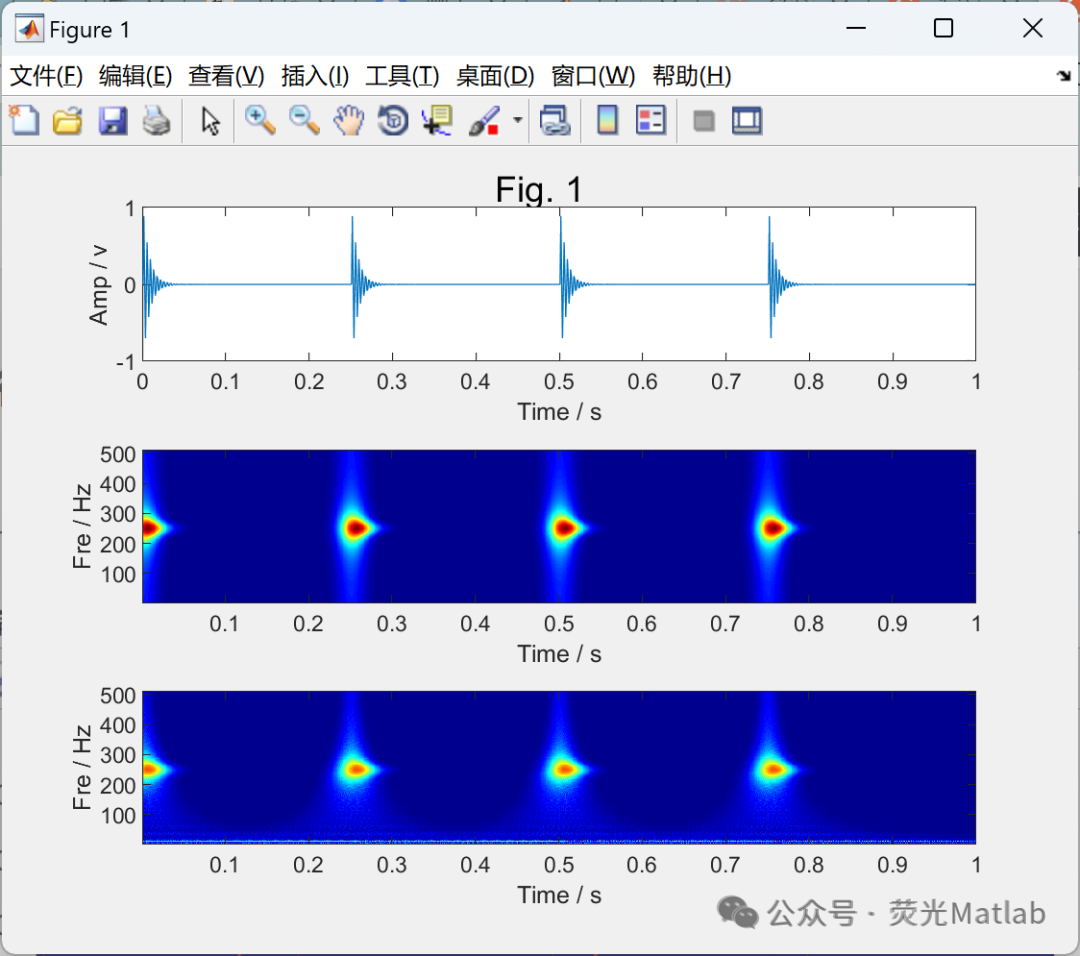
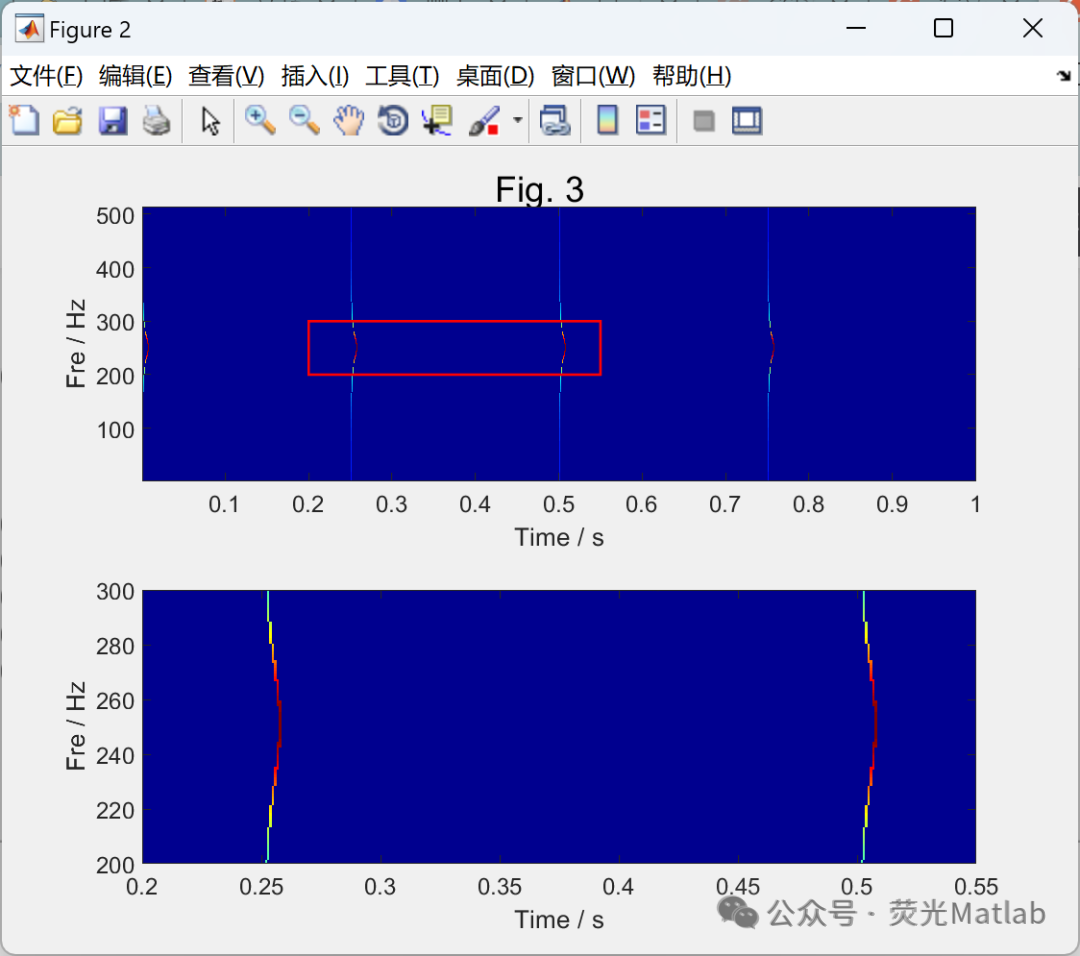
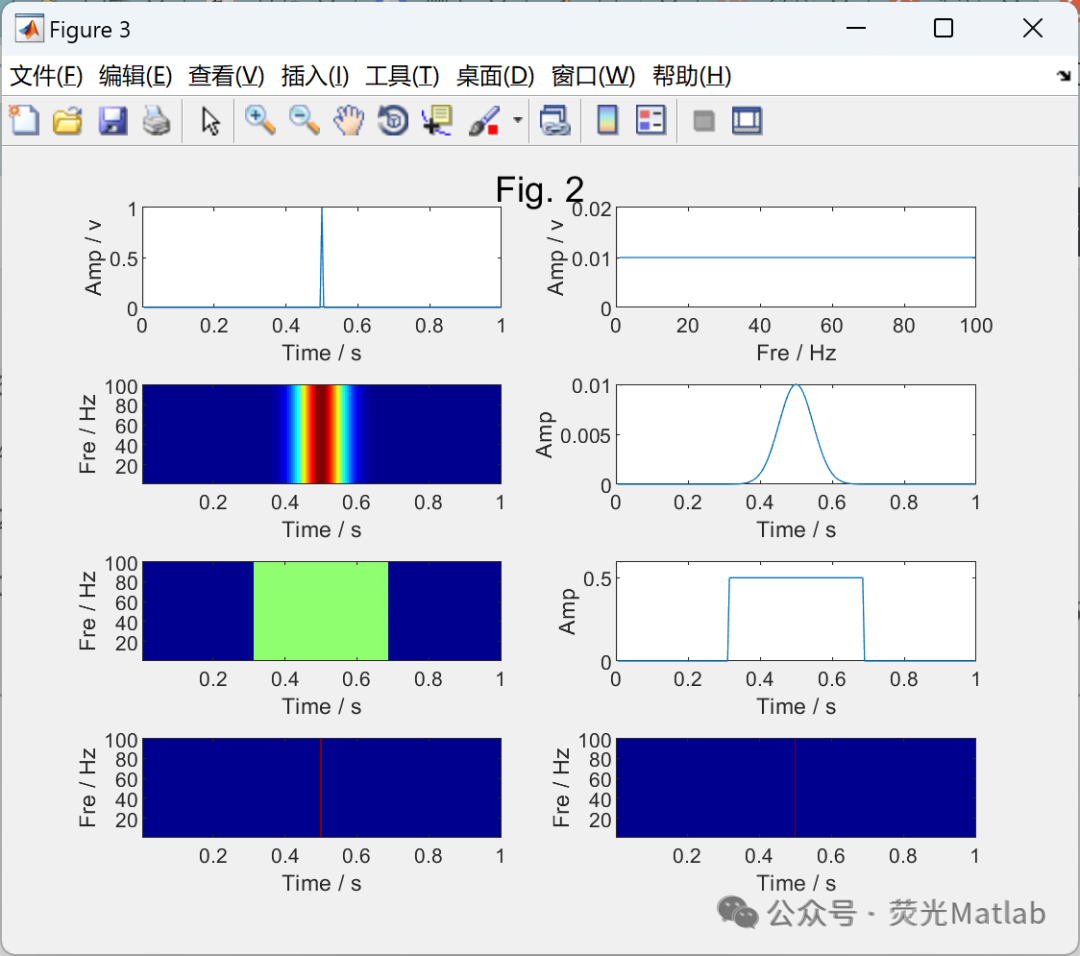


Partial Code

clear

fs=1024;
t=0:1/fs:(1-1/fs);

s1=sin(2*pi*250*t).*exp(-120*t);
s2=[s1(1:256) s1(1:256) s1(1:256) s1(1:256)];

[m,n]=size(s2);
SampFreq=fs;
time=(1:n)/SampFreq;
fre=(SampFreq/2)/(n/2):(SampFreq/2)/(n/2):(SampFreq/2);

tfr Te=TET_Y(s2',100);
tfr2=WT2(s2',fs,512);
fre2=fliplr(fre);
% ...........................Fig. 1.............................
figure
suptitle('Fig. 1');
subplot(311)
plot(time,s2);
xlabel('Time / s');
ylabel('Amp / v');

subplot(312)
imagesc(time,fre,abs(tfr));
xlabel('Time / s');
ylabel('Fre / Hz');
axis xy
colormap jet

subplot(313)
imagesc(time,fre2,abs(tfr2));
xlabel('Time / s');
ylabel('Fre / Hz');
colormap jet
axis xy;
% ...........................Fig. 3.............................
x1=0.20; x2=0.55;
y1=200;   y2=300;
figure
suptitle('Fig. 3');
subplot(211);
imagesc(time,fre,abs(Te));
xlabel('Time / s');
ylabel('Fre / Hz');
axis xy

References

[1] Shi Minghao, Liao Xiangjun, Liao Yuan. Study on the Performance of Removing Phenol from High-Salinity Organic Wastewater in the Solar Thermal Membrane Distillation Process [J/OL]. Membrane Science and Technology: 1-11 [2024-02-25]. http://kns.cnki.net/kcms/detail/62.1049.TB.20240223.1253.007.html.
[2] Du Mingfeng. Logical Transformation of Educational Governance Modernization [J]. Journal of East China Normal University (Education Science Edition), 2024, 42(03): 87-98. DOI:10.16382/j.cnki.1000-5560.2024.03.008.
[3] Cabrera R E, Schrader L R, Walker E T, et al. Nonlinear frequency modulation for Fourier transform ion mobility mass spectrometry improves experimental efficiency [J]. International Journal of Mass Spectrometry, 2024, 497.
Some content in this article is sourced from the internet, and references will be noted or cited as references. If there are any inaccuracies, please feel free to contact us for removal.



Scan to contact us!