
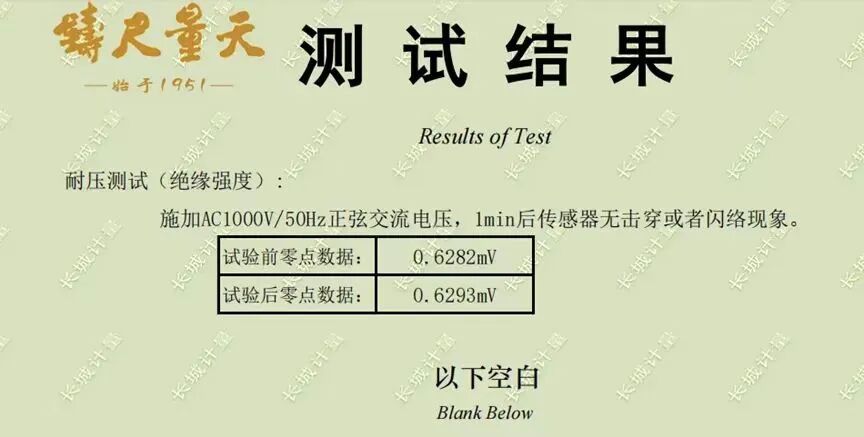
Hunan Qitai Sensor Technology Co., Ltd. has announced good news today — its self-developed metal-based pressure sensitive chip has passed the 1000VAC insulation voltage test conducted by the Beijing Great Wall Metrology Institute.
The pressure sensor based on the metal-based pressure sensitive chip, commonly known as the “metal sputtered film” pressure sensor, is hailed as the “pearl among pressure sensors” in the industry. In China, it is often lamented that while the “metal sputtered film” pressure sensor is excellent, it is unaffordable, indicating that the “noble” quality of this type of pressure sensor is recognized by people. The unaffordability is due to the lack of large-scale production in China previously. The “noble” quality referred to here means that this sensor has excellent accuracy, stability, and reliability, can withstand various harsh environments, and the connections between components can be achieved through thermal welding processes (such as laser welding, electronic welding, sub-arc welding, etc.), which do not produce leaks. The substrate material is made of special metals to utilize the good elasticity and fatigue resistance of metals. The excellence of this product lies in the fact that the total thickness from its substrate surface to the functional resistance layer and protective layer does not exceed a few micrometers, while products from other technical routes (silicon-based, ceramic-based, etc.) generally have a total film thickness that is several times to dozens of times that of metal sputtered film products. The choice between thick film and thin film schemes is a key factor determining the quality of pressure sensors. The thin film scheme has good film adhesion, is responsive, and has low internal stress in the film, making it less prone to zero drift and providing better long-term stability. If the temperature coefficient of the resistive functional material is well managed, the temperature drift performance is also excellent.

It is reported that as early as the 1960s, the Netherlands and France proposed the concept of thin film pressure sensors, but progress was slow due to process limitations. It was not until the 1970s, with the maturity of microelectronics technology and vacuum sputtering processes, that the Netherlands achieved a technological breakthrough, first reporting related research results in the 1970s. The products developed showed less than one-thousandth zero drift after continuous operation for eight years, marking a breakthrough in practical applications of this technology. Subsequently, the United States and France also reported thin film technology based on evaporation processes in the mid-1970s. Germany and Russia advanced the industrial application of this technology in the late 1980s using magnetron sputtering methods. The UK used 17-4PH stainless steel diaphragms and molecular bonding technology to manufacture fully inorganic sensitive components, significantly enhancing product performance in harsh environments, and launched commercial products at the end of the 20th century. Currently, Germany is the largest producer, with the UK, Japan, and Switzerland also having some production capacity, while other countries have relatively few core products circulating in the market.
Wang Guoqiu, the founder and academic leader of Qitai Sensor, told reporters that China began developing such products in the early 1990s, initially led by the National University of Defense Technology. Relevant research institutions have made beneficial attempts at industrialization. In 2016, Hunan Qitai began constructing its factory and production line, with the production line being completed in 2019 and achieving a “double climb” in yield capacity in 2021, with a total investment exceeding 350 million yuan. Since the product entered the market in 2021, Hunan Qitai’s products have undergone four to five years of market testing, have been applied in many fields, and have initially stabilized their foothold, achieving large-scale production and “import substitution,” with the chip product yield recently reaching 95%, higher than the average yield of similar products internationally. Hunan Qitai’s production line has also become the only large-scale production line in the country. In 2024, under the auspices of relevant agencies of the Ministry of Industry and Information Technology, it passed a national-level technical evaluation meeting, with the technology overall reaching an internationally advanced level, and some key indicators reaching an internationally leading level.
Currently, the insulation voltage capability of metal-based pressure sensitive chips worldwide generally does not exceed 500VAC, which is far from sufficient for high-power systems like high-speed rail. The higher voltage strength of metal-based pressure sensitive chips is a global challenge. After five years of efforts, Hunan Qitai has finally conquered the 1000VAC voltage strength of metal-based pressure sensitive chips, clearing the technical barriers for Hunan Qitai’s pressure sensors to enter applications in high-speed rail, nuclear power, household appliances, and other fields.

Long press to follow
Source: Hunan Daily Editor: Jiang Hui
First Review: Tan Qiongsi Second Review: Yan Qiong Third Review: Su Yiwen