In the daily work of electronic engineers, when troubleshooting non-functional or poorly performing circuit faults, they often start from the schematic level, using simulation and other analytical tools to identify issues. However, sometimes even after exhausting efforts, it is difficult to pinpoint the root cause, leading to frustration and confusion. In fact, many times the root of the problem is not a complex design flaw, but rather an overlooked PCB cleaning issue.
During the assembly or modification of PCBs, materials such as flux are used to assist in component soldering. However, if the flux residue is not removed after soldering, it can severely degrade the surface insulation resistance of the PCB, resulting in a significant decline in circuit performance. An engineer once conducted a series of tests, setting up a balanced Wheatstone bridge network test circuit activated by a 2.5V reference voltage, simulating a high-impedance bridging sensor, connected to an INA333 with a gain of 101V/V. Under ideal conditions, the output voltage difference of the balanced bridge network should be 0V, but flux contamination caused the actual voltage to drift over time.
Uncleaned circuit boards not only fail to reach the expected VREF/2 voltage and remain unstable after an hour, but also collect a significant amount of external noise, resulting in DC errors and excessively long stabilization times; although manual cleaning shows some improvement, it can be affected by environmental factors, such as air conditioning circulation in the testing facility causing strange low-frequency noise; only thoroughly cleaned and dried circuit boards can maintain stable voltage without any drift.
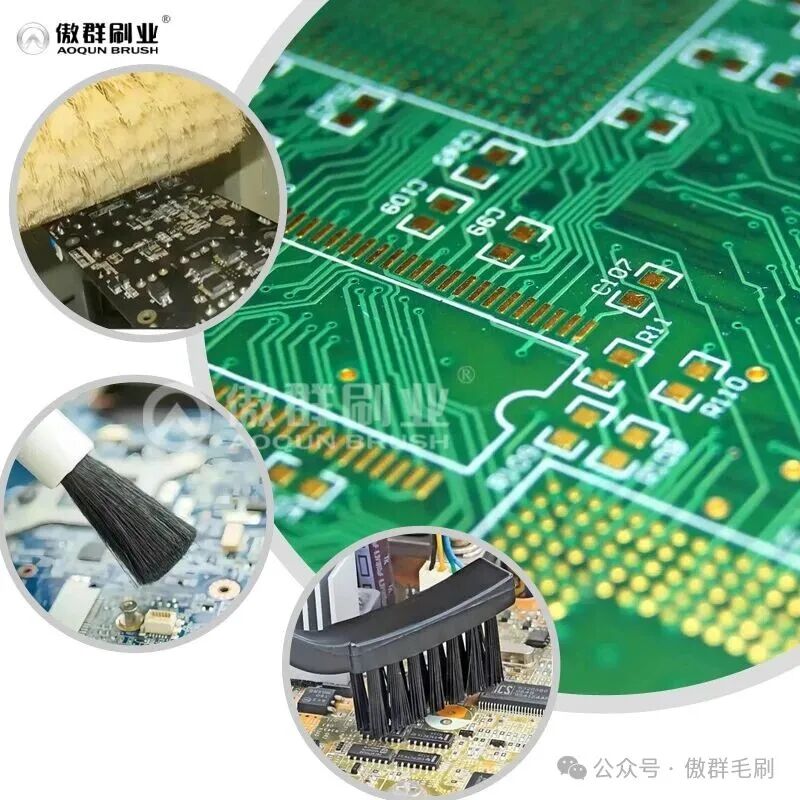
To achieve efficient PCB cleaning, choosing the right tools is crucial. PCB cleaning roller brushes play an important role in PCB cleaning due to their excellent performance. The high-performance PCB board wear-resistant brushes from Aoqin Intelligent Manufacturing include suitable types of cleaning roller brushes, widely used in various cleaning stages of PCB production. With a cross-sectional density of up to 300,000 bristles per square meter, they significantly enhance cleaning efficiency and precision, meeting the cleaning needs of different processes and materials of PCBs, helping to solve cleaning challenges such as flux residue, and safeguarding circuit performance.