Foreword
Embodied intelligence, as a hot topic in the current technology field, is reshaping our understanding of intelligent systems at an unprecedented speed. It emphasizes that intelligent agents interact with the environment in real-time through physical entities, achieving an integration of perception, cognition, decision-making, and action. In this system, sensors undoubtedly play a key role as the “foundation of perception”, comparable in importance to the human sensory system, serving as a bridge between the physical and digital worlds.

| Classification of Embodied Intelligence Sensors
As robots learn to “touch” the world, embodied intelligence sensors become the key to connecting the virtual and physical. From the precise operation of industrial robotic arms to the flexible interaction of service robots, multidimensional sensing technologies enable intelligent agents to perceive their environment. In recent years, the Chinese market has exploded, with the market size of embodied intelligence in China expected to reach 863.4 billion yuan in 2024, a year-on-year increase of 65%. In just the first two months of 2025, the financing scale in the domestic embodied intelligence robotics field reached 4.45 billion yuan, nearly matching the total for the entire year of 2024. It is expected that the market size will exceed 973.1 billion yuan in 2025, with the intelligent sensor market size reaching 179.55 billion yuan. Domestic companies such as Orbbec and Hanwei Technology are leading the way in niche areas like 3D vision and flexible touch, driving the industry into a golden development period through continuous technological innovation.
Author: Han Zhuoyang
Technical Cooperation/Industry Connection
Join the Community
Key Points
• Development trends of embodied intelligence and sensor markets
• Classification of embodied intelligence sensors
• Technologies and layouts of four representative sensor companies
01
When German Precision Meets Chinese Innovation:
These Four Sensor Companies Enhance Robotic Touch!
1.1
Bosch:
The Culmination of German Precision
A century-old industrial giant, Bosch operates in over 40 countries, with one in three cars globally equipped with Bosch sensors, holding over 800 core patents in inertial measurement and environmental perception.
Core Technologies
(1) Six-Axis IMU Technology: The MPU-6050 uses self-developed MEMS technology, with an angular velocity measurement range of ±250°/s to ±2000°/s, and zero drift <10°/h, providing motion posture reference for Boston Dynamics’ Atlas robot.
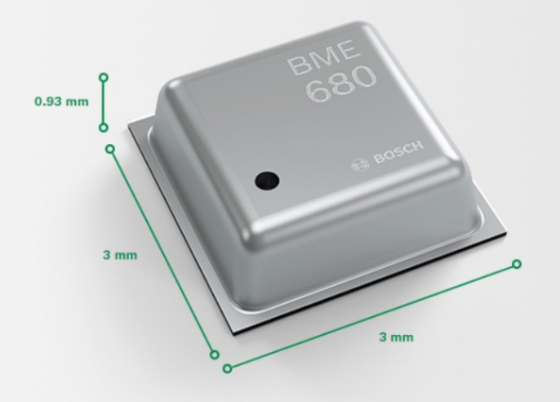
(2) Multimodal Environmental Perception: The BME680 integrates pressure (±0.12hPa), temperature (±0.5℃), and humidity (±3%RH) sensors, enabling environmental adaptive adjustments in Amazon warehouse robots.
(3) AI Edge Computing: Equipped with a Neural Processing Unit, it compresses tactile data processing latency to 30ms, meeting Tesla Optimus’s requirements for egg-grabbing force control.
Core Products in the Field of Embodied Intelligence
(1) MPU-6050: Used in KUKA industrial robots, it controls weld seam errors within 0.2mm through real-time posture compensation in automotive welding scenarios.

| Core Technology of MPU-6050
(2) BME680: Integrated into Samsung’s BotCare service robot, it automatically triggers air purification functions through air quality monitoring, increasing user satisfaction by 27%.

Commercial Layout
Bosch has a prominent advantage in the automotive sensor market, with revenues reaching 15 billion euros in 2024, accounting for 35% of the global autonomous driving sensor market. It has established exclusive supply agreements with over 30 automotive companies, providing core sensors such as radars and cameras for multiple vehicle models, enhancing driving safety and intelligent experience.
Additionally, in June 2025, Bosch will establish a joint venture with Galaxy General called “Chengmai Boyin Co-Creation Technology Co., Ltd.”, focusing on the development of agile robots for complex assembly and intelligent quality inspection scenarios. Both parties will collaborate with Joint Automotive Electronics to build the “RoboFab” laboratory, exploring intelligent perception and system deployment of robots in automotive manufacturing, accelerating the large-scale application of embodied intelligence in the industrial sector.
Future Outlook
By the end of 2025, Bosch plans to mass-produce brain-like computing-based neuromorphic sensors, which can reduce power consumption by 70%, achieving real-time fusion of multimodal data. This will enable intelligent devices and autonomous vehicles to perceive their environment more quickly and accurately, improving decision-making efficiency and safety.
1.2
Orbbec:
The Chinese Pioneer in Giving Machines Stereoscopic Vision
A domestic leader in 3D vision, serving over 800 enterprises, with 4 out of every 10 3D facial recognition devices globally using Orbbec technology, building a full-stack capability from chips to algorithms.
Core Technologies
(1) Binocular Structured Light: The Gemini 2.0 uses a 940nm infrared light source, achieving 0.1mm 3D modeling accuracy within a range of 0.5-3 meters, and has been certified by Apple’s supply chain.
(2) Hybrid Solid-State LiDAR: The Atlas series uses a MEMS mirror solution, achieving a point cloud density of 240 lines at a detection distance of 100 meters, enabling obstacle avoidance in complex road conditions in Xiaopeng G9’s autonomous driving system.
(3) Heterogeneous Computing Chip: The self-developed OBC1000 chip processes 3D point clouds at a speed of 1.2 TOPS, with a power consumption of only 4.5W, compatible with UBTECH’s WalkerX humanoid robot.
Core Products in the Field of Embodied Intelligence
(1) Gemini 2.0: Used in CATL’s battery detection robots, it identifies tab wrinkles through 3D modeling, increasing detection efficiency by 3 times, with a false detection rate of <0.5%.
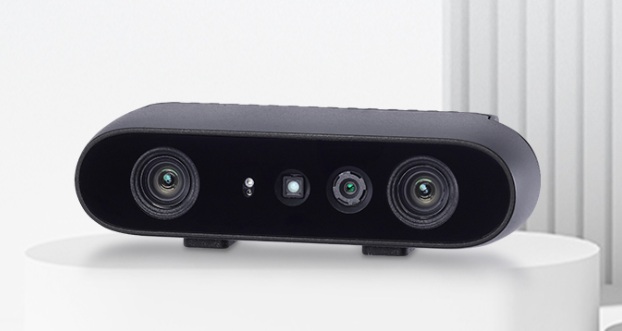
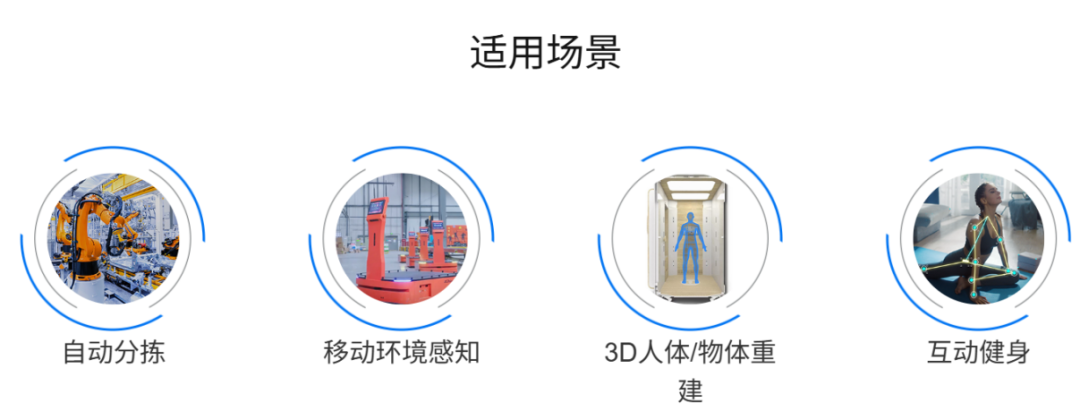
(2) AstraPro: Integrated into SenseTime’s educational robots, supporting 108 types of gesture recognition, achieving human-machine interactive teaching in STEAM classrooms, increasing student participation by 40%.
Commercial Layout
In 2024, Orbbec’s revenue in the consumer electronics sector will account for 65%, continuously supplying 3D cameras for Huawei’s Mate series and expanding to manufacturers like Xiaomi and OPPO. In the industrial sector, it has partnered with Foxconn to establish 20 automated inspection production lines, improving detection accuracy by 30%, with products applied in leading enterprises across multiple industries.
Future Outlook
Orbbec plans to mass-produce a 0.5mm flexible 3D vision module in Q4 2024, which has been adapted for multiple humanoid robots, enhancing hand operation accuracy. In 2025, it plans to launch an upgraded version to further optimize performance and expand applications in medical and special operation robots.
1.3
Hanwei Technology:
The Breakthrough Player from Gas Sensing to Intelligent Touch
The first listed sensor company in A-shares, with 23 years of technological accumulation, building four product lines: touch, force control, smell, and vision, providing core sensing components for 60% of domestic industrial robot manufacturers.
Core Technologies
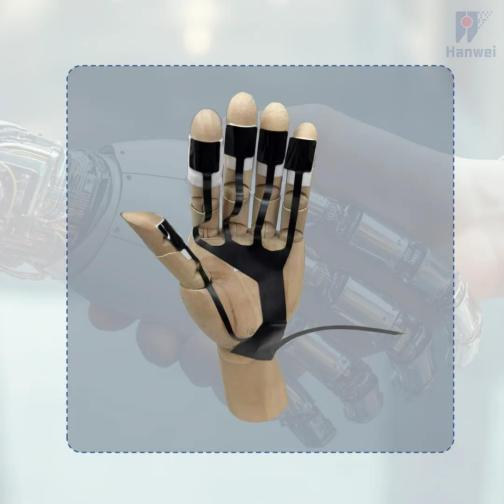
(1) Flexible Electronic Skin: Made from carbon nanotube/PDMS composite film, with a pressure resolution of 0.1kPa (human fingertip is 0.05kPa), and performance degradation of <5% after 100,000 bends.
(2) Six-Dimensional Force Sensor: Based on a strain gauge bridge structure, with a range of ±50N, and a force vector measurement error of <0.8%, it has passed compatibility testing with Fanuc robots.
(3) Bionic Electronic Nose: Equipped with a 16-channel metal oxide sensor array, it can identify 136 types of gases such as alcohol and formaldehyde within 5 seconds, with a response time of <800ms.
Core Products in the Field of Embodied Intelligence
(1) ZNS-01 Flexible Film Pressure Sensor:: A resistive sensor developed by its subsidiary Suzhou Nengsida Electronics, with a thickness of <0.3mm, a range of 0-5kg, featuring low power consumption, high stability, and fast response. The output resistance changes with pressure, which can be used for robotic tactile perception and smart glove pressure detection, with a typical test voltage of DC3.3V.
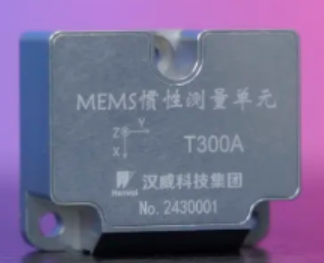
(2) KT-EX6-13 Six-Axis Inertial Measurement Unit:: Based on MEMS technology and SIP packaging, with built-in intelligent algorithms. It integrates gyroscopes and accelerometers, capable of accurately sensing robotic posture changes, with high precision, fast response, and high reliability, suitable for humanoid robots, drones, and other fields.
Commercial Layout
In 2024, Hanwei Technology’s revenue from industrial robot sensors will increase by 60% year-on-year, signing long-term agreements with over 20 leading manufacturers such as UBTECH, with a market share of 35% in domestic force sensors. Its products have entered the supply chains of Xiaomi and BYD, with Suzhou Nengsida’s flexible sensors expected to reach an annual production capacity of ten million units, with new production lines expected to be operational in the second half of 2025.
Future Outlook
In 2025, Hanwei plans to launch implantable bioelectronic skin, achieving human-machine neural signal interaction through ECG-compatible design, initially used in medical rehabilitation robots. It also plans to release a new generation of self-healing flexible tactile sensors, which can recover 90% of performance within 24 hours after damage, expanding applications in complex environments.
1.4
Daime Robot:
The Dark Horse Reconstructing Tactile Precision with Monochromatic Light
Founded in 2018, this innovative enterprise has developed a unique high-resolution sensing technology using monochromatic light, receiving hundreds of millions in financing from institutions like Jinding Capital, providing core components for Boston Dynamics and Yuzhu Technology.
Core Technologies
(1) Monochromatic Light Tactile Sensing: Using nano-imprinting technology, it integrates over 40,000 sensing units in 1cm², achieving a spatial resolution of 0.15mm, five times more accurate than traditional capacitive tactile sensors, capable of accurately sensing subtle pressure changes.
(2) Ultra-Flexible Substrate: A 0.1mm thick PDMS material substrate that can stretch to three times its original length, closely adhering to robotic joints to achieve 180° bending, and has passed medical-grade ISO13485 certification, suitable for medical robots and other precision scenarios.
(3) Tactile Flow Compression Algorithm: Using event-driven technology, it reduces data transmission bandwidth from 10GB/s to 2GB/s, adapting to 5G edge computing needs, significantly improving data transmission efficiency.
Core Products in the Field of Embodied Intelligence
(1) DM-TacW: Used in Yuzhu Technology’s B1 robot hand, achieving 0.05mm micro-crack detection, replacing manual flaw detection in aircraft engine blade inspections, improving efficiency by 10 times.
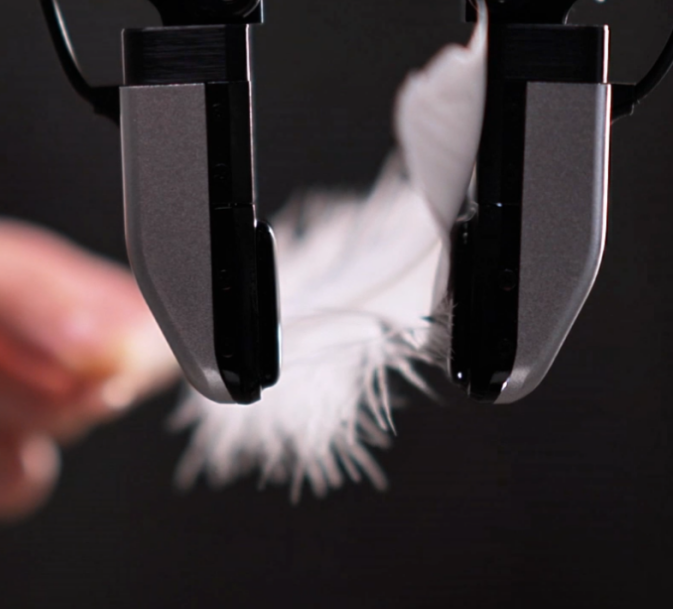
(2) DM-Hand1: A dexterous hand integrated with 1280 tactile units, with a gripping force control accuracy of ±0.02N, compatible with 90% of mainstream robot controllers (such as ABB IRC5).

Commercial Layout
In 2024, Daime Robot’s revenue in the medical field will account for 42%, continuously providing tactile technology for orthopedic surgical robots to Beijing Jishuitan Hospital. In the industrial sector, its intelligent grabbing system for excavators in collaboration with SANY Heavy Industry improves operational efficiency by 30%, and it has partnered with Foxconn to create an intelligent sorting system with an accuracy rate of 98%, covering over 50 enterprises.
Future Outlook
In 2024, Daime plans to mass-produce brain-machine interface electronic skin, which has been trialed in devices for ALS patients, with plans to upgrade signal response speed in 2025. Products such as the DM-TacW visual tactile sensor have been applied in scenarios of embodied intelligence and logistics, while the DM-Hand1 dexterous hand and DM-EXton acquisition system are available for developers.
02
Conclusion
The competition in embodied intelligence sensors is essentially a three-dimensional war of “technological barriers, mass production capabilities, and ecological collaboration”. Bosch builds a moat with its industrial genes, Orbbec tears open market gaps with visual innovation, Hanwei Technology forms an encirclement with a multidimensional product matrix, and Daime Robot achieves a breakthrough with micro-nano technology. As sensors evolve from physical perception to cognitive media, the key to victory in the next decade lies in who can enable machines not only to “perceive” the world but also to “understand” the environmental semantics behind touch—this may be the most exciting ultimate question of embodied intelligence.
-E.N.D-
✦
✦
✦
Contact Us
Demand Connection/Join the Community
 For procurement connection needs, please follow the 【Lianjie Robot Procurement Platform】 to publish robot procurement needs for free.👇Follow 【Robot Industry Applications】 to learn more about embodied intelligence industry application practices.👇


Lianjie Embodied Intelligence Center
Focusing on the field of embodied intelligence (including humanoid robots), dedicated to linking technology and industry. Leveraging Lianjie’s innovative industrial resource advantages and Lianjie Qichen’s capital advantages, we empower technological growth through a dual drive of “investment + service”.
Currently, Lianjie has covered robot companies such as Gaoxian Robotics, Luoshi Robotics, and Zhujidongli through a mother fund, and has invested in humanoid robot body companies through the iCANX Scientist Fund to accelerate evolution. We have established strategic cooperation with several leading universities and research institutes such as the Chinese Academy of Sciences, Tsinghua University, Peking University, and Beihang University, aiming to bring excellent scientific and technological achievements to the industry.
Service content and methods include:
1
Holding vertical industry summits/salons. Achieving real-time information sharing, sharing real scenarios and cases, and face-to-face contact with industry experts for Q&A.
2
Embodied intelligence industry research reports and consulting. We will organize one-on-one, targeted deep-dive exchanges with executive teams of embodied intelligence companies, helping the industry collect first-hand industry information and make accurate business judgments.
3
Building an industrial service platform. Based on existing business and strategic planning, assist enterprises in clarifying industry resources, quickly connecting industry experts and project resources, co-constructing the embodied intelligence ecosystem for enterprises, accelerating the landing of the second curve; at the same time, matching funding support for quality projects.
Past Highlights
Core Components
·Boston Dynamics’ Atlas vs. Yuzhu, a comparison of bionic joint drive technologies!
·Do robots have a “sixth sense”? Unveiling the superpowers of six-dimensional force sensors!
·Core Components | The rise of Zhongdali De in the Yuzhu supply chain from motors to reducers!
·What makes the “little heart” of dexterous hands: how hollow cup motors make robot hands as flexible as humans?
·Core Components | Dissecting the star supply chain of Yuzhu, Mingzhi Electric!
·Multimodal sensor fusion has exploded! How much do future smart devices really “understand” you?
·The black technology of fingertip movement: is electronic skin a big deal?
Industry Leaders
·Smart Square releases the new generation of intelligent robot AlphaBot 2, opening a new era of AGI terminals.
·Smart Yuan is once again on fire! What’s the difference between the newly launched robot Lingxi X2 and X1 versions?
·The commercialization path of the machine dog in the deep cloud is unparalleled.
·How did the Yuzhu machine dog go from XDog to B2-W and gain “superpowers”?
Industry & Scenarios
·Deeplink | Schneider Electric’s scene is open to find partners for embodied intelligence in China!
·The revolution of medical robots: when robot nurses make their first rounds.
·Demand Release | Cleaning robots needed for nuclear power plant cleaning scenarios.
·Space mining is starting! Robots embark on a “working” journey in the galaxy.
·When humanoid robots shuttle through warehouses, the logistics industry is being reshaped!
·The rise of the “steel legion” in the deep sea: how Chinese underwater robots rewrite the future?
Software Algorithms and System Architecture
·The journey of smarter robots: what magical “magic” does end-to-end multimodal entail?
·The robot “digital training ground” is upgraded again! Can robots be developed like building blocks?
·Data wars: the “data genes” competition behind the robot technology schools of Boston Dynamics, Galaxy General, Smart Yuan, etc.
·Comprehensive breakthrough! How do AI chips and robot “brains” achieve collaborative design?
Founder Interviews
·Exclusive interview with Liu Yulong, co-founder of Smart Body Technology: From the father of “Iron Egg” to the four-legged revolution, empowering thousands of industries with embodied intelligence.
·Founder Interview | From sweeping robots to kitchen revolutions: the entrepreneurial veteran Chen Zhen’s practice of embodied intelligence industrialization.
Quality Projects
·Weitai Technology: A new star in visual tactile sensors, easily grasping the high-precision revolution behind eggs.
·Smart Body Technology collaborates with the China Blind Association, Tsinghua University, and Peking University to open a new chapter in the development of intelligent guide dogs.
·Goodbye to cloud dependence: Agasai’s “Tongtianxiao” opens a new era for humanoid robots with edge AI.
·Strong Brain Technology breaks through, when brain-machine interfaces meet intelligent bionic hands.
Industry Events
·Heavyweight announcement | The automotive & embodied intelligence dream collaboration sees Shanghai! The Shanghai Embodied Intelligence Robot Industry Conference is officially launched!
·Welcome to participate and exhibit | Saiguan Technology confirms attendance at the Shanghai Embodied Intelligence Robot Industry Conference.
·The “key leap” of embodied intelligence is about to take place, the 2025 Technology Innovators Conference is gearing up!
·World Science Coffee | Huang Tiejun: Open source and openness are the core paths to promote AI innovation.
·Industry and technology are moving towards each other, and the embodied intelligence industry supply and demand exchange meeting was successfully held!