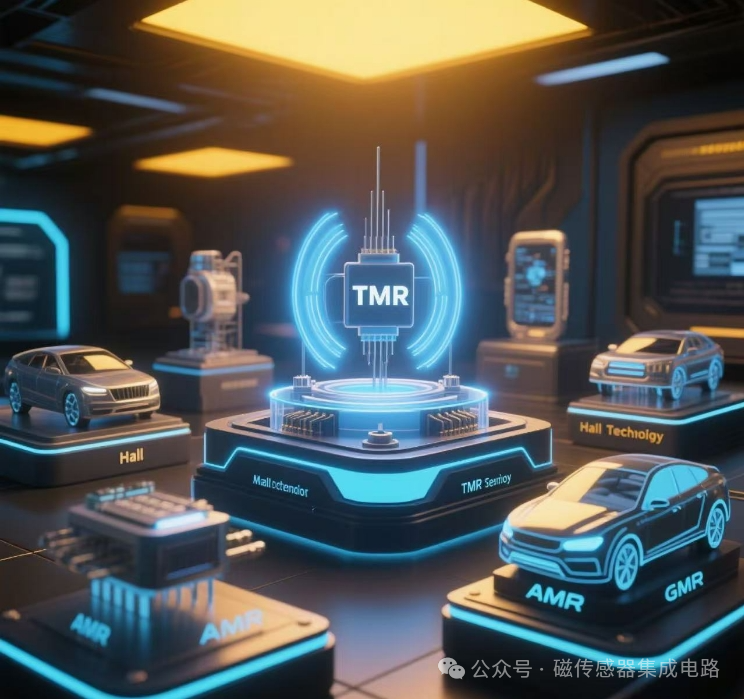
In the wave of industrial automation, smart vehicles, and the Internet of Things, high-precision magnetic sensing technology has become a core demand. Tunnel Magnetoresistance (TMR) technology, with its unique advantages, is emerging as the undisputed leader in the future magnetic sensor field, standing out among various magnetic sensing technologies.
1. TMR: The Precise Eye of Quantum Effects
TMR sensors are based on the magnetic tunnel junction effect in quantum mechanics: when two ferromagnetic layers are separated by a nanoscale insulating layer, their resistance changes significantly with the direction of the external magnetic field. This microscopic mechanism endows TMR sensors with ultra-high sensitivity (up to hundreds to thousands of times that of Hall technology), extremely low power consumption (microampere operating current), a wide linear range, and excellent temperature stability.
2. Technical Arena: Comprehensive Superiority of TMR
Compared to traditional magnetic sensing technologies, TMR exhibits significant advantages:
| Characteristic | Hall | AMR | GMR | TMR |
| Sensitivity | Low | Medium | Medium-High | Extremely High |
| Power Consumption | Medium-High | Medium | Medium | Extremely Low |
| Temperature Stability | Poor | Poor | Average | Excellent |
| Linearity | Average | Requires Set/Reset | Average | Excellent |
| Frequency Response | High | Medium-High | High | Extremely High |
| Cost | Extremely Low | Low to Medium | Medium | Medium to High (Continuously Decreasing) |
-
Cost: The early cost of TMR chips was significantly higher than that of Hall and AMR. With the maturation of key processes (such as MgO barrier layers), increased capacity of foundries (like TSMC, X-Fab), and the popularity of multi-channel integrated designs, TMR costs are rapidly decreasing and are gradually penetrating the mid-to-high-end industrial and consumer markets.
-
Application Scope: The outstanding performance of TMR makes it the preferred choice in high-precision current detection (new energy vehicles, photovoltaic inverters, DC charging piles, wind power generation), ultra-low power position/speed sensing (industrial equipment, white goods), bio-magnetic imaging (magnetocardiography, magnetoencephalography), high-density magnetic encoders, and advanced electronic compasses. Its applications are rapidly expanding from traditional industries and automotive to consumer electronics (TWS, VCM, keyboards) and medical devices.
-
Market Acceptance: The acceptance of TMR in the high-end market is rapidly increasing. Giants like TDK, Infineon, Allegro, and Multi-Dimensional Technology are actively laying out their strategies, and TMR magnetic switches, current sensors, and angle sensor chips have become mainstream in the market. It is quickly replacing AMR/GMR in high-reliability, high-precision scenarios and is challenging the mid-range market dominated by Hall effect sensors.
3. The Path to Dominance: Key Challenges TMR Must Overcome
Despite its significant advantages, TMR still needs to overcome its own bottlenecks to fully dominate the market:
1. Thermal Stability and Signal Drift: The magnetism of ferromagnetic materials may fluctuate at high temperatures, leading to output drift. Continuous optimization of magnetic multilayer materials (such as CoFeB) and annealing processes is required to enhance high-temperature stability.
2. Noise Optimization: In ultra-high sensitivity applications (such as bio-magnetic sensing), intrinsic magnetic noise (1/f noise) needs further suppression. Optimizing the tunnel junction interface and exploring new barrier materials are key.
3. Suppression of Complex Field Interference: In practical applications, stray field interference often exists. It is necessary to combine on-chip integrated compensation coils or advanced algorithms (such as AI filtering) to achieve precise signal extraction.
4. More Advanced Wafer Integration: Achieving deeper and lower-cost single-chip integration of TMR with CMOS processes is the core path to reducing costs, enhancing reliability, and realizing complex functions (such as smart sensors).
5. Continuous Cost Reduction: Further improvements in wafer yield, optimization of design rules, and expansion of production scale are needed to accelerate the replacement of Hall and AMR technologies in the mid-to-low-end market.
Conclusion: The Core Engine of Precise Sensing
TMR technology, with its quantum-level high sensitivity and low power consumption characteristics, is reshaping the performance boundaries of magnetic sensors. With breakthroughs in materials science, the application of advanced wafer processes, and cost optimization brought about by large-scale production, the penetration of TMR in Industry 4.0, new energy vehicles, high-end medical devices, and next-generation consumer electronics will accelerate. Overcoming challenges in thermal stability and noise, and achieving more economical wafer integration will be the decisive battles for TMR to completely win the “main battlefield” of magnetic sensing—this technological revolution has already begun, and its precise sensing power will undoubtedly become the core engine of the future intelligent world.