SDN (Software Defined Networking) and virtualization technologies play a critical role in the system integration projects you are responsible for, especially in scenarios such as data center construction, video surveillance system integration, and multi-system coordinated control, demonstrating significant technical advantages.
1. Application Analysis of SDN
1. Core Advantages
– Centralized Control and Flexible Scheduling: SDN separates the control plane from the data plane, allowing a central controller to manage network traffic and policies uniformly, achieving dynamic routing, load balancing, and bandwidth allocation on demand.
– Automated Operations: Supports API-driven network configuration changes, reducing manual intervention and improving operational efficiency.
– Multi-System Coordination: Can integrate with environmental monitoring systems and BA systems to dynamically adjust network policies based on environmental data (temperature, humidity, power load).
2. Specific Applications in Projects
– IDC Data Center Projects:
– Achieve intelligent linkage between network traffic and data center environment through SDN, for example, automatically adjusting cooling power based on server load.
– Supports multi-link aggregation and rapid failover, ensuring high availability (99.99%).
– Video Surveillance Projects:
– Utilizes SDN to optimize video stream transmission paths, reducing latency and improving multi-level platform retrieval efficiency.
– Supports QoS policies, ensuring bandwidth priority for critical services (such as police retrieval).
2. Application Analysis of Virtualization Technologies
1. Core Advantages
– Resource Pooling and Elastic Scaling: Abstracts physical resources (computing, storage, network) into virtual resources, supporting on-demand allocation and dynamic expansion.
– High Availability and Disaster Recovery: Enhances system reliability through virtual machine migration, snapshots, and redundant deployment.
– Cost Reduction and Energy Saving: Increases resource utilization, reduces the number of physical devices, and lowers energy consumption and operational costs.
2. Specific Applications in Projects
– Smart Park Projects:
– Uses Kubernetes to manage microservice architecture, achieving automatic scaling of services to support over 100,000 concurrent device accesses.
– Deploys AI algorithm models through virtualization to support intelligent applications such as facial recognition and behavior analysis.
– IDC Data Center Projects:
– Utilizes virtualization technology for pooled management of server resources, combined with HVDC power supply and modular deployment, to improve energy efficiency ratio PUE ≤ 1.5 (liquid cooling ≤ 1.3).
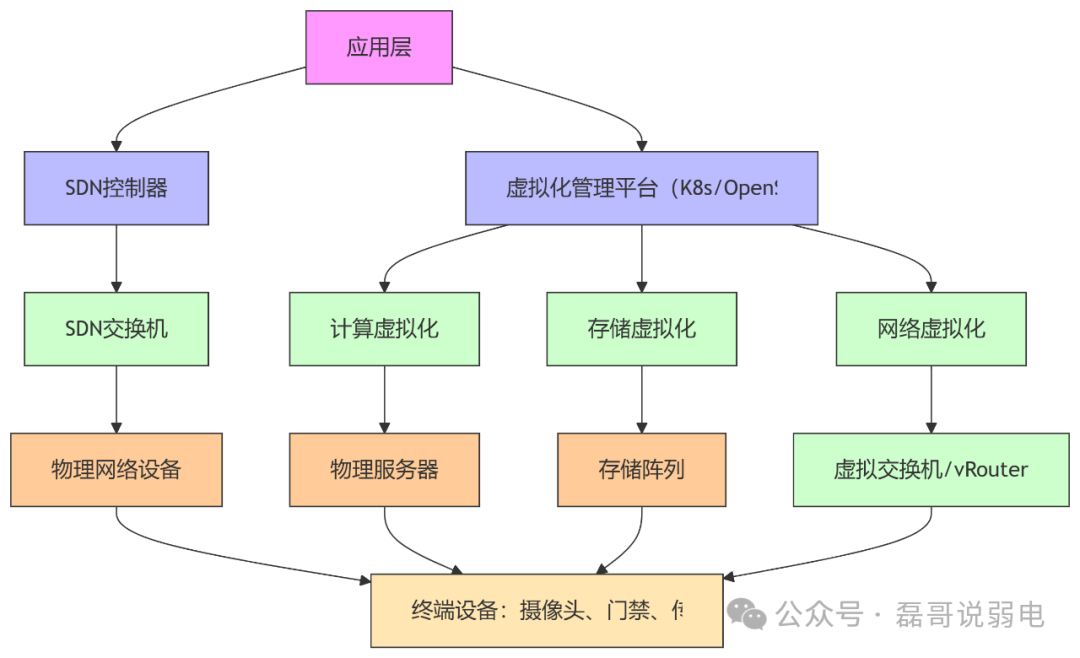
3. SDN + Virtualization Collaborative Architecture Diagram (System Diagram)
4. Conclusion
Applying SDN and virtualization technologies to:
– Intelligent Operations and Energy Efficiency Management (such as SDN+ environmental linkage in IDC data centers);
– Large-scale Device Access and Microservice Governance (such as K8s+SDN in smart parks);
– High Availability and Disaster Recovery Design (such as active-active data centers, distributed storage);
– Resource Elasticity and Cost Optimization (such as virtual resource pools, modular deployment).