After systematically reviewing Mark Weiser’s vision of ubiquitous computing in AI Interaction Philosophy II | Invisible Design Philosophy: Rereading Mark Weiser’s Interaction Vision, deconstructing Steve Jobs’ philosophy of direct manipulation in AI Interaction Philosophy III | Intimate Machines: Steve Jobs’ Interaction Design Revolution, and critically analyzing the limitations of the current conversational paradigm in AI Interaction Philosophy IV | The Limitations of Language—A Critique of the Conversational Paradigm, we stand at the threshold of constructing the next generation of AI interaction paradigms. It is evident that the path forward is not merely to patch up existing chat interfaces but to undertake a thorough, design-led paradigm revolution.
This section will synthesize all the above analyses and propose a future-oriented, actionable new framework for AI design. We name it “Embodied Virtuality,” a term directly borrowed from Weiser, which fundamentally means: liberating the virtual power of computation (data, intelligence, connectivity) from its electronic shell, allowing it to integrate, inhabit, and enhance the physical world we live in. This framework aims to guide designers and product strategists in building truly next-generation intelligent products and services that transcend chat interfaces.

To better position this new framework within the history of human-computer interaction development, we will first outline its evolutionary context through a comparative framework.
Table 1: Comparative Framework of Human-Computer Interaction Paradigms
| Feature Dimension | Command Line Interface (CLI) | WIMP Graphical Interface (GUI) | Mobile Direct Manipulation | Conversational AI (CUI) | Comprehensive AI (Embodied Virtuality) |
|---|---|---|---|---|---|
| Core Metaphor | Dialogue (with interpreter) | Desktop/Office | Physical Objects | Human Dialogue | Intelligent Environment |
| Cognitive Load | High (reliant on recall) | Medium (reliant on recognition) | Low (reliant on intuition) | High (reliant on articulation) | Extremely Low (reliant on prediction) |
| Discoverability | Low | High | High | Extremely Low | Contextual/Environmentally Aware |
| Control Center | User Commands | User Selections | User Gestures | Ambiguous | User-Guided Agent |
| System Role | Executor | Toolbox | Extension of Hand | Prophet/Partner | Proactive Assistant/Medium |
| Key Philosophy | Precision | Efficiency | Intuition | Natural Language | Calm Empowerment |

This table clearly reveals the evolutionary path of human-computer interaction, where each paradigm leap is accompanied by a shift in core metaphors and a reduction in specific types of cognitive load. It also ruthlessly exposes the significant regression of conversational AI in key dimensions such as discoverability and cognitive load, further confirming its nature as a transitional paradigm.
Most importantly, it provides a structured definition for the “Embodied Virtuality” framework we are about to propose: it inherits the sense of empowerment and control from direct manipulation and combines it with the ideal of environmental intelligence’s low cognitive friction, ultimately achieving a form of “Calm Empowerment” that Weiser pursued.
Based on this, we propose the following five complementary core design principles:
Principle One: From Reactive Prompts to Ambient Assistance
The current mainstream mode of AI interaction is mired in the “tyranny of prompts.” It requires users to become “prompt engineers,” translating complex intentions into machine-preferred language, essentially shifting the entire cognitive burden onto the user. The first principle of the Embodied Virtuality framework is to completely overturn this passive, question-and-answer model.
The primary mode of AI interaction should shift from passively waiting for user prompts to actively providing context-aware assistance.

AI should act like a quiet yet perceptive background service, predicting needs based on context (where you are, what time it is, what is on your schedule), your behavior patterns (the applications you are using, your historical preferences), and environmental information (who is in the room, how noisy it is), providing help in a timely and non-intrusive manner.
This is a direct realization of Mark Weiser’s concept of “Calm Technology”—technology should blend into the periphery of the environment, easily called upon when needed, but retreating into the background when not required, never demanding your attention forcefully.
For example, imagine an architect using design software. A traditional AI assistant would require her to stop and input “help me find fire-resistant materials that comply with local regulations.” In the ambient assistance paradigm, when the AI detects she is designing a fire escape, a window containing relevant material information and regulatory clauses would quietly appear on the side of her screen for her reference at any time.
This shift in interaction initiation moves the power from the user to the context itself, transforming computation from a tool that needs to be actively “used” into an “environment” that the user immerses in and benefits from.
Principle Two: Direct Manipulation of Intelligence
The greatest user anxiety with conversational AI stems from its “black box” nature. Users input prompts and then wait for an almost unpredictable result, lacking a sense of control and transparency, as if playing a “slot machine.” This principle aims to transform AI from an unfathomable “prophet” into a transparent, controllable creative medium by introducing Steve Jobs’ philosophy of direct manipulation.

Users should not merely negotiate with AI through language but should be provided with tangible, graphical interfaces to directly shape, guide, and refine AI’s outputs and processes. This means visualizing abstract concepts within AI models (such as style, tone, complexity) into “controls” that users can touch and manipulate.
- In image generation: Users no longer need to repeatedly input “make the mountain a bit taller, in a style more like Van Gogh,” but can directly “grab” the peak with the cursor and drag it upwards, while adjusting a “style palette” slider for “Van Gogh” style weight, seeing seamless changes in real-time. This transforms the creative process from a series of “dice rolls” into a fluid digital sculpting experience.
- In text editing: Users no longer input “make this paragraph more formal,” but can select text and bring up a control panel containing dimensions like “formality,” “persuasiveness,” and “conciseness.” By dragging sliders, AI will instantaneously and reversibly rewrite the text, allowing users to intuitively explore subtle differences in expression.
This mode of interaction shifts the relationship between users and AI from a frustrating linguistic negotiation to a creative partnership. It greatly enhances trust and the joy of creation by empowering users with agency and immediate, predictable feedback.
Principle Three: The Right Modality for the Moment
The greatest fallacy of the “chat box” is its attempt to solve all problems with a single interaction modality (text dialogue). This completely ignores the richness of human interaction with the world and the diversity of contexts. The Embodied Virtuality framework insists that design must abandon the fantasy of finding a “universal interface” and instead embrace a multimodal strategy.
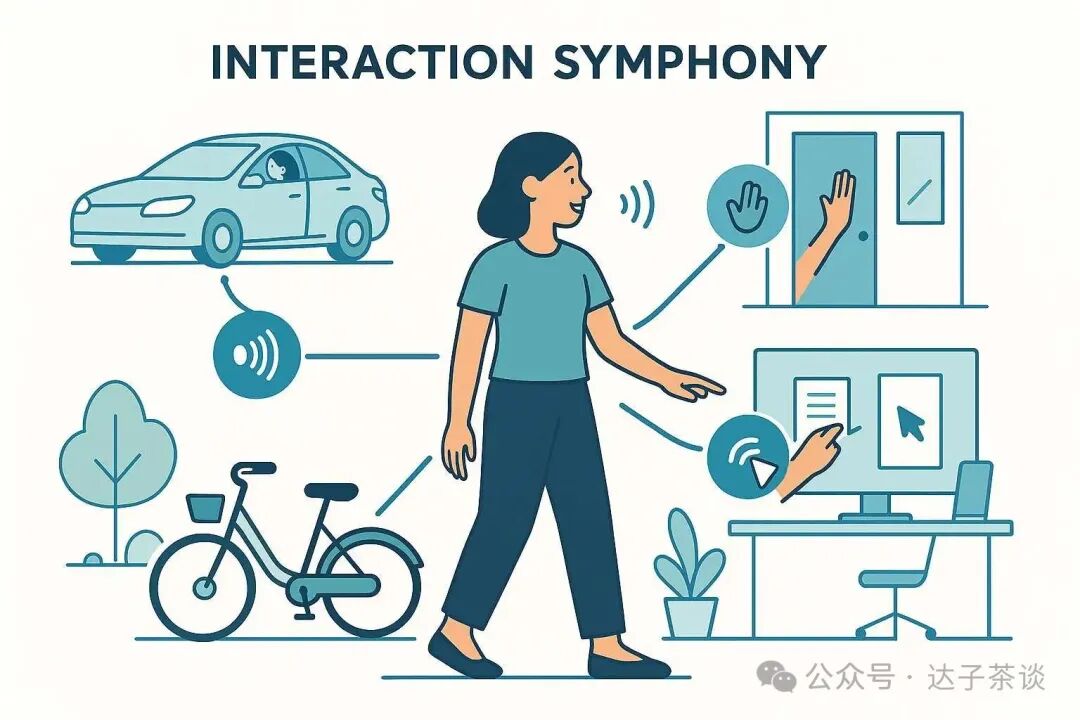
This means that interaction methods should dynamically and seamlessly adapt based on the nature of the task, the environment, and the user’s immediate state. Human intelligence itself is multimodal, and AI interaction should be as well. A well-designed AI system should be able to fluidly understand and respond to multiple input signals:
- When you are driving, controlling navigation and music through voice commands is the safest and most efficient way.
- When you are in an AR environment designing spatial layouts, the combination of gestures (for rotating and scaling 3D models) and gaze tracking (for selecting components) is far more intuitive than any other method.
- When you are at your desk precisely editing a contract, keyboard input and direct manipulation with a mouse remain the irreplaceable golden combination.
- When you want your home smart speaker to play music, sometimes the most natural way is to pick up your phone and tap the speaker, using NFC technology to transmit commands.
Future AI systems will no longer be a single “chatbot” or “voice assistant,” but a fluid, contextual intelligent agent that understands and maintains context, freely switching between multiple input and output modalities to provide the most appropriate interaction method for every “moment” of the user.
Principle Four: Intelligence in the World, Not on a Screen
Screens, whether computers, phones, or watches, are essentially just “windows” to observe the digital world. They draw a clear line between the physical world and virtual information. To fully unleash AI’s potential, this boundary must be broken.
This principle is the most direct inheritance and realization of Mark Weiser’s vision of “Embodied Virtuality”: the ultimate destination of AI is to transcend the limitations of two-dimensional screens, entering and inhabiting the physical world, objects, and spaces around us, making the environment itself perceivable, responsive, and interactive. This is the core of research in “Embodied AI.”

This requires a fundamental shift in the way designers think:
- From designing “apps” to designing “behaviors”: We no longer think about a mobile app that controls smart furniture, but how this smart chair should sense when you have been sitting still for too long and actively adjust your posture, or how this smart lamp should automatically adjust color temperature and brightness based on the content of the book you are reading.
- From designing “interfaces” to designing “interactions”: Interaction with a smart room may occur through natural language, a simple gesture, or by moving a physical object within the room. UI is no longer pixels on a screen but behaviors and feedback in the physical world.
- From “data input” to “environmental awareness”: AI’s input is no longer just the text typed by users, but the room’s temperature, light, sound, and the positions, activities, and even emotional states of the people within it.
This principle drives us toward a truly ubiquitous computing future, where AI is no longer a program in our pockets but an intelligent partner with a physical form that can perceive and act.
Principle Five: Clarity and Control in an Age of Agency
As AI becomes increasingly proactive, contextual, and embodied—gaining greater agency—a significant challenge arises: how to ensure that this intelligence serves people rather than controlling, disturbing, or even harming them? Therefore, the final principle of the framework, and the most critical ethical cornerstone, is to provide users with absolute clarity and ultimate control.
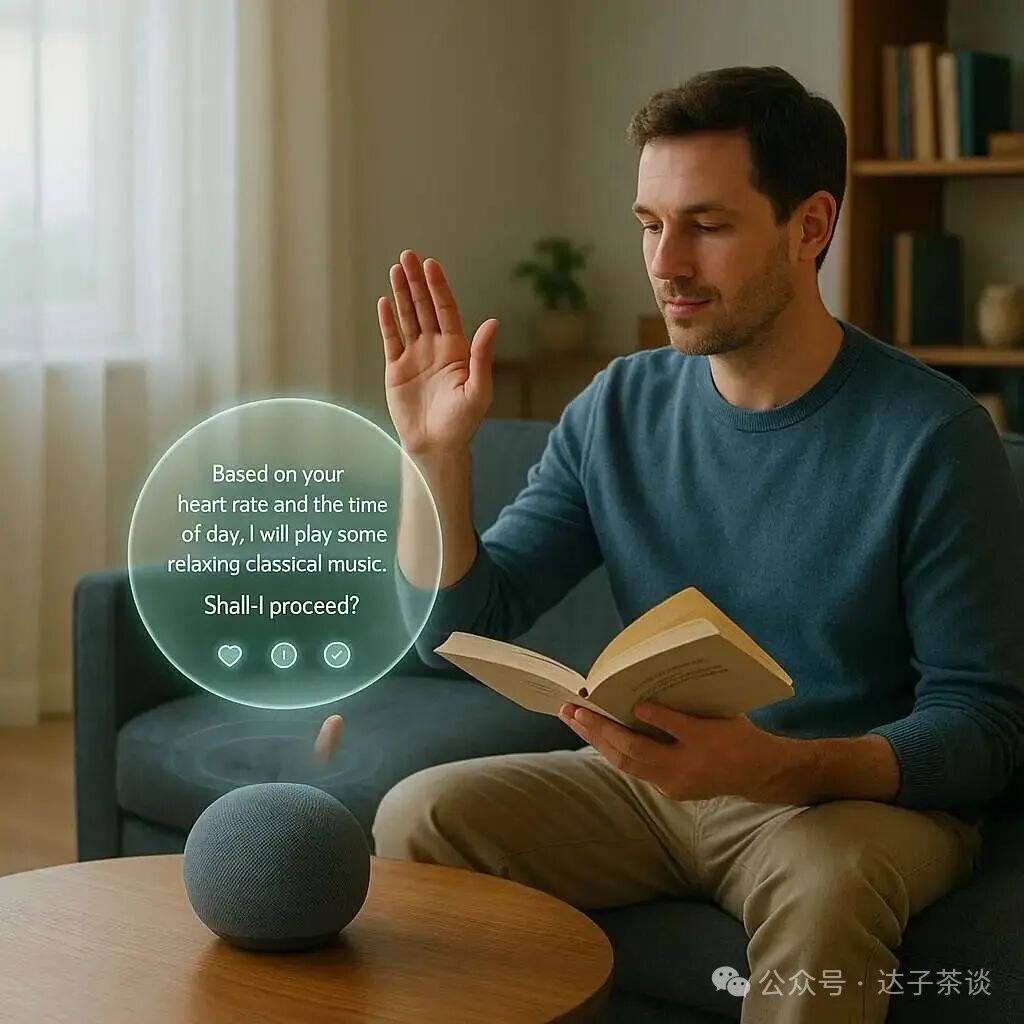
This principle incorporates Jobs’ ideas about feedback, predictability, and user-centric control as a core safeguard against the potential risks of autonomous systems. An unchecked intelligence is dangerous, and trust is the only prerequisite for societal acceptance.
- Legibility: AI’s behaviors and decision-making processes must be visible to users in a simple, understandable manner. When a smart home system dims the lights and plays music as you return home, it should be able to inform you with a simple prompt (“Welcome home, ‘Relax Mode’ activated”). This transparency is the first step in building trust.
- Reversibility: Almost all user actions and most of AI’s proactive behaviors should be one-click reversible. A powerful and ubiquitous “undo” function is the ultimate tool for establishing user security and encouraging exploration.
- Controllability: Users must have simple yet powerful tools to set boundaries, veto suggestions, and take manual control at any time. For example, users can easily set hard rules like “never make sounds while I am sleeping” or “do not push any non-urgent notifications before 9 AM on weekdays.” The ultimate veto power must always remain in the hands of the user.
Without clear feedback and user control, these technologies, which are meant to help, will inevitably be perceived as intrusive, unsettling overseers, stifling all their potential. This principle ensures that the intelligent future we build remains centered on human well-being and dignity.
In summary, these five principles—from ambient assistance to direct manipulation, from multimodal interaction to embodied intelligence, and ultimately grounded in clarity and control—form a coherent design philosophy. They guide us away from the narrow path of creating “artificial interlocutors” toward the true vision of artificial intelligence: building a world where technology no longer demands our attention but enhances our human potential in a calm, reliable, and transparent manner. The ultimate goal is not a more perfect chatbot, but a more intelligent, composed, and dignified reality.