:Click↑“Wanyi Selected” Subscribe to the Leading Media in the High-Reliability Power Supply Industry
Wanyi Selected—The Leading Media in the High-Reliability Power Supply Industry
Here you will find technical insights on power supplies, analysis of industry trends, introductions to the latest power supply products, and many power supply experts sharing their technical experiences with you. Follow us and grow with the Chinese power supply industry!
Power Supply Design for Ship Integrated Control System Based on VICOR Module
Introduction
A certain ship integrated control system uses the VME bus embedded single board computer from SBS Company as the central control console’s main computer, requiring a power supply that provides stable voltage, high conversion efficiency, low ripple and noise, and good heat dissipation, with a compact structure for installation in a standard 6U height chassis along with the embedded single board computer.
This power supply design can be approached in two ways: either designing everything from the basic power conversion unit to a complete functional prototype, or optimizing and integrating a mature power conversion function module with auxiliary circuits (output voltage regulation, voltage detection and alarm, etc.) to create a suitable, efficient, and reliable power module. Considering that well-known companies in the domestic and international power supply field have developed a full range of modular power supplies based on market demand, adopting the second method allows for a more flexible and quicker completion of the power supply system design and development, shortening the development cycle and saving labor and design costs. Additionally, using a modular power supply significantly reduces external wiring, solder points, or connection points, thereby greatly increasing product reliability.
Currently, well-known brand products of modular power supplies include Vicor from the USA, Cosel and LAMBDA from Japan, and TRACO Power from Switzerland. Among them, the Vicor series modules have obvious advantages in power density, heat management, and configuration flexibility, widely used in harsh environments and high-reliability applications, making them the preferred power supply for computers in extreme conditions. This article presents a power supply design for a certain embedded single board computer using Vicor modules based on actual project needs.
1 Power Supply Design and Implementation
1.1 Basic Requirements and Technical Scheme
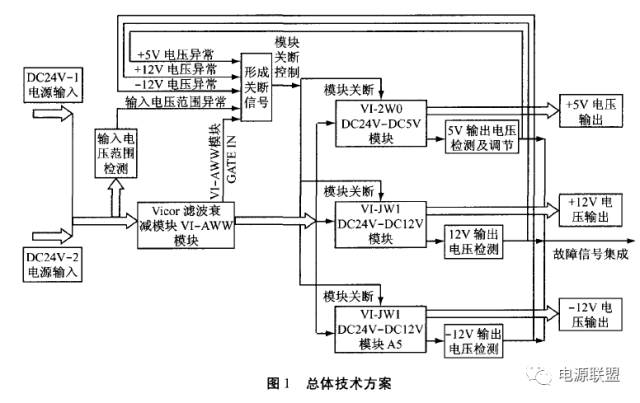
According to the power supply distribution planning of the system, the designed power supply module can obtain two paths of DC24V input power. Therefore, the basic requirement for this power supply design is to convert the DC24V power supply into DC+5V and ±12V working power supplies that meet the requirements of the single board computer. Based on the design requirements and specifications of the Vicor series power modules, the VI-IAM module (Input Attenuator Module) is proposed to filter the input power supply, and on this basis, the VI-2W0 and VI-JW1 modules are selected to further convert to DC+5V and ±12V, as shown in the overall technical scheme in Figure 1.
1.2 Dual Input Redundant Design, Input Power Status Monitoring and Filtering
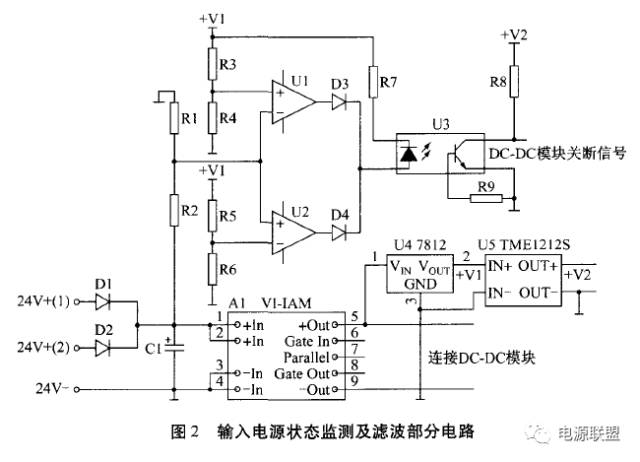
To improve system reliability, dual input redundant power supply is adopted, with dual power input and monitoring and filtering circuits for input voltage upper and lower limits as shown in Figure 2. In the figure, two paths of DC24V input power supply are provided through two diodes for redundant power supply. To meet EMC technical requirements and reduce noise interference, the VI-IAM module A1 is used for filtering. The VI-IAM input attenuation module is a DC input front-end filter that can ensure EMC technical performance when used with Vicor converter modules. To detect the input voltage range, a voltage upper and lower limit comparison circuit centered on an operational amplifier is set up in the figure. When the input voltage exceeds the set upper or lower threshold, an input voltage anomaly signal is generated through an optocoupler to shut down the lower DC/DC module. The reference voltage for comparison at the input of the operational amplifier is provided by the output of the 7812 voltage regulator, while the output of the DC/DC converter TME1212S is used as the power supply for the optocoupler output circuit.
1.3 DC/DC Conversion Main Circuit and Regulation Circuit Design
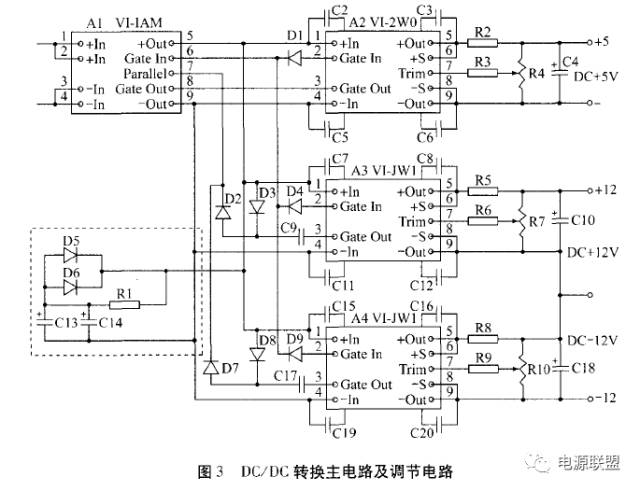
The DC/DC conversion main circuit and regulation circuit are shown in Figure 3. The DC24V input voltage is filtered through the VI-IAM input attenuation module and then converted into +5V and ±12V DC voltage through the VI-2W0 and VI-JW1 modules. To ensure that the output voltage of the DC/DC converter has a certain adjustable range or remains stable at the nominal value when the input voltage deviates from a certain range or has significant load effects, a voltage adjustment resistor network is connected at the output of the VI-2W0 and VI-JW1 modules based on the design and calculation methods recommended in the Vicor module application manual. Taking the adjustment of the +5V output voltage of the VI-2W0 module as an example, a potentiometer R4 with a resistance value of 10kΩ is used to adjust the output voltage, while resistors R2 and R3 are used to limit the range of voltage adjustment. When R2 is selected as 23.63kΩ and R3 as 90kΩ, the output voltage can be adjusted within ±10%. The circuit in the dashed box in Figure 3 is used to smooth out fluctuations in the input voltage of the DC/DC converter. When there are significant instantaneous disturbances in the input voltage, two large-capacity electrolytic capacitors C13 and C14 will smooth out the input voltage fluctuations through charging and discharging, ensuring the normal operation of the DC/DC converter.
1.4 DC/DC Conversion Module Shutdown Protection Function Circuit Design
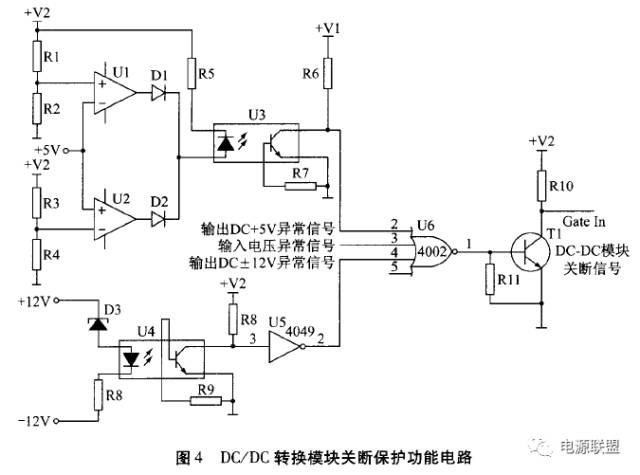
When the input and output voltages of the DC/DC conversion module deviate significantly, to ensure the reliable operation of the embedded single board computer system and interface board, the power supply circuit should be equipped with an automatic shutdown protection function: that is, automatically shut down the power module when there is an abnormal input or output, protecting the load circuit. The shutdown protection function circuit designed for the DC/DC conversion module is shown in Figure 4.
Since DC+5V is the most important power supply for the embedded single board computer, it should have higher power quality and better stability. The voltage upper and lower limit comparator circuit in Figure 4 detects the DC+5V output voltage, and when the voltage deviates significantly from the normal value, an output voltage anomaly signal is generated through an optocoupler. The DC±12V is the power supply for the fans and other interface components in the computer, and the power quality requirement can be lower than that of DC+5V. To simplify the circuit design, a voltage regulator D3 and optocoupler U4 are used to form a DC±12V output voltage status detection circuit. In the event of abnormal input and output voltages, the shutdown signal generated by the relevant detection circuit is used as input to the NOR gate 4002, outputting a total shutdown signal. When the transistor T1 is turned on, the Gate In pin level connected to it is pulled low, shutting down the DC/DC converter.
1.5 Other Issues
1.5.1 Heat Dissipation and Structural Design
Good heat dissipation design is very important for improving the reliable operation of the power supply. Poor heat dissipation can easily lead to deteriorating power quality, and practical experience shows that power supply functional failures are often caused by high-temperature thermal damage. Although Vicor power modules have high efficiency (80% to 90%), there is still 10% to 20% power loss, which is dissipated in the form of heat. This article designs the power supply module to be installed in a standard 6U height chassis. If effective heat dissipation measures are not taken, this heat will raise the temperature of the power supply itself and the internal plug-in boards of the chassis, making heat dissipation design an issue that cannot be ignored. To properly address this issue, the power supply housing is designed to be a metal shell with good heat dissipation characteristics, with the heat dissipation surface of the Vicor power module mounted on the metal housing, and a fan configured at the bottom of the chassis to ventilate and cool the power supply and other circuit boards, thereby ensuring excellent heat dissipation characteristics.
1.5.2 Electromagnetic Compatibility Design
Good electromagnetic compatibility design for power supplies is an effective way to ensure that computers and other electronic devices are electromagnetically compatible and protected from interference. This article has taken corresponding measures in the previously discussed circuit design, explained as follows:
1) Use of the VI-IAM module in conjunction with the DC/DC converter to meet EMC technical performance requirements and reduce noise interference;
2) Connecting X-type capacitors (C1 in Figure 2) at the input of the VI-IAM module, and connecting Y-type bypass capacitors (C2, C3, C5, C6 in Figure 3) between the input and output of the VI-2W0 and VI-JW1 modules to ground, to reduce differential mode and common mode interference, meeting electromagnetic compatibility requirements;
3) The power supply uses a closed metal shell to ensure good electromagnetic shielding.
2 Module Matching Test and Conclusion
The power supply designed and developed based on the Vicor power module, according to the methods described above, is connected to a standard VME bus chassis. The electrical characteristics are defined and requirements are met to supply power to the VME bus embedded single board computer and other interface devices. After laboratory trial operation and long-term continuous assessment tests, it shows that the power supply designed based on the Vicor module meets all performance requirements, and the power supply design and implementation methods proposed in this article have unique advantages in terms of operational reliability, power density, conversion efficiency, load characteristics, electromagnetic compatibility, and heat dissipation characteristics.
Wanyi Selected—The Leading Media in the High-Reliability Power Supply Industry
Here you will find technical insights on power supplies, analysis of industry trends, introductions to the latest power supply products, and many power supply experts sharing their technical experiences with you. Follow us and grow with the Chinese power supply industry!
Click“Follow”to learn power supply knowledge with hundreds of thousands of engineers