Follow+Star PublicAccount, don’t miss out on exciting contentAuthor | strongerHuangWeChat Public Account | Embedded ColumnTen years ago, when we developed electronic products with touch functionality, we typically used a main control MCU along with a separate touch IC, which also required additional peripheral resistors, capacitors, and other components!In an increasingly competitive era, for some high-volume products, the cost of a single resistor or capacitor can be quite sensitive… The primary issues with using a separate touch IC (along with resistors and capacitors) are thecost and thecomplexity of design (including circuit design and PCB space, etc.).As a result, more and more “integrated circuits” are emerging, which combine the MCU, touch IC, and various components like resistors and capacitors into a single chip, thereby reducing the need for external components, and in some cases, eliminating the need for any resistors or capacitors at all.
Challenges Faced by Traditional Touch ICs
Although there are still many traditional touch ICs on the market, they face numerous challenges.
First is thecost challenge, as mentioned earlier, some manufacturers are very sensitive to the cost of a single resistor/capacitor, making it difficult to convince them to spend a few more cents on a touch IC.
Secondly, there is thepower consumption issue, as a standalone touch IC combined with external capacitors and resistors will inevitably increase the overall system power consumption, which is very unfriendly for battery-powered products.
Thirdly, there is theflexibility aspect; MCUs with touch functionality can allow for some touch parameter configurations, whereas many parameters of traditional touch ICs are not exposed.
This is just a relative comparison of current market demands and the challenges or drawbacks of traditional touch ICs compared to integrated touch IC solutions. Of course, traditional touch ICs also have some advantages (which will not be described here).
Renesas Releases Low-Cost, Low-Power Capacitive Touch MCU: RA0L1
On September 17, Renesas announced the release of the low-cost, low-power capacitive touch MCU: RA0L1.
Address:
https://www.renesas.cn/zh/about/newsroom/renesas-adds-capacitive-touch-ultra-low-power-ra0-mcus
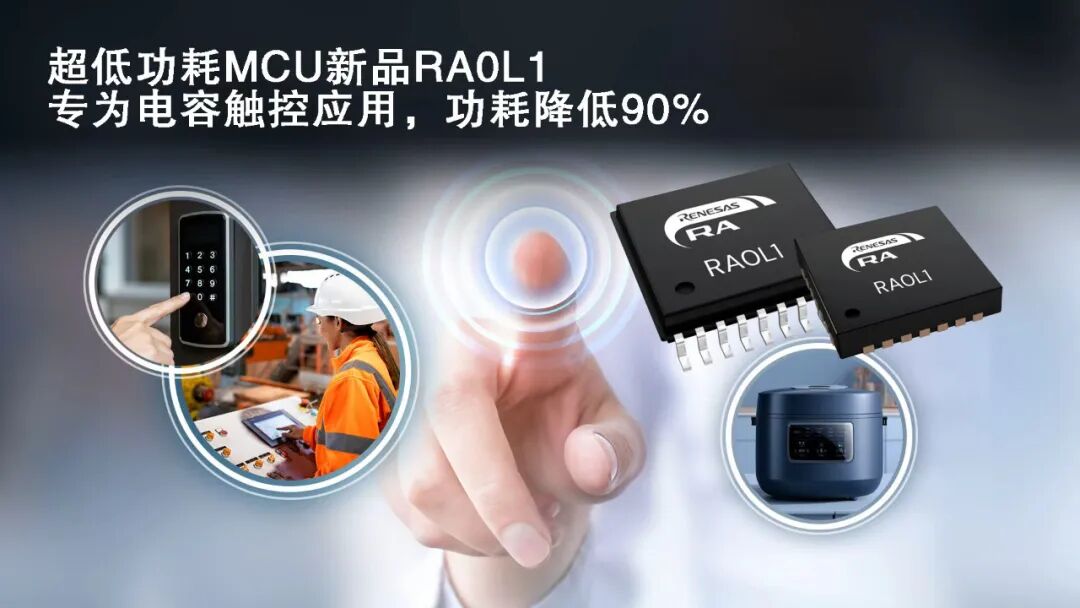
From the official description, we can see some highlights of the RA0L1: low cost, ultra-low power, advanced Cortex-M23 core, and leading capacitive touch technology.
Power consumption: Current as low as 2.9mA in active mode, and standby power consumption drops to a negligible 0.25μA.
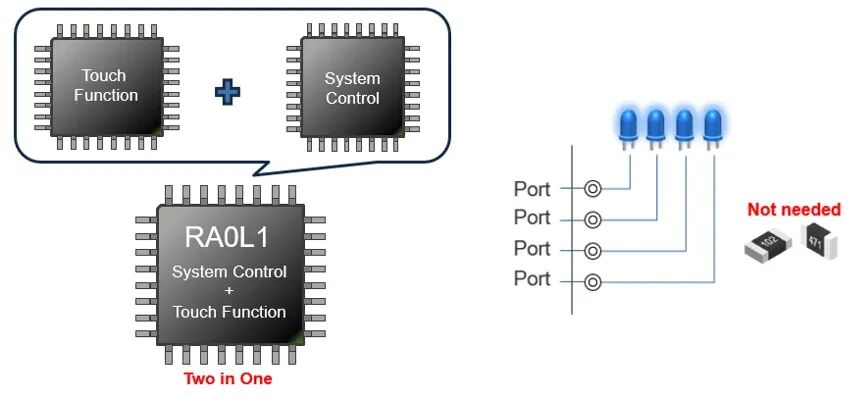
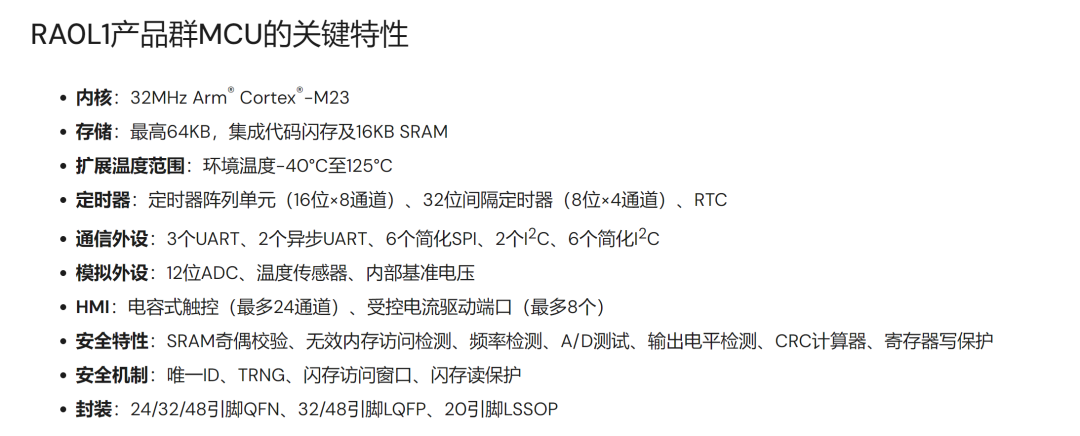 Using the RA0L1 integrated touch MCU can effectively reduce costs and complexity: Traditionally, adding touch functionality requires additional separate ICs and circuits to implement features like LED indicators. This means more components, larger circuit board sizes, and higher BOM costs. The RA0L1 integrates capacitive touch and constant current LED control directly into the MCU, eliminating the need for external ICs and resistors, thereby reducing design burdens. Fewer components not only lower system costs but also allow for smaller product sizes, which is a key advantage in space-constrained designs.
 Finally, what solution do you use for your touch products? Feel free to share in the comments!———— END ————
Tutorial on Deploying AI Models on MPU with Ubuntu System
When Microcontrollers Meet Zephyr, Unlocking Embedded Development!
High-Performance MCUs + AI Will Be the Future Trend!