Enhanced Intelligence with “AI”
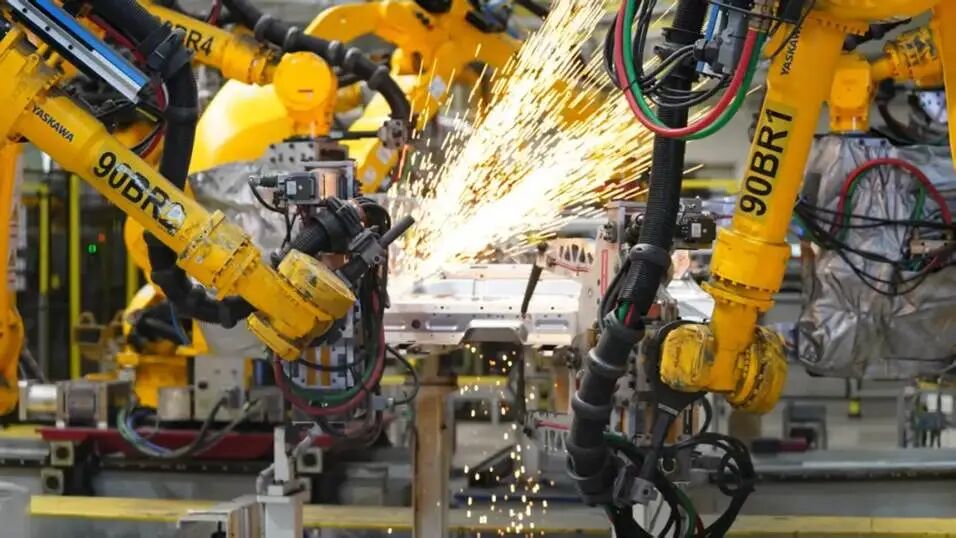
“When industrial robots incorporate a new form of embodied intelligence, they evolve from mere fixed-path actuators to autonomous entities capable of perception, reasoning, and execution. In response to the explosive growth in functional requirements for robots, the “brain” of industrial robots, the MCU, must possess stronger advanced processing capabilities and machine learning abilities to effectively handle these demands.
Chad Steider, Senior Product Marketing Manager at Chipone Technology, stated that under the backdrop of AI technology driving and the transformation of the manufacturing industry, downstream customers have raised higher performance requirements for MCUs. They expect new industrial MCUs to integrate AI, feature wireless transmission capabilities, and enhance security. For instance, the demand for edge computing is driving a deep integration of AI with MCUs for applications such as image recognition and voice processing.
Integration Requirements Upgraded
In industrial production processes, scenarios such as production process management, on-site manufacturing management, and equipment maintenance require the use of MCUs that integrate AI and edge computing. Chad Steider noted: “This necessitates further integration of AI acceleration units within MCUs, expanding the capacity of on-chip storage and the number of general-purpose interfaces (GPIO) to enhance edge computing capabilities for various scenarios such as manufacturing and smart cities, efficiently achieving local real-time control and small model inference.” He mentioned that this integration has already been validated in scenarios such as smart security and industrial inspection, enabling rapid completion of tasks like image recognition, sound processing, and monitoring of equipment and environmental anomalies without relying on the cloud, thereby reducing dependency on cloud services, improving response speed, and saving costs.
Multimodal perception is also a technological revolution that embodied intelligent industrial robots are undergoing. To achieve autonomous judgment and action, robots need to capture complex sensory information such as vision, force, temperature, and position. As a result, the same robot can transition from serving simple scenarios to simultaneously meeting diverse tasks across different scenarios through information acquisition and machine learning. This enhances the flexibility of task load conversion for industrial robots. However, such a robot that can be reused in different scenarios will see a dramatic increase in the number of signal pathways it needs to process, especially the number of sensors mounted.
Highly Competitive MCUs Have Three Key Features
After a prolonged period of inventory adjustment, the industrial MCU market is returning to a growth phase. The construction of smart factories and the digital transformation of outdated factories are bringing innovative vitality to the industrial robot and industrial MCU markets.
Chad Steider stated that as the manufacturing industry moves towards higher-end, intelligent, sustainable, and human-centered directions, various stages of industrial manufacturing will introduce more sensors and actuators, leading to a continuous increase in demand for industrial MCUs.
Under the trend of AI technology driving and the transformation of the manufacturing industry, MCUs that meet the following four requirements will maintain strong demand for a long time:
1. Support edge AI inference. The market capacity for edge AI inference is rapidly growing. Advanced edge AI processors can make critical decisions locally without relying on the cloud, thereby enhancing response speed, ensuring data privacy, and reducing system operating costs.
2. High energy efficiency and low power consumption. In scenarios where battery power is deployed at the edge and energy supply is limited, low-power products have a higher market competitiveness; especially as AI functionalities increase the demand for edge computing power, processors need to support low power consumption.
3. High security and reliability. In terms of data security, MCUs need to have hardware-level security modules and integrated encryption engines; in terms of functional safety, they must comply with ICE61508 industrial functional safety standards.
4. Support efficient real-time decision-making. The increasing automation of industrial production requires faster data processing responses. The most straightforward way to achieve this is to move the decision-making process closer to the data collection point. This means that MCUs must not only be responsible for data collection but also process the data and transmit the results to the entire system.
This article is reprinted fromCENA China Electronics News, original link:https://mp.weixin.qq.com/s/Qk9bVYdF9GrBYlw2RTt1BQ
Scan the following QR code to follow Chipone Technology’s social media platforms