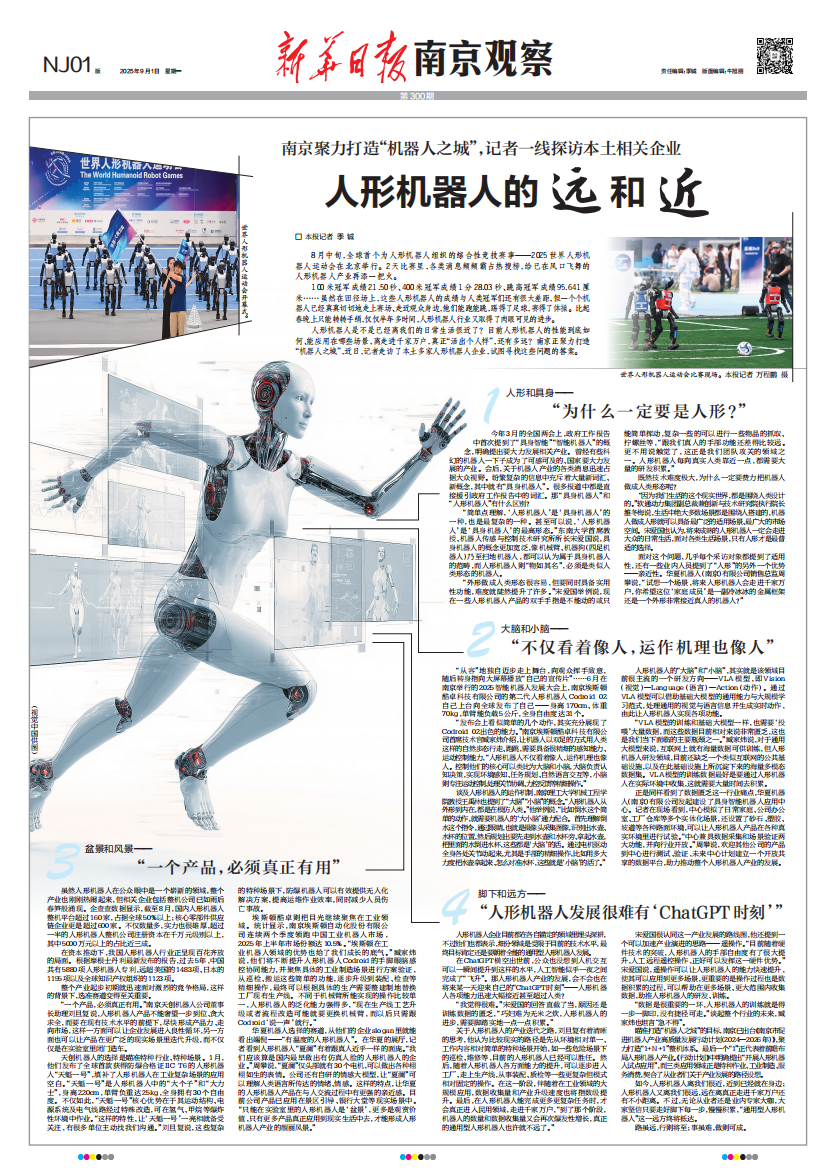
In mid-August, the world’s first comprehensive competition for humanoid robots—the 2025 World Humanoid Robot Games—was held in Beijing. During the two-day event, various news items frequently topped the trending charts, adding fuel to the already booming humanoid robot industry.
The 100-meter champion’s time was 21.50 seconds, the 400-meter champion’s time was 1 minute 28.03 seconds, and the high jump champion’s height was 95.641 centimeters… Although these humanoid robots still have a significant gap compared to human champions on the athletics field, they have truly stepped onto the stage and come closer to the audience. They can run, jump, play soccer, and perform gymnastics. Compared to the Spring Festival Gala where they could only wave a handkerchief, the humanoid robot industry has made visible progress in just over six months.
Are humanoid robots already close to our daily lives? What is the current performance of humanoid robots, in what scenarios can they be applied, and how far are we from them entering thousands of households and truly ‘living like a person’? Nanjing is focusing on building a ‘Robot City’, and recently, reporters visited several local humanoid robot companies to seek answers to these questions.
The opening ceremony of the World Humanoid Robot Games
Humanoid and Embodied—
“Why must it be humanoid?”
In March of this year, the concept of ’embodied intelligence’ and ‘intelligent robots’ was mentioned for the first time in the government work report during the National Two Sessions, clearly stating the need to vigorously develop related industries. Once considered somewhat science fiction, robots have suddenly become tangible and a key area for national development. Following the sessions, various news about the robot industry quickly captured public attention. The information is filled with numerous new terms and concepts, including ’embodied robots’. Many reports directly quote the terminology from the government work report.So, what is the difference between ’embodied robots’ and ‘humanoid robots’?
“To put it simply, ‘humanoid robots’ are a type of ’embodied robot’, and they are also the most complex type. It can even be said that ‘humanoid robots’ represent the highest form of ’embodied robots’.” Professor Song Aiguo, Chief Professor and Director of the Robot Sensing and Control Technology Research Institute at Southeast University, explained that the concept of embodied robots is broader; mechanical arms, robotic dogs (quadruped robots), and even vacuum robots can all be considered as part of the embodied robot category, while humanoid robots are ‘as the name suggests’, they must resemble human forms.
“Creating a human-like appearance is easy, but achieving practical functionality at the same time significantly increases the difficulty.” Song Aiguo cited examples where some humanoid robot products have fingers that cannot move or can only perform simple waving motions, while more complex ones can grasp objects or screw in bolts, “but they are still far from the functional capabilities of real human hands. Not to mention the sense of touch, which is one of the areas our team is working on. Every step closer a humanoid robot gets to a real human requires a substantial amount of R&D accumulation.”
Given the significant technical challenges, why is it necessary to make robots humanoid?
“Because the reality we live in is designed around humans.” Luo Dongmei, Vice President of Softcom Power Group and Executive Director of the Innovation and Technology Research Institute, stated that most scenarios in life are built around people, and humanoid robots can thus have the broadest applicable scenarios and the largest market space. Song Aiguo also believes that mature humanoid robots will eventually enter the daily lives of the public, and in various life scenarios, only humanoid forms are the most universal choice.
In response to this question, almost every interviewee mentioned applicability, and some industry insiders pointed out another advantage of ‘humanoid’—approachability. Zhou Pan, Sales Director of Huaxia Robotics (Nanjing) Co., Ltd., said, “Imagine a scenario where humanoid robots will enter thousands of households; would you prefer this ‘family member’ to be a cold, metallic frame or a robot that closely resembles a real person?”
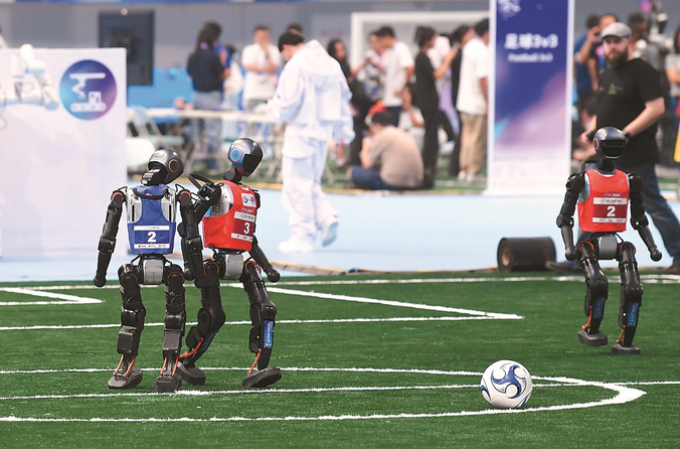
Competition scene of the World Humanoid Robot Games
Brain and Cerebellum—
“Not only do they look like humans, but their operational mechanisms also resemble humans”
“Calmly” walking onto the stage alone, waving to the audience, and then turning to point at the big screen to play “its promotional video”… In June, at the 2025 Intelligent Robot Development Conference held in Nanjing, the second-generation humanoid robot Codroid 02 from Nanjing Estun Automation Co., Ltd. introduced itself to the world—standing 170 cm tall, weighing 70 kg, with a single arm capable of carrying 5 kg, and a total of 31 degrees of freedom.
“The seemingly simple actions at the launch event actually showcased Codroid 02’s outstanding capabilities.” Zang Jiawei, Chief Technology Officer of Nanjing Estun Automation Co., Ltd., explained that enabling a robot to walk, run, and jump in a natural bipedal manner requires very fine perception and motion control capabilities, “humanoid robots not only look like humans, but their operational mechanisms also resemble humans. The core control can be likened to the brain and cerebellum, where the brain is responsible for cognitive decision-making, achieving environmental perception, task planning, and natural language interaction, while the cerebellum focuses on motion control, handling joint coordination, force control feedback, and other fine operations.”
When discussing the operational mechanisms of humanoid robots, Professor Wang Yulin from the School of Mechanical Engineering at Nanjing University of Science and Technology also mentioned the concepts of ‘brain’ and ‘cerebellum’. “Humanoid robots, from their appearance to their internal workings, are all mimicking humans.” He cited the example of pouring water, which is a simple action that requires the robot’s ‘big and small brains’ to work together. First, it must understand the command to pour water, using its ‘eyes’, or cameras, to capture images and identify the positions of the kettle and cup, then plan to walk to the kettle and cup, pick up the kettle, and pour the water into the cup—these are all tasks for the ‘brain’. The motors drive the joints throughout the body, especially the fine operations of the hands, such as how much force to use to lift the kettle and how to align it with the cup—these are tasks for the ‘cerebellum’.”
The ‘brain’ and ‘cerebellum’ of humanoid robots actually represent a mainstream research direction in the field—the VLA model, which stands for Vision (visual), Language (language), and Action (action). Through the VLA model, humanoid robots can leverage the general capabilities of foundational large models and large-scale learning paradigms to process general visual and language information and generate real-time actions, thereby enabling humanoid robots to perform various functions.
“Training the VLA model, like foundational large models, also requires ‘feeding’ a large amount of data, and currently, this data is relatively scarce, which is one of the main bottlenecks we face.” Zang Jiawei stated that for general large models, there is a wealth of data available on the internet for training, but in the field of humanoid robot development, there is currently a lack of a public infrastructure similar to the internet, as well as the vast multimodal datasets that have been accumulated on such infrastructure. The training data for the VLA model is best collected through humanoid robots in real environments, which requires a significant amount of time to accumulate.
Recognizing the industry pain point of data scarcity, Huaxia Robotics (Nanjing) Co., Ltd. initiated the establishment of an Embodied Intelligent Robot Application Center. Reporters on-site observed that the center simulated various physical scenarios such as daily households, company offices, and factory warehouses, and set up various road surfaces like sand, plastic, and slopes, allowing humanoid robot products to be tested in real environments. “The center serves both data collection and scenario validation functions and is open to the industry,” Zhou Pan said, welcoming other companies’ products to test and validate at the center. In the future, the center plans to establish an open and shared data platform to help promote the development of the entire humanoid robot industry.
Bonzai and Scenery—
“A product must truly be useful”
Although humanoid robots are a brand new field in the public eye, the entire industry has just begun to flourish, with related companies, including complete machine companies, emerging like mushrooms after rain. According to data from Qichacha, as of August, there are over 160 domestic humanoid robot complete machine platforms, accounting for more than 50% of the global total; the number of core component supply chain companies exceeds 600. Not only is the quantity large, but the strength is also substantial, with over half of the humanoid robot complete machine companies having registered capital above 10 million yuan, and nearly 30% above 50 million yuan.
Driven by capital, China’s humanoid robot industry is showing a flourishing landscape. According to a recent report from Morgan Stanley, in the past five years, China has had 5,880 humanoid robot patents, far exceeding the 1,483 from the United States, 1,195 from Japan, and 1,123 from the World Intellectual Property Organization.
The entire industry is rapidly facing a fierce competitive landscape from the very beginning, making it crucial to choose the right track.
“A product must truly be useful.” Liu Danfu, Assistant to the Chairman of Tianchuang Robotics, stated that humanoid robot products should not expect to achieve everything at once or be overly ambitious, but should quickly form product strength and enter the market based on existing technological levels. This way, on one hand, it allows for a virtuous cycle of enterprise development, and on the other hand, it enables products to iterate and upgrade in a wider range of real scenarios, rather than just being developed behind closed doors in laboratories.
Tianchuang Robotics has chosen to focus on special industries and scenarios. In January, they launched the world’s first humanoid robot ‘Tian Kui No. 1’ that obtained the explosion-proof certification IIC T6, filling the application gap for humanoid robots in complex industrial scenarios. ‘Tian Kui No. 1’ is a ‘big guy’ and ‘strongman’ among humanoid robots, standing 220 cm tall, with a single arm capable of carrying 25 kg, and possessing 30 degrees of freedom. Moreover, ‘Tian Kui No. 1’ has core advantages in its motion structure, power system, and electrical wiring, allowing it to operate in explosive environments such as hydrogen and methane. “Such characteristics made ‘Tian Kui No. 1’ attract significant attention upon its debut, with many units proactively reaching out to us for communication,” Liu Danfu said. In these complex special scenarios, explosion-proof robots can effectively provide unmanned solutions, improving operational efficiency while reducing personnel casualties.
Estun Automation continues to focus on the industrial sector. Statistics show that Nanjing Estun Automation Co., Ltd. has led the Chinese industrial robot market for two consecutive quarters, with a market share of 10.5% in the first half of 2025. “Estun’s advantages in the industrial robot field also give us the confidence to grow.” Zang Jiawei stated that they will continuously enhance the hand-foot-eye-brain coordination capabilities of the humanoid robot Codroid and focus on specific industrial manufacturing scenarios for solution validation, gradually upgrading from simple functions like inspection and transportation to more intricate operations like assembly and inspection, ultimately allowing for a complete replacement of existing production lines in factories based on specific production needs. Unlike the relatively singular operations that mechanical arms can achieve, humanoid robots have much stronger generalization capabilities, “now, upgrading production line processes or workflows may require replacing mechanical arms, but in the future, it will just require telling Codroid ‘to do it’.”
Huaxia Robotics’ chosen track is evident from their corporate slogan—“Humanoid Robots with Warmth”. In Huaxia’s showroom, reporters saw the humanoid robot ‘Xialan’ with a face almost identical to a real person. “We should be one of the earliest companies in China to create humanoid robots with lifelike human faces.” Zhou Pan said, “Xialan” has 30 motors in its head alone, allowing it to make various lifelike expressions. The company also has a self-developed emotional large model that enables ‘Xialan’ to understand the emotions and feelings conveyed by human language. Such features give Huaxia’s humanoid robot products a stronger sense of approachability during interactions with people. Currently, the company’s products have been applied in real scenarios such as guiding in scenic areas and in bank lobbies. “Humanoid robots that can only exist in laboratories are ‘bonsai’, more for ornamental value; only when more products are truly applied to real life can a beautiful scenery of the humanoid robot industry be formed.”
Footsteps and the Distance—
“The development of humanoid robots is unlikely to have a ‘ChatGPT moment’”
Humanoid robot companies are currently focused on their respective fields, but they all express that the segmentation is limited by current technological levels, and the ultimate goal is certainly to develop into a versatile general-purpose humanoid robot.
Before the emergence of ChatGPT, the public did not expect human-computer interaction to reach such a level so quickly; artificial intelligence seemed to have completed a ‘leap’ overnight.Will the development of the humanoid robot industry also welcome its own ‘ChatGPT moment’ in the future—where humanoid robots’ capabilities rapidly approach or even exceed those of humans?
“I think it’s difficult.” Song Aiguo’s response was straightforward, citing the scarcity of training data as the reason, “A skilled worker cannot make bricks without straw; the progress of humanoid robots requires steady accumulation step by step.”
Liu Danfu has clear thoughts on the iterative path of the humanoid robot industry, believing that a more realistic path is to start from relatively simple special scenarios with relatively simple work content, such as inspections and maintenance in dangerous environments, which current humanoid robots can already handle. Then, as humanoid robots’ capabilities improve, they can gradually enter factories and production lines to engage in more complex but relatively fixed operations like assembly and quality inspection. During this stage, with large-scale applications in the industrial sector, the volume of data collection and the speed of industry upgrades will also increase exponentially. Finally, when humanoid robots can perform more complex tasks, they will truly enter the civilian sector and into thousands of households. “At that stage, the number of robots and the volume of data collection will again experience explosive growth, and true general-purpose humanoid robots may not be far off.”
Song Aiguo agrees with this roadmap for industry development and also mentioned a thought that could accelerate industry evolution—remote operation. “Currently, with breakthroughs in hardware technology, the freedom of humanoid robot hands has greatly improved, and remote manual control can take advantage of this hardware advantage.” Song Aiguo stated that remote operation can quickly enhance the capabilities of humanoid robots, allowing them to be applied in more scenarios. More importantly, the operation process is also a data accumulation process, which can help collect data in more scenarios and larger areas, promoting the R&D and training of humanoid robots.
“Data is a very important link; the training of humanoid robots must be step by step, with no shortcuts.” When discussing the future of the entire industry, Zang Jiawei also admitted that “there is no need to rush.”
Aiming to build a ‘Robot City’, Nanjing has introduced the ‘Nanjing City Action Plan for Promoting High-Quality Development of the Robot Industry (2024-2026)’, focusing on creating a ‘1+N+1’ complete machine system. The last ‘1’ represents the forward-looking layout of the humanoid robot industry. The action plan clearly states the need to “carry out pilot applications of humanoid robots,” with three application areas being special operations, industrial manufacturing, and service consumption, aligning with the industry players’ vision for development.
Today, humanoid robots are very close to us, close enough to be right beside us; yet they are also far from truly entering thousands of households. However, both practitioners and industry experts firmly believe that as long as each step is taken carefully and accumulatively, the ‘general-purpose humanoid robot’ will eventually reach that distant goal.
The road may be long, but it will be reached; the task may be difficult, but it can be accomplished.
Information worth noting


Source: Xinhua Daily
Contributed by: Wang Shen
Reviewed by: Ma Ye
Published by: Liang Huachang